
Muhammad ibn Tumart (ca. 1080–1130) was a North African religious reformer who founded the Almohad movement in North Africa. His organisation of Berber warriors helped bring about the end of Almoravid rule in the Maghreb.
Muhammad ibn Tumart was a Masmuda (Mesmuda) Berber from the Atlas Mountain region of Morocco. Of these people, James E. Brunson and Runoko Rashidi wrote that “the Mesmuda Berbers were described as Blacks by Abu Shama in his Kitab al-Ravdatayn.”
Ibn Tumart was born sometime between 1078 and 1082. His name is given alternatively as Muhammad ibn Abdallah or Muhammad ibn Tumart. The name “Tumart” or “Tunart” comes from the Berber language and is glossed as “good fortune,” “delight,” or “happiness.” He showed remarkable piety as a youth and was nicknamed Asafu (Berber for “firebrand” or “lover of light”) for his habit of lighting candles at mosques. In pursuit of religious learning, he left home around 1105 to visit the principal cities of Islamic civilisation. He studied in Córdoba and then travelled east to complete his religious education. Studying with various scholars along the way, Ibn Tumart developed a particularly strict interpretation of the Qur’an, one that emphasised each believer’s personal responsibility for the faith of the community.
After his studies in Baghdad, Ibn Tumart is said in one account to have proceeded on pilgrimage to Mecca (hajj), but to have been expelled from the city. He then went to Cairo and Alexandria, where he took ship back to the Maghreb. The journey was not without incident. Ibn Tumart, angered by the presence of wine on board, reportedly threw the ship’s flasks overboard and harangued the sailors to ensure they adhered to the correct prayer times and number of genuflections. In some reports, the sailors, exasperated, threw Ibn Tumart overboard, only to find him still bobbing in the water half a day later and haul him back aboard. In different chronicles, he is also described as having either caused or calmed a storm at sea.
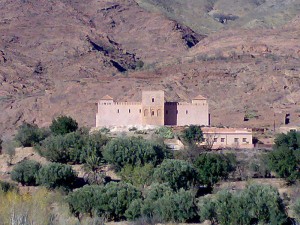
Mosque erected in 1156 in honor of Ibn Tumart at Tinmel, once part of a large fortified complex, the first headquarters of the Almohads
Around 1118, he returned to North Africa, where he preached in towns and villages against what he saw as the immoral behavior of the inhabitants, calling upon them to act in accordance with the strictures of Islamic law. Waving his puritan’s staff among crowds of listeners, Ibn Tumart denounced the mixing of the sexes in public, the drinking of wine, the playing of musical instruments, and the fashion—among the Sanhaja Berbers of the Sahara, and then in Almoravid towns—of veiled men and unveiled women.
Setting himself up on the steps of mosques and schools, Ibn Tumart challenged all who approached him to debate. His antics and fiery preaching prompted exasperated authorities to hustle him along from town to town. After being expelled from Bejaia, Ibn Tumart set up an encampment at Mellala (a few miles south of the city), where he began to attract his first committed followers. Among these were al-Bashir (a scholar who would become his chief strategist), Abd al-Mu’min (a Zenata Berber who would succeed him as leader), and Abu Bakr Muhammad al-Baydhaq (who would later write the Kitab al-Ansab, a principal chronicle of the Almohads). It was at Mellala that Ibn Tumart and his close companions began to forge a concrete plan of political action
In 1120 Ibn Tumart and his small band of followers headed west into Morocco. He stopped in Fez, the intellectual capital of the country, and engaged in polemical debates with the city’s leading scholars. Having exhausted their patience, the ‘ulama of Fez had him expelled. He proceeded south, driven from town to town like a vagabond—according to one report, he and his companions even had to swim across the Bou Regreg, unable to afford the ferry passage. Shortly after his arrival in Marrakesh, Ibn Tumart is said to have sought out the Almoravid ruler Ali ibn Yusuf at a local mosque. In the famous encounter, when ordered to acknowledge the presence of the emir, Ibn Tumart reportedly replied, “Where is the emir? I see only women here!”—a cutting reference to the face veils worn by the Almoravid ruling class. Another source claims that Ibn Tumart threw the sultan’s sister from her horse for appearing in public without a veil.
Charged with fomenting rebellion, Ibn Tumart defended himself before the emir and his leading advisers. Presenting himself as a mere scholar and a voice for reform, he lectured the emir and his entourage about the dangers of religious innovations and the centrality of the Sunnah. When the emir’s own scholars pointed out that the Almoravids also embraced puritanical ideals and professed devotion to the Sunnah, Ibn Tumart replied that Almoravid puritanism had been clouded and distorted by “obscurantists,” pointing to widespread laxity and impiety in their dominions. Pressed on doctrinal issues, he emphasized his distinctive teaching on tawhid (the absolute unity of God) and the divine attributes. After a lengthy examination, the Almoravid jurists of Marrakesh concluded that, however learned, Ibn Tumart was blasphemous and dangerous, and recommended that he be executed or imprisoned. The emir, however, contented himself with having Ibn Tumart flogged and expelled from the city.
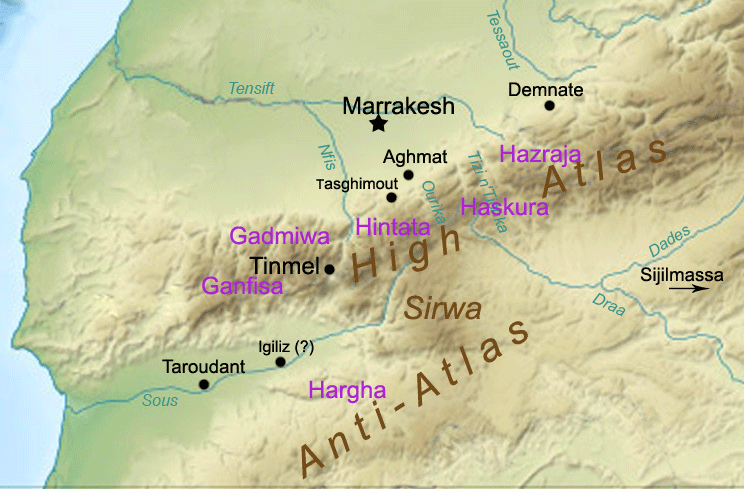
Approximate locations of the main Masmuda people that adhered to the Almohads
Ibn Tumart returned to his birthplace in the Atlas Mountains, where he began recruiting disciples among his fellow Masmuda tribesmen. In time, a small band of devotees gathered around him, and a new movement took shape with both religious and political aims. Ibn Tumart called his followers the Unitarians (al-Muwahhidun); in Spanish sources they are known as the Almohads.
One account relates that he taught the Qur’an to the mountain Berbers word by word: men were lined up, each taught a single word, and then made to recite in turn, so that together they could reproduce the resonant Arabic of the holy text. Another story claims that Ibn Tumart ordered a brutal four-day purge in which thousands of men were killed and family members were commanded to put one another to the sword. Whether or not these tales are strictly accurate, they speak to his ability to reorganize fractious mountain clans into a new social, religious, and military order.
In 1121 Ibn Tumart proclaimed himself to be the long-awaited Mahdi—the “rightly guided one,” chosen to purify the community of the faithful before the end of the world. Righteousness, in his view, was to be attained by belief in his doctrine of the absolute unity of God and by adopting the Qur’an and prophetic tradition (hadith) as the sole sources of Islamic law. Justice was to be restored by fighting in his armies to overthrow the “heretical” Almoravid government.
An attempt by the Almoravid rulers to crush the movement prompted Ibn Tumart to move in 1122–1124 from his home region to a remote mountain village, Tinmel (Tin Mal). For the next five years he recruited the bulk of his warrior disciples and organized them into an obedient and disciplined fighting force. In 1130 he launched a major military campaign against Marrakesh, but his forces, unaccustomed to siege warfare and fighting on the plains, were defeated. Shortly thereafter, Ibn Tumart fell ill and died in August 1130, only a few months after the disastrous defeat at al-Buhayra. His followers initially concealed his death for some time in order to preserve the cohesion of the movement.
One “bizarre and chilling” story about this final phase reports that Ibn Tumart returned to the battlefield at night with some of his followers and ordered them to bury themselves, leaving only a small straw above ground to breathe through. To encourage the demoralised Almohads, he then challenged doubters to go to the battlefield and ask the martyrs if they were enjoying the bliss of heaven after dying for God’s cause. Hearing the “voices” of the buried men, the doubters were reassured. To prevent the ruse from being discovered, Ibn Tumart is said to have had the straws filled in, leaving his followers to suffocate where they lay.
Seventeen years after Ibn Tumart’s death, under the leadership of Abd al-Mu’min, the Almohads finally succeeded in overthrowing the Almoravids and capturing Marrakesh in 1147. By then, the Almohad empire extended across much of North Africa and parts of al-Andalus.
Source:
When We Ruled by Robin Walker
http://biography.yourdictionary.com/muhammad-ibn-tumart
https://en.wikipedia.org/wiki/Ibn_Tumart