
Anna Albertine Olga Brown was a famous late 19th‑century circus performer known as Miss La La.
Lala was born on April 21st, 1858, in the then German (now Polish) city of Stettin (Szczecin), to a Black father, Wilhelm Brown, and a white Prussian mother, Marie Christine Borchardt. She performed with various troupes and regularly transfixed Paris and other cities across Europe.
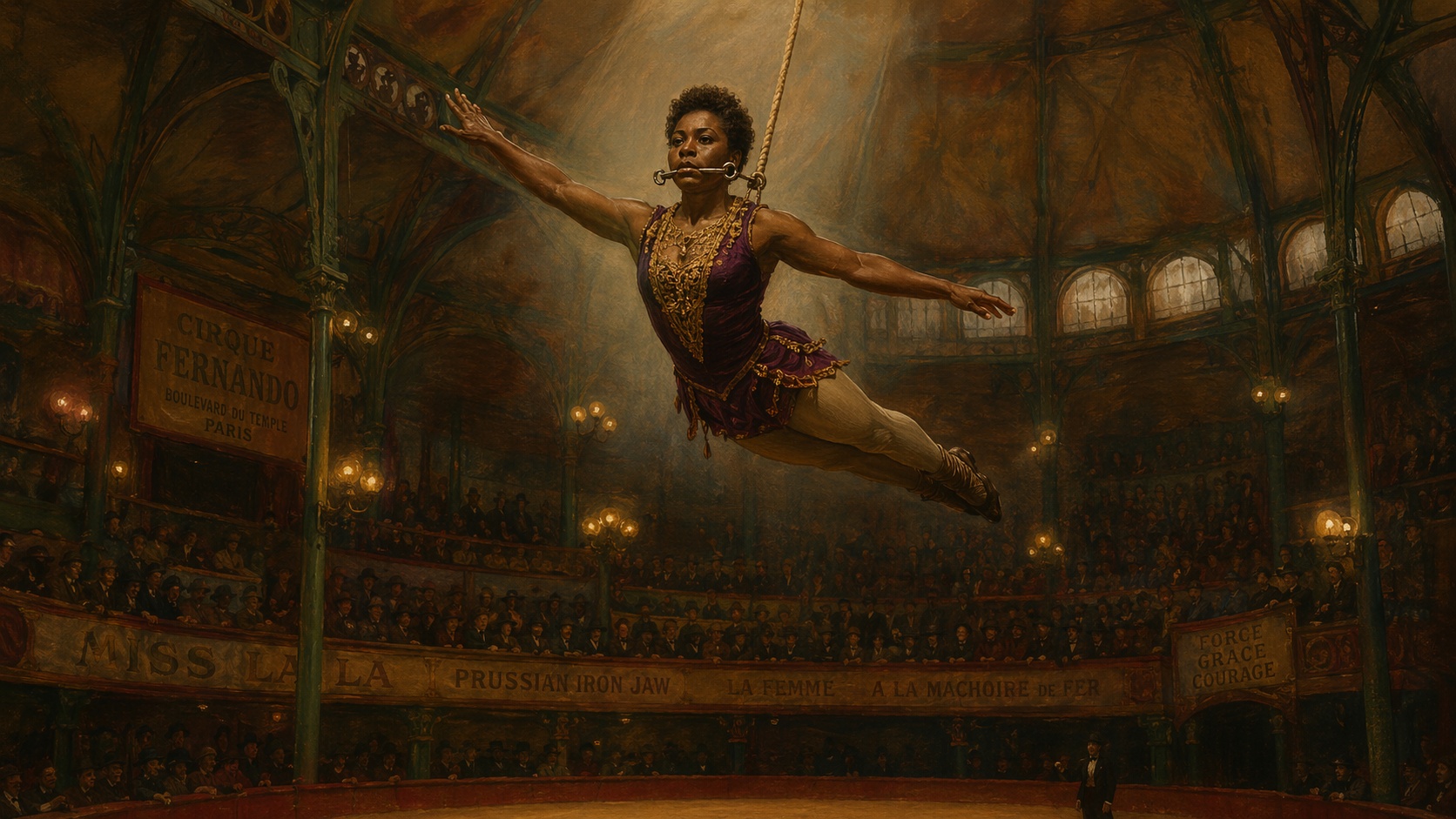
Although she was small of stature, Lala possessed incredible strength. She was an all‑round circus artist and at various times worked as a trapeze artist, hand balancer, wire walker, strength artist and “iron jaw” performer (a popular acrobatic strength act of the time), which saw her suspended high in the air while holding a great weight using only her teeth.
Her first appearance in the circus was at the age of nine, but it was in her early twenties in France that she found fame. She toured numerous circuses and music halls throughout Europe, including the UK, where she performed at London’s Royal Aquarium’s Central Hall and at Manchester’s Gaiety Theatre.
Lala was part of troupes such as the Folies‑Bergère and a later act known as the Keziah Sisters. She partnered with another strength acrobat, Theophila Szterker (also known as Kaira la Blanche), and together they were billed as Les Deux Papillons (The Two Butterflies).
Lala’s African and European ancestry was regularly exploited to create mystery around her background and to reinforce her “exoticism,” thereby increasing ticket sales. In Paris she was hailed as “La Vénus Noire,” and in London stories circulated that she was an African princess who had lost her throne when her chiefs pledged allegiance to Queen Victoria. According to this fabricated tale, Lala was sold into the Maafa (slavery) and eventually ended up in a circus in the South of France.
In writings of the time, Lala was described as a “dusky” Amazon, greatly admired for her agility and strength, and as someone “strong above the average of womankind in the jaw.” In Paris, Lala’s iron jaw act was praised as superior even to those of male iron‑jaw performers.
Lala was immortalised at the age of 21 when she was painted by Edgar Degas at the Cirque Fernando, close to his studio in Montmartre. The painting depicts Lala suspended from the roof of the circus by a rope connected to a bit between her teeth.
Lala continued to perform from the 1860s up to the late 1880s, working across Germany, France, the UK and elsewhere in Europe. In 1888 she married an African‑American contortionist by the name of Emanuel (Manuel) Woodson.
Emanuel and Lala went on to have a daughter, Rose Eddie Woodson, who was born in London in March 1894. According to the newspaper The New York Age (October 21, 1915), the couple went on to have two more daughters, who formed an act called the Three Keziahs.
The last known secure trace of Lala’s life, when she was known as Anna Woodson and Olga Woodson, is from 1919, in a United States passport application. Later research suggests that she likely died in 1945, but documentation remains fragmentary.
Source: https://thecircusgirlblog.wordpress.com/tag/olga-kaira/
http://jstheater.blogspot.co.uk/2013/04/proustdegassurrealist-drawing-morgan.html