“Don’t let our history die.” ~Edward Scobie
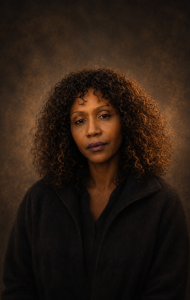
I am Meserette Kentake, a Jamaican-born writer, independent researcher, and founder of Kentake Page. Raised in Kingston and now residing in London, my intellectual, emotional, and spiritual home has always stretched across the Black Atlantic—to Africa, the Caribbean, the Americas, and every place where African people have forged istwa (history), memory, culture, and hope.
As Lucille Clifton wrote, “I am accused of tending to the past.” Our istwa has fascinated me since childhood. In high school in Jamaica, I chose Caribbean history over European history—a decision that shaped my lifelong journey. In London, in my early thirties, I had the opportunity to study African World Studies with Femi Biko. I also began an undergraduate degree in African Studies at SOAS, but left after a year. Many years later, in my early forties, I finally completed a degree in Psychology.
When my youngest son reached adulthood, I returned to formal study and began a Master’s degree in African History in September 2023. In July 2024, only six weeks before I was due to finish, the university suspended the program. I had received distinctions for both written assignments and was on track to graduate with distinction, pending the completion of my dissertation on the impact of the Haitian Revolution.
This was a profound disappointment, one from which my mind and spirit have not fully recovered. Even the joy of visiting Ghana—the motherland—for the first time in 2025 could not entirely ease that loss. Yet the interruption did not end my work. It reaffirmed that my education has always extended beyond institutions: through reading, research, reflection, and the long discipline of returning to the questions that matter.
For more than five decades, I have read and researched relentlessly to understand those who came before me. Through girlhood, womanhood, and motherhood, I read with a desire to understand the Maafa—the centuries-long catastrophe of Atlantic trafficking and captivity—but gradually expanded to encompass the broader istwa of Africa, the Caribbean, the Americas, and Europe.
I am currently researching and writing my debut book on the Maafa. I understand the Maafa as a great catastrophe that shattered the sacred calabash of Being, scattering its fragments across bodies, memory, social structures, and the spiritual field. My writing seeks to gather those fragments—honoring the Ancestors, affirming the wholeness of the Living, and repairing our covenant with those yet to be born.
Kentake Page is dedicated to my mother, Delores Anderson, who always encouraged me to share what I knew. She would often complain when I told her about something that I had read: “You walk around with too much knowledge in your head. You must learn to share it with the world.” Without her, Kentake Page would not exist, as I would have just continued reading for my own knowledge and pleasure. I am also deeply grateful to others—especially my eldest son—who sustained and encouraged me during times when competing commitments nearly led me to give up on Kentake Page.
In addition to my love of African and Black history, I enjoy studying astrology, psychology, African cosmology, and spirituality.
Personally, I am a mother of three sons and a grandmother to one granddaughter and four grandsons. My birth name was Althea Welsh (Yes, I changed my name by deed poll because my personal identity required an African name). I attended Holy Rosary Prep and Holy Family Primary before attending Camperdown High School. I left Jamaica at the tender age of 21 and have lived in London since, where I had my three sons. I have a BSc in Counseling Psychology and a Post-Graduate Certificate in African History. I currently work full-time in education (not as a teacher), and I look forward to the day I can focus fully on historical writing. As we say in Jamaica, I now “have more days behind me than in front of me.” Because our istwa matters to me, ancestry matters too. I have traced my mtDNA to the Yoruba people. Therefore, the woman taken out of Africa and put on a transatlantic ship was Yoruba. My recent paternal line is from western Haiti, and my maternal line is from St Ann, Jamaica. My maternal grandfather was also from Cuba, and my great-grandfather was from Bangladesh. This bloodline profoundly explains my resistance to Christianity and the church as a child, and my search for and deep need for an African spiritual system to guide my livity in this incarnation.
I am available for historical research, editorial consultancy, exhibitions, documentaries, and other projects relating to Black history and the African diaspora. Inquiries are welcome at meserette@kentakepage.com.
About Kentake Page
Kentake Page was founded on 12 December 2012, beginning briefly as a literary blog before evolving into an independent archive dedicated to Black history, cultural memory, and the recovery of stories that deserve to be remembered.
Biography is one of our istwa’s greatest teachers. Through a single life — revolutionary, freedom fighter, scholar, writer, artist, educator, healer, scientist, spiritual figure—we can encounter a larger historical world. One name can become a doorway. One life can take us across oceans and centuries.
Kentake Page is therefore more than a collection of articles. It is a living archive of connections. It seeks to reconnect stories that have too often been separated by geography, language, nation, and the divisions imposed by the hunter’s narrative. To remember those who came before us is an act of gratitude, but it is also an ethical responsibility. Every forgotten biography restored to view, every overlooked event revisited, and every life remembered helps raise up a larger story that has too often been fragmented or silenced.
Kentake Page is also more than an istwa site; it is an altar to the Ancestors, grounded in the belief that our story stretches across the worlds of the Living, those yet to be born, and the Ancestors. Therefore, the afterlife of the Maafa must be confronted if balance is to be restored. As my understanding of the Maafa has deepened, so too has my sense of responsibility. The story of the Maafa does not exist in isolation; it is entangled with the histories of Indigenous peoples across the Americas and beyond—peoples who also endured invasion, dispossession, and attempted erasure.
I recognize that telling our story with integrity requires acknowledging these shared and intersecting istwa. In this spirit, Kentake Page seeks not only to honor Afrikan and diasporic experiences but also to respectfully engage with and highlight Indigenous histories. In many ways, this evolution honors the “little girl” in me who first recognized that Taíno and Afrikan stories met in struggle and survival. Therefore, Kentake Page has expanded its scope to include Indigenous histories as part of a broader commitment to truth-telling, restoration, and intellectual and spiritual solidarity across communities whose pasts and futures remain profoundly interconnected.
Additionally, one of the pillars of Kentake Page is the words attributed to Queen Hatshepsut:
“I have restored that which was in ruins.
I have raised up that which was destroyed.”
That is the work Kentake Page seeks to perform. Every article published here forms part of an ongoing effort to restore our istwa from the wounds of his-story and raise it from imposed silence and historical erasure. My hope is not simply that readers leave Kentake Page with more information, but with a deeper sense of connection—to the past, to one another, and to the responsibilities that memory asks of us.
Why Language Matters
Another pillar of Kentake Page is the proverb:
“Until lions have their own historians, the tale of the hunt will always glorify the hunter.”
Writing from the perspective of the lion requires more than changing who tells the story. It requires us to examine the language through which the story itself has been understood.
Language is never neutral. The words we use do more than describe the past. Words determine how we understand it, whose actions are legitimized, and how people are remembered. Too often, the istwa of Africa’s people has been told through the language of the hunter. When we repeat the language from his-story uncritically, we run the risk of perpetuating assumptions and categories created by those who used violence against us and profited from our suffering.
The hunter’s narrative can diminish our humanity while making domination appear ordinary, legitimate, or inevitable. Words can transform invasion into discovery, dispossession into settlement, captivity into identity. The hunter invades, steals, and dispossesses, and then calls himself the governor or the official or the authority. This is then recorded and written over and over again from one book to another and is rarely questioned.
For this reason, I pay careful attention.
Wherever possible, I seek language that restores our dignity, agency, and the context. I do not write from the margins. Nor do I write from a positionality of history from below. These familiar expressions still position us in relation to someone else’s center. However, I am also mindful that many borrowed words—such as diaspora—have been contested, reshaped, and given richer meanings through generations of African and diasporic scholarship.
Kentake Page therefore approaches language with curiosity and care. I want to ask what our inherited words reveal, what they conceal, whose perspective they preserve, and whether they allow the people we encounter in history to appear before us in the fullness of their humanity.
This is not an exercise in political correctness. It is an exercise in historical consciousness.
Kentake Page Substack is the companion publication to the website.
While the website serves as a growing historical archive, Substack provides space for my personal essays. It gives me room to “write what I like.”
Most of my pieces written for Substack would not have been appropriate for the website, as I am not writing our istwa in the conventional sense alone on the platform. The essays on Substack are rooted in the memories of my own life. They often begin with something small: a line in a book, a historical figure, a feeling, a dream, a question that has stayed with me for years. From there, they travel outward into the histories of the Maafa, African cosmologies, Black diasporic life, resistance, grief, creativity, and survival. These essays follow in the personal, reflective, and socially conscious traditions of writers such as Alice Walker and bell hooks.
Kentake Page Mailing List – Subscribing via the Substack Form
With the launch of a new Kentake Page website (Aug 12, 2026), the mailing list is now connected to Kentake Page on Substack. The Substack platform is my preferred way of communicating with readers about new posts and website updates.
If you would like to continue receiving Kentake Page updates by email, please subscribe through the Substack form provided. You do not need to be familiar with Substack to join the Kentake Page mailing list. Substack simply provides the platform through which these email updates are now delivered.
Your email address remains part of the Kentake Page mailing community, and you can unsubscribe at any time. Readers who choose to create or use a Substack account can also follow Kentake Page directly there and access its essays, notes, and other publications.
One Kentake Page, two connected spaces: the website remains the main historical archive, while Substack provides a direct way for me to stay in touch with readers and share new work.
Use of Artificial Intelligence
Kentake Page is researched, written, edited, and curated by me. I use artificial intelligence as an editorial and creative assistant to help organize research, refine and review drafts, identify connections between historical subjects, and develop original historical illustrations.
AI has been particularly valuable in addressing a longstanding challenge for Kentake Page: copyright and image licensing. In the past, concerns about using externally sourced images made me increasingly cautious about publishing new articles. AI now allows me to create original visual interpretations for the archive, significantly reducing my reliance on copyrighted images while also giving Kentake Page its own distinctive visual identity.
AI-assisted artworks are interpretative rather than documentary. They are intended to help readers imagine historical people, places, and moments, particularly where suitable visual material does not exist or cannot reasonably be used. They should never be understood as historical source material.
AI also reduces the considerable physical labor involved in maintaining a large independent archive. African istwa is vast. Our species, Homo sapiens, emerged in Africa at least 300,000 years ago. African people therefore stand at the deepest roots of human history, even though the modern political and cultural category “Black” belongs to a much more recent historical world. There is an extraordinary amount of istwa to recover, research, and share.
Using AI-assisted research, editorial, and creative tools means that work which might once have taken me several days can sometimes be completed in considerably less time. This is invaluable while I continue to work full-time, write my debut book, publish on Substack, and maintain Kentake Page.
Above all, what matters to me is getting our istwa out into the world.
AI makes that easier, but it does not replace historical research, critical judgment, or editorial responsibility. I read and review the material I publish, return to the underlying sources where necessary, and revise the work before publication. The choice of subjects, historical interpretation, language, ethical framework, and final editorial decisions remain my own.
Support Kentake Page
Kentake Page is an independent project. I research, write, edit, and maintain it myself, although some of the older posts were written by my closest friend, Uchenna Edeh.
The website is intentionally free from advertising. This is a conscious decision on my part. I refuse to let our stories of captivity, resistance, memory, and cultural inheritance be interrupted by commercial distraction.
However, maintaining and expanding Kentake Page requires time, books, archival research, subscriptions, technology, travel, and continuing financial commitment. If you find value in this work, there are several ways to support it:
- Read, share, and recommend Kentake Page articles.
- Subscribe to Kentake Page on Substack for new essays and archive updates.
- Support the archive through book donations, sponsorship, or financial contributions.
In the future, I will be crafting the Kentake Page Essays. These personal and researched essays will only be available on Kentake Page. For the price of a coffee, readers can help sustain Kentake Page while receiving a carefully crafted work not available on the public site.
Secondly, I intend to produce a Black istwa keepsake that supporters can buy for themselves or family and friends.
Whether you read an article, share a biography, subscribe to the Substack, recommend Kentake Page to others, or choose to provide financial support, you become part of the ongoing work of ensuring that these stories continue to be remembered.
Privacy
Kentake Page respects your privacy. If you subscribe to the newsletter or contact me through this website, your information will be used only in accordance with the Kentake Page Privacy Policy. You may unsubscribe from mailing-list communications at any time.
Thank you for reading thus far.
Ancestral blessings,
Meserette Kentake
12 August 2026