
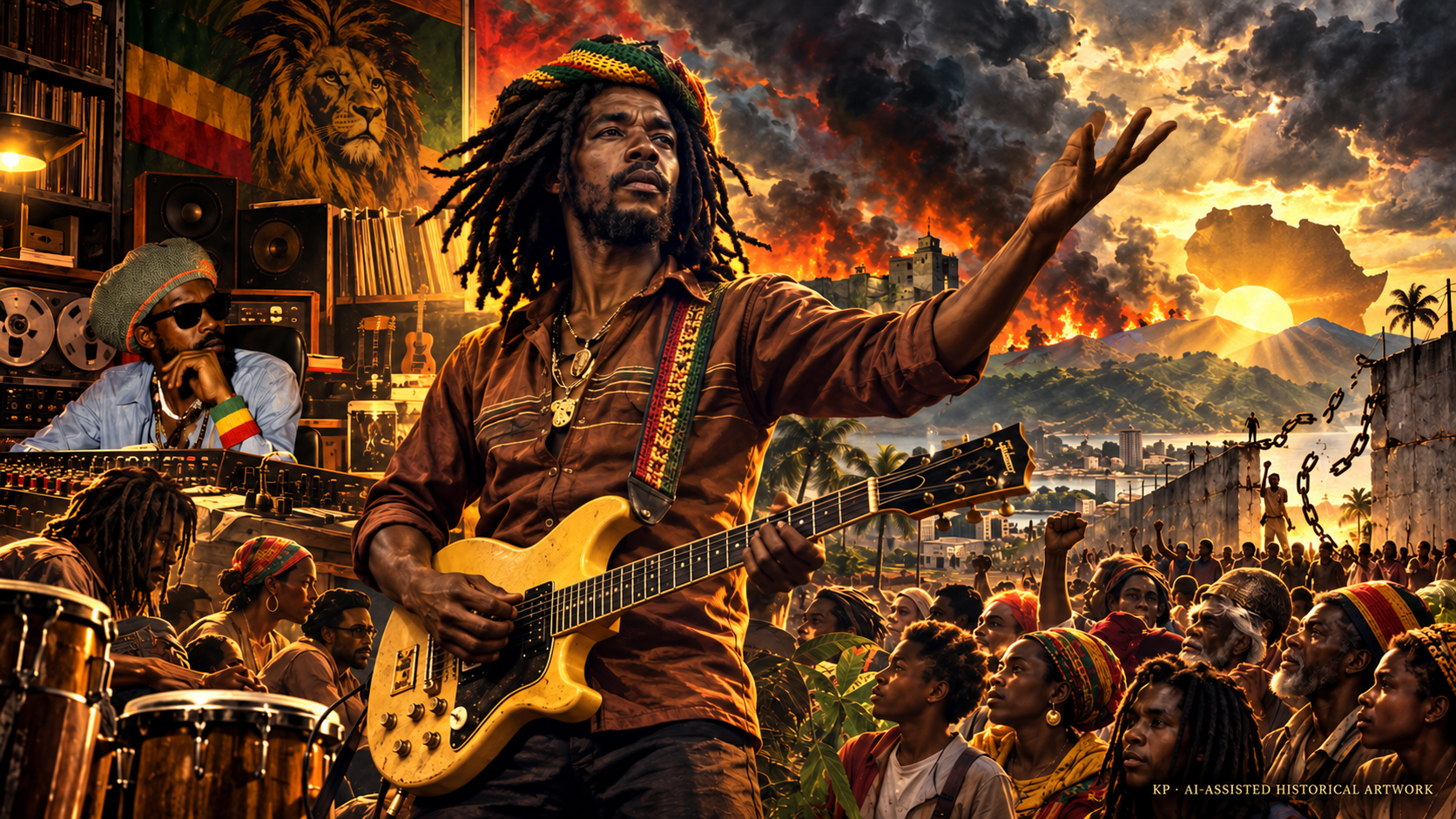
Peter Tosh was a founding member of the Wailers and one of reggae’s most uncompromising voices. Alongside Bob Marley and Bunny Wailer, he helped shape a musical movement that carried Jamaican experiences and Rastafari consciousness to audiences worldwide. A gifted singer, songwriter and multi-instrumentalist, Tosh later established a distinguished solo career, using his music to challenge racism, apartheid, police brutality and the criminalization of cannabis.
Born Winston Hubert McIntosh in Westmoreland, Jamaica, on 19 October 1944, Tosh moved to Kingston as a young man and became part of Trench Town’s musical community. There he joined Marley and Neville Livingston, later known as Bunny Wailer. Singer and mentor Joe Higgs helped the young musicians develop their voices and harmonies.
The Wailers formed in 1963. Their early line-up also included Junior Braithwaite, Beverley Kelso and Cherry Smith. Recording for producer Clement “Coxsone” Dodd at Studio One, they achieved an early breakthrough with the ska recording “Simmer Down,” which became a major Jamaican hit in 1964.
Tosh brought considerable instrumental ability to the group. A largely self-taught guitarist and keyboard player, he helped his fellow Wailers develop their own musicianship. Bunny Wailer later recalled: “There was Peter and he played and we learned from him playing.” Tosh has also been credited with teaching Marley guitar, although the broader claim—that he was an important musical teacher within the early group—is more firmly supported by Bunny’s testimony.
As Jamaican popular music moved from ska through rocksteady into reggae, the Wailers’ sound evolved with it. Rastafari increasingly informed their music and their understanding of African identity, oppression and liberation. Their work with Lee “Scratch” Perry in the early 1970s produced enduring recordings, including “Soul Rebel,” “Duppy Conqueror,” and “Small Axe.” These recordings helped define the developing reggae sound.
In 1973, the Wailers released their first Island Records album, Catch a Fire, followed later that year by Burnin’. Tosh contributed “400 Years,” while Burnin’ featured “Get Up, Stand Up,” the enduring anthem he co-wrote with Marley. His songwriting and distinctive voice were central to the group’s musical identity.
By 1974, the original partnership had broken apart. Tosh and Bunny Wailer pursued separate careers amid disagreements over management, artistic control, and the growing emphasis on Marley as the group’s central figure. Marley continued performing with a reconstituted band called Bob Marley and the Wailers.
Tosh released his debut solo album, Legalize It, in 1976 through Columbia/CBS. Its title track became an anthem for cannabis-law reform. Banned from Jamaican radio, the song expressed convictions Tosh continued to defend publicly, linking cannabis to Rastafari practice and challenging its criminalization.
His second album, Equal Rights (1977), broadened that demand for freedom into an international declaration of human dignity. Songs including “Equal Rights,” “Apartheid” and “African” connected struggles in Jamaica with those of African peoples and the wider Black diaspora. As his former manager, Herbie Miller, later explained, the album responded to struggles for humanity, equity, and dignity across the world—not simply to conditions in Jamaica.
With his backing band, Word, Sound and Power, Tosh developed a commanding presence on stage. The band included drummer Sly Dunbar and bassist Robbie Shakespeare. In 1978, he signed with Rolling Stones Records and released Bush Doctor. His duet with Mick Jagger on “(You Gotta Walk) Don’t Look Back,” a song previously recorded by the Temptations, and his appearances supporting the Rolling Stones introduced him to a wider rock audience.
Yet increased exposure did not soften his political message. At Jamaica’s One Love Peace Concert in April 1978, Tosh challenged the country’s political leadership in the presence of Prime Minister Michael Manley and opposition leader Edward Seaga. He spoke about poverty, injustice and cannabis prohibition, warning: “Hungry people are angry people.” For Tosh, peace without justice was inadequate.
In September that year, he was severely beaten while in police custody. Accounts describe serious head injuries and a broken hand; Tosh said that he survived by pretending to be dead. The episode became one of the most notorious examples of the violence he confronted and condemned. The beating is often linked to his outspoken concert appearance, as a direct retaliatory motive.
He followed with Mystic Man in 1979, Wanted Dread & Alive in 1981, and Mama Africa in 1983. Throughout these recordings, Tosh continued to combine musical experimentation with declarations of African identity and resistance to oppression. His relationship with the music industry remained difficult, particularly over promotion and how far commercial partnerships could accommodate his political commitments.
Biographer John Masouri described Tosh as “genuinely revolutionary in his thoughts and ambitions for his music.” His association with the Rolling Stones did not change that outlook: commercial opportunity remained secondary to his determination to speak on his own terms.
Tosh was a committed opponent of apartheid and refused invitations to perform in South Africa under European-minority rule. His songs and public statements connected reggae to African liberation struggles. He also expressed solidarity with Palestinians; according to Masouri’s account, reported in The Independent, he was refusing invitations to perform in Israel as early as 1979 because of his support for a Palestinian homeland.
His final studio album, No Nuclear War, appeared in 1987. It won the Grammy Award for Best Reggae Recording in 1988, after his death.
On 11 September 1987, Tosh was murdered during an armed robbery at his home in St Andrew, Jamaica. He was forty-two. Three gunmen entered the house and demanded money. Among them was Dennis “Leppo” Lobban, whom Tosh had previously assisted after his release from prison.
The attack also claimed the lives of Wilton “Doc” Brown and broadcaster Jeff “Free I” Dixon. Several others were wounded, including Tosh’s partner, Marlene Brown, and drummer Carlton “Santa” Davis. Lobban was convicted of the three murders in 1988; his appeal was dismissed in 1990.
Nicholas Campbell’s documentary Stepping Razor: Red X (1993) explored Tosh’s life, music, and death. Drawing on the musician’s personal tape-recorded reflections alongside interviews and performance footage, the film preserved something of his searching, provocative voice.
In October 2012, Jamaica posthumously awarded Tosh the Order of Merit. His legacy rests not simply on his reputation for militancy, but on the musical intelligence and moral insistence with which he demanded equal rights and justice.
Sources:
http://www.independent.co.uk/arts-entertainment/music/features/move-over-bob-marley-peter-tosh-is-finally-getting-the-recognition-he-deserves-8914028.html
https://en.wikipedia.org/wiki/Peter_Tosh
https://english.ahram.org.eg/NewsContent/5/33/318158/Arts–Culture/Music/UNESCO-adds-reggae-to-global-cultural-heritage-lis.aspx
https://www.grammy.com/artists/peter-tosh/6832
https://www.petertosh.com/history
https://www.northcountrypublicradio.org/news/npr/137701446/peter-tosh-reclaiming-a-wailer
https://www.furious.com/perfect/petertosh.html
https://www.nytimes.com/1987/09/13/world/gunmen-kill-peter-tosh-reggae-star-in-jamaica.html
https://www.jamaicaobserver.com/2012/04/21/the-night-peter-tosh-was-killed
https://www.latimes.com/archives/la-xpm-1993-06-02-ca-42321-story.html