
I had to go and see Equalizer 2 with Denzel Washington. I have been a fan of Denzel since he played Steve Biko in Cry Freedom. I remember going to the Empire cinema in Leicester Square, London, to watch that film on my own. What was happening in South Africa at the time meant the world to me, and I had to see the film. Needless to say, I fell in love with Denzel’s Black body.
Over the years I have sometimes groaned at some of the roles he has played (like Training Day and Safe House, which make me ask the question, “Why Denzel?”), yet I still go to see every film he is in. Although The Equalizer and Equalizer 2 are very violent thrillers, Denzel Washington (as Robert McCall) plays the part of a sacred warrior. He is a retired special forces agent turned avenger, who no longer follows orders to kill but lets his heart decide. His quiet storm — his rage — is directed against those who have harmed the “innocents.”
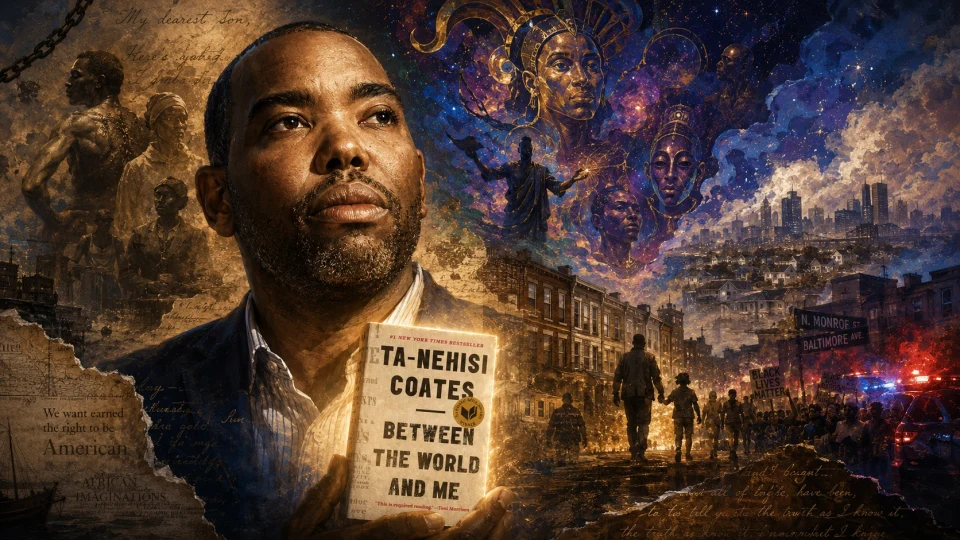
In the opening scene of Equalizer 2, McCall is reading Ta-Nehisi Coates’ book, Between the World and Me. When I saw that cover in his hands, I immediately sat up straight in the cinema. I knew I was in for a treat. This is not the kind of book that usually shows up in Hollywood thrillers, and its presence on screen felt rare, deliberate, and important. I was not disappointed. Equalizer 2 is shaded by Blackness in ways that are absent from the first film; Coates’ book becomes part of the film’s moral weather.
A long letter about the Black body
Between the World and Me is a long love letter, woven from profound knowledge and intense emotion, that Coates wrote to his adolescent son about the story of race on the American landscape. It is a landscape shaped by torture, theft, and enslavement, after being acquired through murder. The World, for Coates, is one secured and ruled by savage means. As he explains to his son, the American police officer carries the power of the American state and the weight of an American legacy — a legacy that gives them a strange birthright: the right to beat, rape, rob, and pillage the Black body. That legacy demands that of the bodies destroyed every year, a wild and disproportionate number of them will be Black. In America it is traditional to destroy the Black body — it is heritage. And because it is heritage, the destroyers will rarely be held accountable.
The book is divided into three parts, each opened by the words of a Black literary elder.
Part 1 opens with a poem from Sonia Sanchez:
“Do not speak to me of martyrdom
of men who die to be remembered
on some parish day.
I don’t believe in dying
though, I too shall die.
And violets like castanets
will echo me.”
Part 2 opens with a poem from Amiri Baraka:
“Our world is full of sound
Our world is more lovely than anyone’s
tho we suffer, and kill each other
and sometimes fail to walk the air
We are beautiful people
with african imaginations
full of masks and dances and swelling chants
with african eyes, and noses, and arms,
though we sprawl in grey chains in a place
full of winters, when what we want is sun.”
Part 3 opens with a quote from James Baldwin:
“And have brought humanity to the edgy of oblivion: because they think they are white.”
Coates writes his letter to his son with african eyes and african imaginations. What he wants for his son is not martyrdom but consciousness, because his son does not have the privilege of living in ignorance. Knowledge is power, and it is power because it gives you a voice. You can no longer be silenced or live in silence. Of all our studies, it is historical knowledge that gives you a strident voice. As you read Coates’ words, you can hear the boom of history thundering through his message to his son, when he tells him, “You have been cast into a race in which the wind is always at your face and the hounds are always at your heels.”
Coates’ letter is about ringing the alarm and warning his son about those who think they are white — the people he calls the destroyers and the dreamers. He understands that the destroyers have created a dream world that is nightmarish in its contours, a Dream built on the theft of Black land, labour, and life. Coates is one who has awakened inside the destroyers’ dream world and has seen through the illusion. Hence, his book is an urgent message of love with a kind of obsession. We who are Black parents know this love. It is the scent of violet. We live with the twin flames of blue fear and red rage. It is the reason we understood when Prince sang, “I only wanted to see you laughing in the purple rain.”
In Equalizer 2, that fear and rage animate the story because McCall plays not only an avenging role but also a fatherly role to a young man, Miles (Ashton Sanders). It is an affectionate relationship of protection and guidance, echoing the love Coates has for his son, which compelled him to “walk the air” to write the book. McCall sees Miles at a crossroads — pulled between his gift for art and the siren call of the streets — and intervenes with a toughness rooted in care. In one of the film’s most powerful moments, he forces Miles to confront how cheap death has become around him and then offers a counter-possibility: “Why not you?” It is Coates’ question turned inside out — how to live freely in a Black body when the world is built on its destruction.
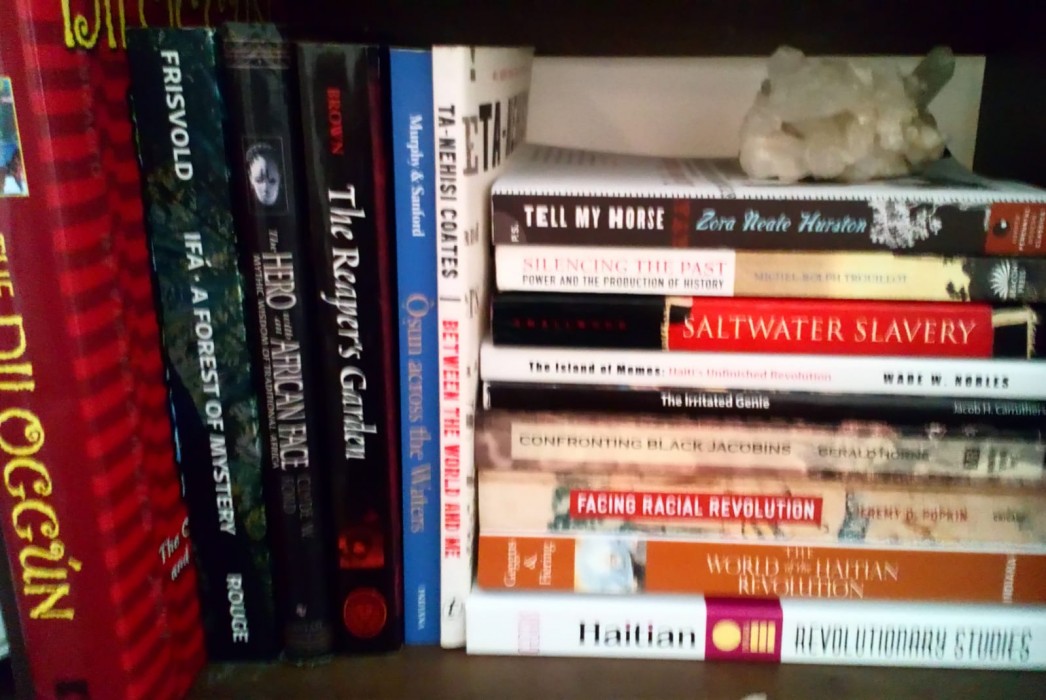
I bought Between the World and Me probably a year or so before seeing Equalizer 2. I skimmed through it and put it on my bookshelf. This summer, I moved it to the centre shelf of my reading/writing desk — the space reserved for books I want to read or reread. In late July 2018, I finally read Between the World and Me and loved it. I immediately called my best friend. I told him I could see why Ta-Nehisi Coates has been compared to James Baldwin.
Equalizer 2 goes even further and places Coates as the current male guardian of the Afrikan-American flame, coming from a line beginning with Frederick Douglass, through Baldwin, and now to him. That brief shot of the Frederick Douglass mural is not an accident; it is a visual genealogy, a deliberate situating of Coates in a continuum of Black prophetic writers.
What was most significant for me was that McCall gives Between the World and Me to Miles to read. McCall has been working through a list of one hundred books in memory of his wife, Vivian. Between the World and Me is not one of those hundred, yet this is the book he chooses for Miles — a book stitched from a father’s fear and love, wholly relevant to the World Miles is growing up in.
When I finished reading Between the World and Me, I thought about writing a post on the book because I loved so much of what Coates had to share. By talking to his son, Coates speaks to us. His letter is intensely personal but profoundly communal in its reach. It touches my life, your life, our lives. We are all sitting at the banquet of despair, starving, and crying out not for food but for sustenance. Whether you agree or disagree, this is a w e l l w r i t t e n book. It sustains you.
Of course, there were parts of the book I was not feeling. I felt Coates had yet to grow in a spirituality that went beyond the pale. He has awakened in the destroyers’ dream world, but on his wanderings, he has not yet found his mother’s garden. I did not see the reason he needed to go to France, because the ones who awakened him — his ancestors — are not there. It is always amazing to me that if one does not believe in the three patriarchal religions — Judaism, Christianity, or Islam — one will inevitably encounter the question, “Do you believe in God?” Does God/the creator/creatress only exist in these three religions? Religions that were created, or rather organised, yesterday? And by yesterday, I mean within the last two thousand years.
Considering that Afrikan people have existed as homo sapiens sapiens for over 300,000 years, am I to believe that everything my people believed in for over 288,000 years before there was “religion” is worth nothing? Is there a place in this world where a Black wo/man can be free, or feel free, when the destroyers are still at the gates after burning the towns, killing the men, raping the women, scattering the people, and exploiting the lands and resources? It is an illusion to believe that there is any place in this world where the air is not tainted with racism, exploitation, corruption, and hatred.
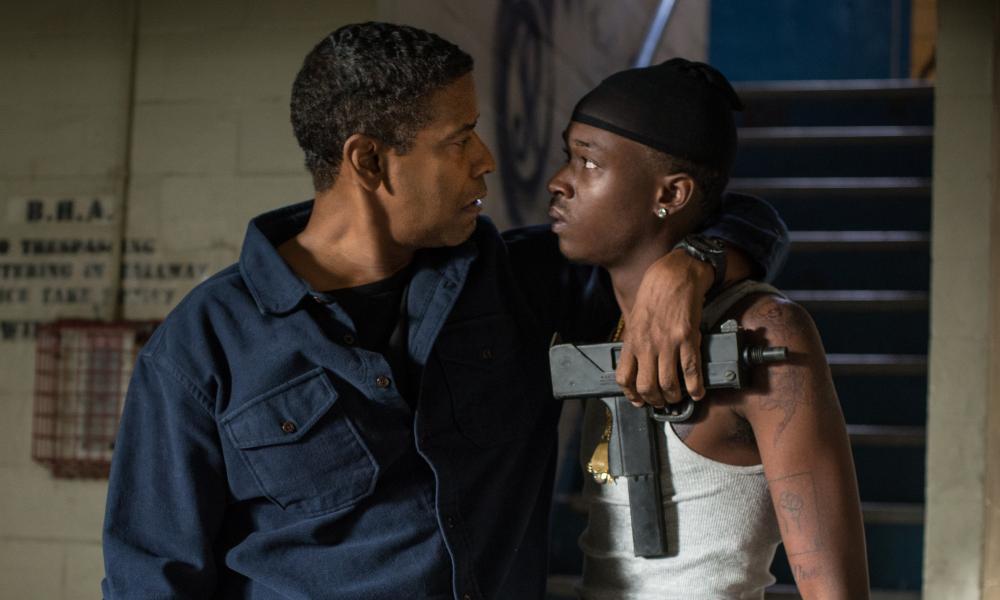
After watching Equalizer 2, I realised that I should definitely do a “Ten Quotes” post. I felt that Denzel was acting like Eleggua/Esu at the crossroads, offering me an opening. In Yoruba and Afrikan-diaspora traditions, Eleggua is the orisha of roads and paths, the guardian of the crossroads who opens and closes doors and must be invoked before other spirits can be reached. That is how this moment felt: as if McCall, book in hand, had opened a door so Coates’ words could walk into the cinema and sit beside us.
If Coates needs a spiritual tradition to stand on, he should explore Lucumí/Santería. Rather than France, he should go to Cuba, where the Orishas and the ancestors are waiting for him, because he has been struggling for them and for those yet to come. Or he could take an African Ancestry DNA test to find his mother’s garden and reconnect with the ancestral power and inspiration within himself.
And yes, if you are a Black father (or a mother like I am), please buy Between the World and Me. Toni Morrison called this “required reading,” and she was right.
Here are Ten Quotes from Between the World and Me that stayed with me. They are some of the violets on this bleak landscape:
1. [Euro-Americans] believe in the reality of “race” as a defined, indubitable feature of the natural world. Racism — the need to ascribe bone-deep features to people and then humiliate and reduce them — inevitably follows from this inalterable condition. In this way, racism is rendered as the innocent daughter of the Middle Passage or the Trail of Tears the way one deplores an earthquake, a tornado, or any other phenomenon that can be cast as beyond the handiwork of men.
2. These new people (those who have been brought up hopelessly, tragically, deceitfully, to believe that they are white) are…a modern invention. Their name has no real meaning divorced from the machinery of criminal power. The new people were something else before they were white — Catholic, Corsican, Welsh, Mennonite, Jewish — and if all our national hopes have any fulfillment, then they will have to be something else again. It must be said, that the process of washing the disparate tribes white, the elevation of the belief in white, was not achieved through wine tasting and ice cream socials, but rather through the pillaging of life, liberty, labor, and land; through the flaying of backs; the chaining of limbs the strangling of dissidents; the destruction of families; the rape of mothers; the sale of children; and various other acts meant, first and foremost, to deny you and me the right to secure and govern our own bodies.
3. To be Black in Baltimore of my youth was to be naked before the elements of the world, before all the guns, fists, knives, crack, rape, and disease. The nakedness is not an error, nor pathology. The nakedness is the correct and intended result of policy…
4. I could not retreat, as so many, into the church and its mysteries. My parents rejected all dogmas. We spurned the holidays marketed by the people who wanted to be white. We would not stand for their anthems. We would not kneel before their God.
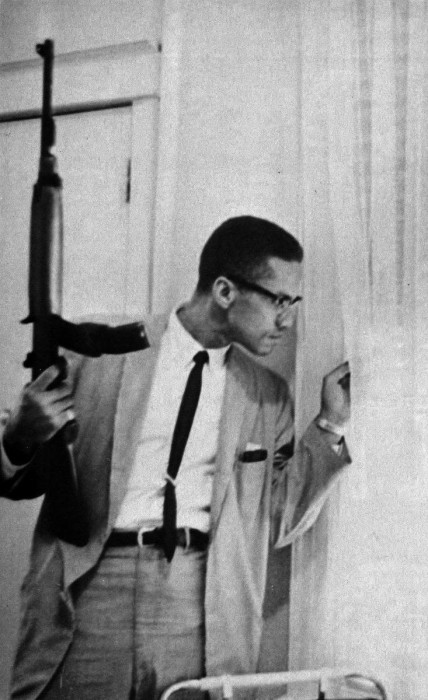
5. If I could have chosen a flag…it would have been embroidered with a portrait of Malcolm X, dressed in a business suit, his tie dangling, one hand parting a window shade, the other holding a rifle. The portrait communicated everything I wanted to be — controlled, intelligent, and beyond fear. I would buy tapes of Malcolm’s speeches — “Message to the Grassroots,” “The Ballot or the Bullet” — down at Everyone’s Place, a black bookstore on North Avenue, and play them on my Walkman. “Don’t give up your life, preserve your life,” he would say. “And if you got to give it up, make it even-steven.” This was not boasting — it was a declaration of equality rooted not in better angels or the intangible spirit but in the sanctity of the black body. You preserved your life because your life, your body, was as good as anyone’s, because your blood was as precious as jewels, and it should never be sold for magical, for spirituals inspired by the unknowable hereafter. You do not give your precious body to the billy clubs of Birmingham sheriffs nor to the insidious gravity of the streets. Black is beautiful, which is to say that the black body is beautiful, that black hair must be guarded against the torture of processing and lye, that black skin must be guarded against bleach, that our noses and our mouths must be protected against modern surgery. We are all our beautiful bodies and so must never be prostrate before barbarians, must never submit our original self, our one of one, to defiling and plunder.
6. Slavery is not an indefinable mass of flesh. It is a particular, specific enslaved woman, whose mind is active as your own, whose range of feelings is as vast as your own; who prefers the way the light falls in one particular spot in the woods, who enjoys fishing where the water eddies in a nearby stream, who loves her mother in her own complicated way, thinks her sister talks too loud, has a favorite cousin, a favorite season, who excels at dressmaking and knows, inside herself, that she is as intelligent and capable as anyone… For this woman, enslavement is not a parable. It is damnation. It is the never-ending night. And the length of that night is most of our history.
7. Black people love their children with a kind of obsession. You are all we have, and you have come to us endangered. I think we would like to kill you ourselves before seeing you killed by the street that America made.
8. Hell upon those who tell us to be twice as good and shoot us no matter. Hell for ancestral fear that put Black parents under terror. And hell upon those who shatter the holy vessel.
9. The forgetting is habit, is yet another necessary component of the Dream. They have forgotten the scale of theft that enriched them in slavery; the terror that allowed them, for a century, to pilfer the vote; the segregationist policy that gave them their suburbs. They have forgotten because to remember would tumble them out of the beautiful Dream and force them to live down here with us, down here in the world.
10. Struggle for the memory of your ancestors. Struggle for wisdom… Struggle for your grandmother and grandfather, for your name.
Acknowledgement: The featured image in this post was created by ChatGPT under the author’s direction.