
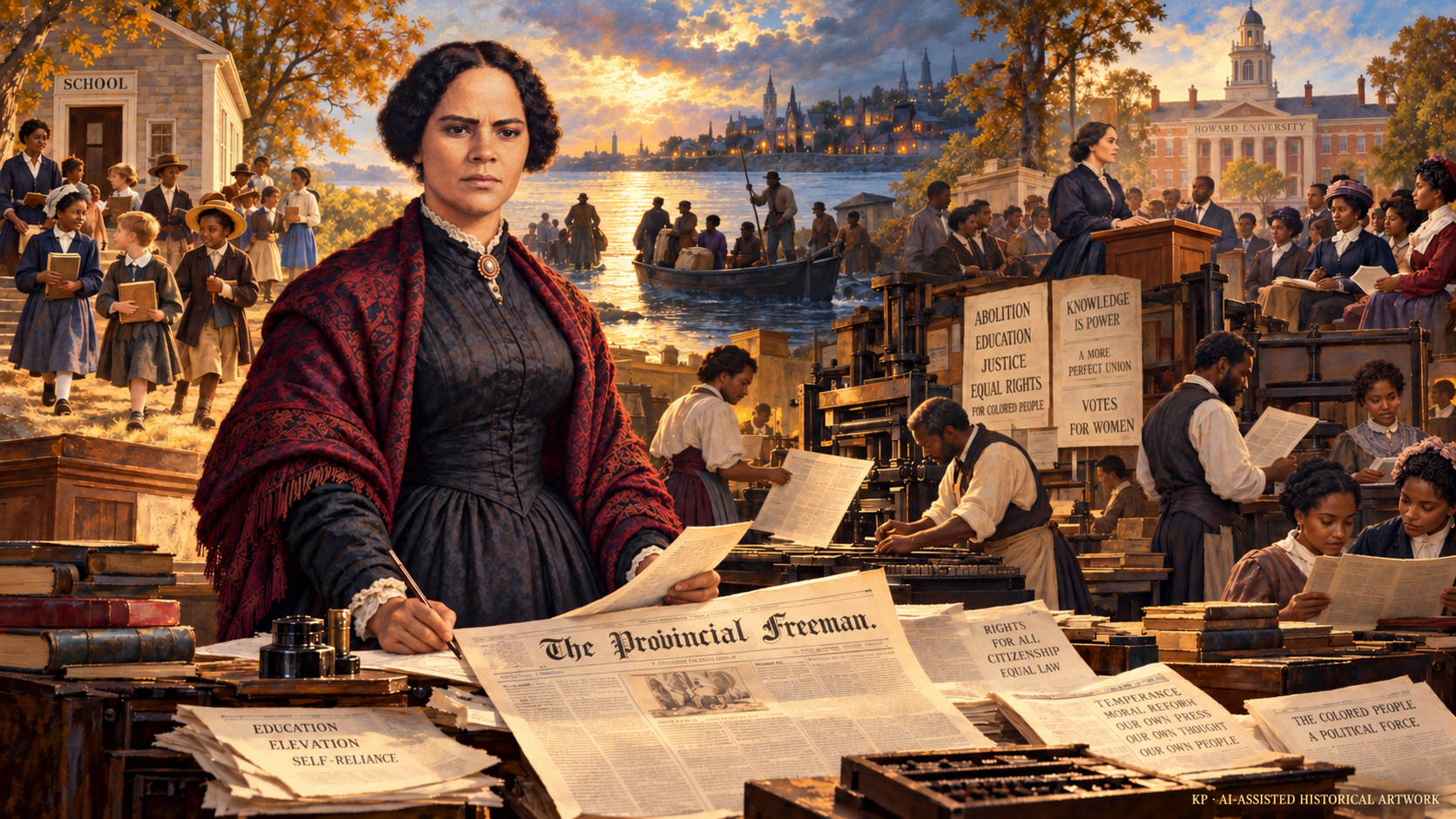
Mary Ann Shadd Cary was a Black Canadian-American educator, abolitionist, writer, newspaper publisher, army recruiter, suffragist, and legal scholar. In 1853, she founded The Provincial Freeman, making her the first Black woman in North America known to publish and edit a newspaper. The paper focused on temperance, education, Black self-determination, and the political advancement of people of African descent in Canada and the United States.
Mary Ann Shadd was born on 9 October 1823 in Wilmington, Delaware, to free Black parents, Abraham Doras Shadd and Harriet Parnell Shadd. She was the eldest of thirteen children. Her parents were deeply involved in abolitionist activity, and the Shadd family helped people liberate themselves through the network now known as the Underground Railroad. In 1833, the family moved to West Chester, Pennsylvania, where Mary Ann attended a Quaker school. She became a teacher as a young woman and later taught in New Jersey, Pennsylvania, Delaware, and New York.
The Fugitive Slave Act of 1850 placed both freedom seekers and those who assisted them in grave danger, including in northern states. In 1851, Shadd moved to Canada West—present-day Ontario—where thousands of Black people from the United States sought greater security under British rule. She settled first in Windsor, across the Detroit River from Michigan, and opened an integrated school for Black and white children. Her educational work reflected a lifelong commitment to racial equality and opposition to segregated schooling.
In 1852, Shadd published A Plea for Emigration; or, Notes of Canada West, a pamphlet encouraging Black Americans to consider migrating to Canada. It argued that Canada West offered opportunities for land, work, education, and community-building. Her position was controversial: unlike some Black leaders who favored mutual-aid institutions and separate Black settlements, Shadd insisted on integration, self-reliance, and full civic participation.
On 24 March 1853, Shadd founded The Provincial Freeman. First published in Windsor, it later appeared in Toronto and Chatham, Canada West. The newspaper was co-edited with the abolitionist Samuel Ringgold Ward and served Black communities in Canada and the United States. It published antislavery news, political commentary, notices of community activity, arguments for education and temperance, and reports challenging racist portrayals of Black life. Shadd’s leadership of the paper made her the first Black woman in North America known to establish, publish, and edit a newspaper.
Shadd married Thomas F. Cary, a Toronto barber and businessman, on 3 January 1856. They had two children, Sarah Elizabeth and Linton. Thomas Cary died in 1860, shortly before the birth of their son, leaving Shadd Cary a widow and the principal support of her young family. The financial burdens of publishing and family life contributed to the eventual closure of The Provincial Freeman.
During the American Civil War, Shadd Cary returned to the United States and recruited Black men for the Union Army. Her work was part of the larger struggle to secure Black military service as a path toward emancipation, citizenship, and political rights. The Library of Congress identifies her as the first Black woman designated as a U.S. Army recruiting officer.
After the Civil War, Shadd Cary settled in Washington, D.C., where she taught, wrote, lectured, and participated in the struggle for Black civil rights and women’s suffrage. In 1869, she entered the inaugural class of Howard University’s Law School, becoming the first Black woman known to enrol in a law school in the United States. She completed her degree in 1883, at the age of sixty, becoming one of the earliest Black women in the United States to earn a law degree. Charlotte E. Ray, who graduated from Howard in 1872, was the first Black American woman to receive a law degree and practice law.
Shadd Cary remained an active advocate for women’s political rights. She participated in the National Woman Suffrage Association and spoke at its 1878 convention. She also supported the Fourteenth and Fifteenth Amendments while criticizing the exclusion of women from the Fifteenth Amendment’s protections. Later, she helped found the Colored Women’s Progressive Franchise Association, linking Black civil rights to women’s suffrage and political autonomy.
Mary Ann Shadd Cary died of stomach cancer in Washington, D.C., on 5 June 1893. Her life joined Black abolitionism, transnational migration, print culture, education, military recruitment, legal study, and women’s suffrage into a singularly important nineteenth-century career. She did not merely record the political transformations of her time: through her teaching, publishing, speaking, and organizing, she helped shape them.
Source:
http://blackhistorycanada.ca/profiles.php?themeid=20&id=5
http://www.biography.com/people/mary-ann-shadd-cary-214141#founding-the-provincial-freemen
https://iupress.org/9780253212061/mary-ann-shadd-cary/
https://www.nps.gov/people/mary-ann-shadd-cary.htm
https://blogs.loc.gov/loc/2019/03/mary-ann-shadd-cary-trailblazer-for-feminism-freedom
https://coloredconventions.org/mary-ann-shadd-cary/
https://thecanadianencyclopedia.ca/en/article/the-provincial-freeman
https://www.neh.gov/article/voice-freedom