
“By any means necessary.”
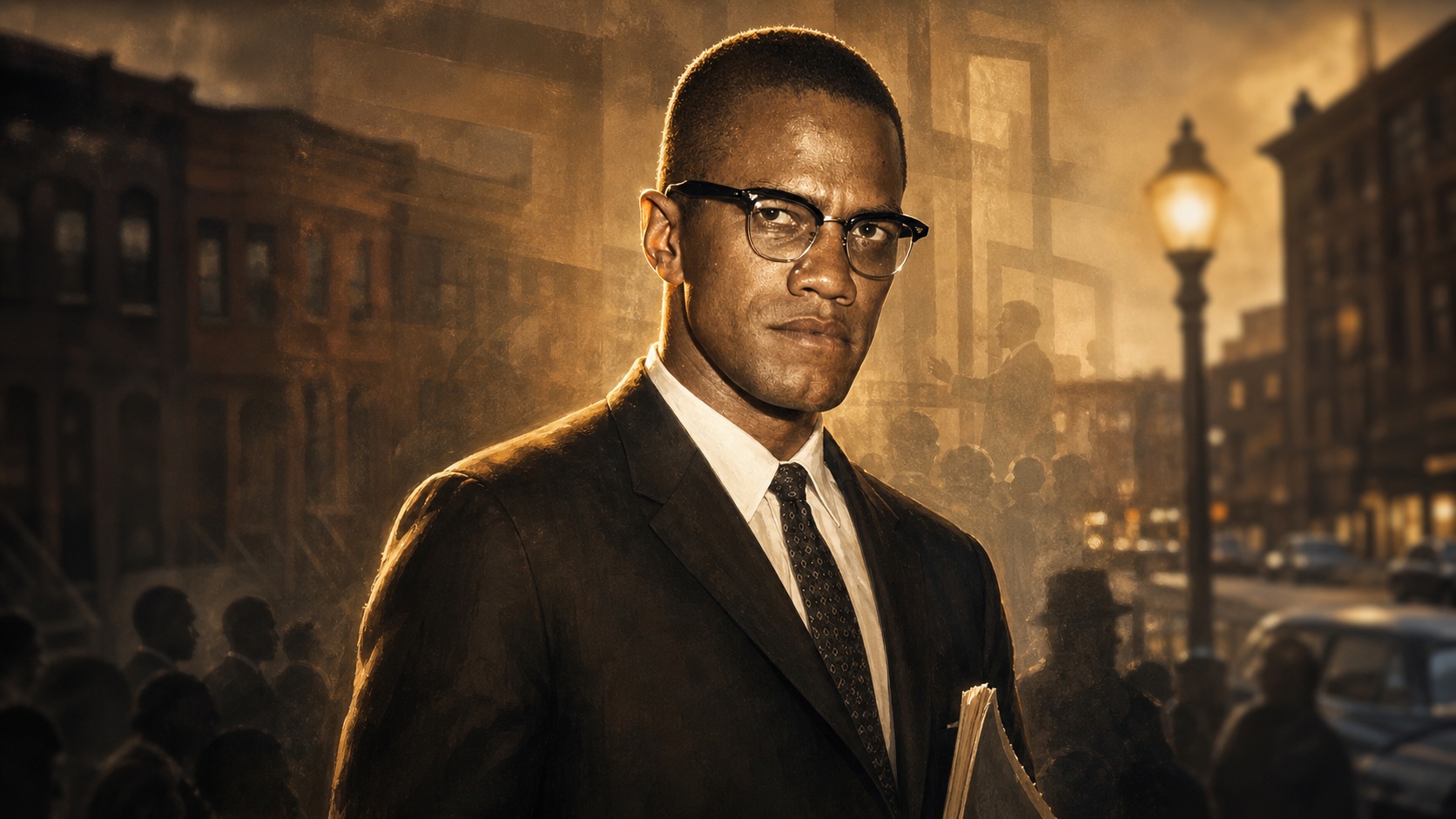
Malcolm X, born Malcolm Little and also known as El-Hajj Malik El-Shabazz, was one of the greatest and most influential Black Nationalist leaders in American history. Articulate, passionate and a naturally gifted and inspirational orator, Malcolm X served as a spokesman for the Nation of Islam, bringing the organization to national and international recognition.
Malcolm X was born on May 19, 1925, in Omaha, Nebraska. His mother, Louise Norton Little, was born in St. Andrew, Grenada, in 1897, and had been raised by her maternal grandmother, Mary Jane Langdon. Louise, as she was known, had a fair complexion and dark, long hair; in everyday encounters, she was often mistaken for being European. It was said that she was the product of her mother’s rape by a Scotsman. Louise had received an excellent elementary-level education, becoming a capable writer and fluent in French. Malcolm’s father, Earl Little, was an outspoken Baptist minister and avid supporter and organiser for Black Nationalist leader Marcus Garvey. Due to his father’s civil rights activism and Garveyite organising, the family faced frequent harassment from Euro-American supremacist groups such as the Ku Klux Klan and one of its splinter factions, the Black Legion. In fact, Malcolm X had his first encounter with racism before he was even born.
When my mother was pregnant with me, she told me later, a party of hooded Ku Klux Klan raiders galloped up to our home in Omaha, Nebraska, one night. Surrounding the house, brandishing their shotguns and rifles, they shouted for my father to come out. My mother went to the front door and opened it. Standing where they could see her pregnant condition, she told them that she was alone with her three small children and that my father was away, preaching in Milwaukee. The Klansmen shouted threats and warnings at her that we had better get out of town because “the good Christian [European] people” were not going to stand for my father “spreading trouble” among the good [Blacks] of Omaha with the “back to Africa” preaching of Marcus Garvey.”
When Malcolm was four, the house where he and his family lived in Lansing, Michigan, was burned down; his family believed white supremacists were responsible. When he was six his father met a violent death when he was struck by a streetcar. His mother and siblings always believed that racist enemies had killed him, but later biographical work has also pointed to the possibility of an “accidental” death within a climate of open racial terror and insurance disputes. His mother suffered an emotional breakdown several years after the death of his father and was committed to a mental institution. Malcolm and his siblings were split up among various foster homes and orphanages.
Malcolm attended West Junior High School, where he was the school’s only Black student. He excelled academically and was well-liked by his classmates, who elected him class president. However, he later said he felt his classmates treated him more like a class pet than a human being. The turning point in Malcolm X’s childhood came in 1939, when his English teacher asked him what he wanted to be when he grew up, and he answered that he wanted to be a lawyer. His teacher responded, “One of life’s first needs is for us to be realistic… You need to think of something you can be… why don’t you plan on carpentry?” Having thus been told in no uncertain terms that there was no point in a Black child pursuing education, he dropped out of school the following year, at the age of 15.
After quitting school, Malcolm moved to Boston to live with his older half-sister, Ella, about whom he later recalled, “She was the first really proud black woman I had ever seen in my life. She was plainly proud of her very dark skin. This was unheard of among [Blacks] in those days.” Ella landed Malcolm a job shining shoes at the Roseland Ballroom. However, out on his own on the streets of Boston, he became acquainted with the city’s criminal underground, soon turning to selling drugs. He got another job as kitchen help on the Yankee Clipper train between New York and Boston and fell further into a life of drugs and crime. Sporting flamboyant pinstriped zoot suits, he frequented nightclubs and dance halls and turned more fully to crime to finance his lavish lifestyle. Malcolm became a master manipulator, skilled in gambling, selling drugs, burglary and hustling. Eventually, he and his long-time friend, Malcolm “Shorty” Jarvis, were arrested and convicted on burglary charges. Malcolm was sentenced to 10 years in prison, but was granted parole after serving 7 years.
In prison, Malcolm underwent a conversion that literally transformed his whole life. To pass the time during his incarceration, he read constantly, devouring books from the prison library in an attempt to make up for the years of education he had missed by dropping out of high school. Also while in prison, he was visited by several siblings who had joined the Nation of Islam (NOI). Malcolm began studying the teachings of NOI leader Elijah Muhammad, who taught that European society actively worked to prevent African Americans from empowering themselves and achieving political, economic, and social success. By the time he was paroled in 1952, Malcolm was a devoted follower of the NOI. He abandoned his surname “Little,” which he considered a relic of the Maafa (Atlantic captivity), in favor of the surname “X”—a tribute to the unknown name of his African ancestors.
Malcolm was appointed as a minister and national spokesman for the Nation of Islam. Elijah Muhammad also charged him with establishing new mosques in cities such as Detroit, Michigan, and Harlem. Malcolm not only utilized newspaper columns, as well as radio and television, to communicate the NOI’s message across the United States, but also engaged in tireless ground-level organising—visiting homes, building local businesses, mentoring new converts and structuring temple life. His charisma, drive, and conviction attracted an astounding number of new members. Due largely to his efforts, the NOI grew from a mere 400 members at the time he was released from prison in 1952 to tens of thousands of members by 1960. Articulate, passionate and a naturally gifted and inspirational orator, Malcolm’s fame eventually eclipsed that of his mentor, Elijah Muhammad.
In 1963, Malcolm X became deeply disillusioned when he learned that his hero and mentor had violated many of his own teachings, most flagrantly by carrying on many extramarital affairs; Muhammad had, in fact, fathered several children out of wedlock. Malcolm was deeply hurt by Muhammad’s actions because he had previously considered him a living prophet. Malcolm also felt guilty about the masses he had led to join the NOI, which he now felt was a fraudulent organization built on too many lies to ignore. His growing criticism of Elijah Muhammad’s personal conduct unfolded against a backdrop of internal rivalries, regional tensions inside the Nation and anxiety about who might succeed the ageing Messenger.
Shortly after his shocking discovery, Malcolm received criticism for a comment he made regarding the assassination of President John F. Kennedy. “[Kennedy] never foresaw that the chickens would come home to roost so soon,” said Malcolm. After the statement, Elijah Muhammad “silenced” Malcolm for 90 days. Malcolm X, however, suspected he was silenced for another reason. In March 1964, Malcolm X terminated his relationship with the NOI. Unable to look past Muhammad’s deception, and determined to develop a broader political and spiritual vision, he decided to found his own religious organization, the Muslim Mosque, Inc., and soon after the secular Organization of Afro-American Unity (OAAU).
That same year, he went on a pilgrimage to Mecca, which proved to be life-altering for him. For the first time, Malcolm X shared his thoughts and beliefs with diverse cultures and found the response overwhelmingly positive. When he returned to the United States, Malcolm X said he had met “blonde-haired, blue-eyed men I could call my brothers,” which gave him a new outlook on integration and a new hope for the future. This time, when Malcolm X spoke, he no longer just preached to African Americans; he had a message for all races.
After resigning from his position in the Nation of Islam and renouncing Elijah Muhammad, relations between the two had become increasingly volatile. FBI and NYPD files, along with later biographies, reveal that both state agencies and hostile NOI elements were closely watching Malcolm. FBI informants working undercover in the NOI warned officials that Malcolm X had been marked for assassination—one undercover officer had even been ordered to help plant a bomb in his car.
After repeated attempts on his life, Malcolm X rarely traveled anywhere without bodyguards. On February 14, 1965, the home where he, Betty, and their four daughters lived in East Elmhurst, New York, was firebombed. Luckily, the family escaped physical injury.
One week later, however, his enemies were successful in their ruthless attempt. At a speaking engagement in Manhattan’s Audubon Ballroom on February 21, 1965, as he prepared to address a meeting of the OAAU, a staged disturbance in the audience drew his security’s attention and three gunmen rushed him onstage. They shot him multiple times at close range. The 39-year-old was pronounced dead on arrival at New York’s Columbia Presbyterian Hospital. One of the men, Talmadge Hayer (also known as Thomas Hagan or Mujahid Abdul Halim), admitted his role and identified other conspirators from the Newark mosque. Two others, Norman 3X Butler (later Muhammad Aziz) and Thomas 15X Johnson (later Khalil Islam), were convicted but always maintained their innocence; decades later, they were formally exonerated after a reinvestigation uncovered suppressed evidence and official misconduct. All three were members of the Nation of Islam, but later research and declassified documents have also highlighted the role of FBI and NYPD surveillance and negligence in creating the conditions for his assassination.
Fifteen hundred people attended his funeral in Harlem on February 27, 1965, at the Faith Temple Church of God in Christ (now Child’s Memorial Temple Church of God in Christ). After the ceremony, friends took the shovels away from the waiting gravediggers and buried him themselves. Later that year, Betty gave birth to their twin daughters.
Malcolm X’s legacy has endured across generations through numerous documentaries, books, and movies. A tremendous resurgence of interest occurred in 1992 when director Spike Lee released the acclaimed movie, Malcolm X. The film received Oscar nominations for Best Actor (Denzel Washington) and Best Costume Design. In recent years, new biographies such as Les and Tamara Payne’s The Dead Are Arising and Manning Marable’s Malcolm X: A Life of Reinvention, together with the ongoing exonerations related to his murder, have continued to reshape and deepen public understanding of his life and death.
Source:
Malcolm X and Alex Haley, The Autobiography of Malcolm X (1965).
Les Payne and Tamara Payne, The Dead Are Arising: The Life of Malcolm X (Liveright, 2020)
Manning Marable, Malcolm X: A Life of Reinvention (Viking, 2011)
New York Times, “A New Life of Malcolm X Brimming With Detail, Insight and Feeling” (review of The Dead Are Arising).
Wikipedia, “Assassination of Malcolm X.”
Smithsonian Magazine, “Two Men Wrongfully Convicted of Killing Malcolm X Are Exonerated.”
New York Times, “J. Edgar Hoover Hid That Malcolm X Witnesses Were F.B.I. Informants.”
Democracy Now!, “Malcolm X Assassination: New Details Pointing to FBI, NYPD.”