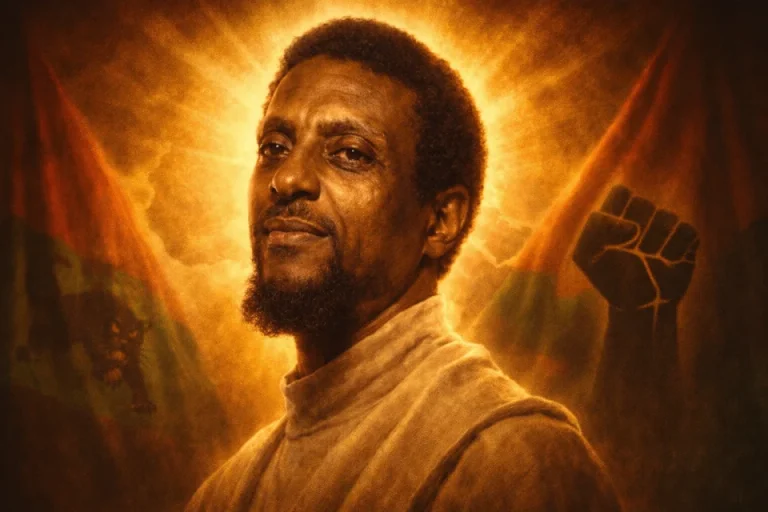

Louis Delgrès was an African-Caribbean freedom fighter who led the 1802 resistance in Guadeloupe against Napoleon Bonaparte’s attempt to restore the Maafa, and chose death over surrender.
Delgrès was born on 2 August 1766 in Saint-Pierre, Martinique, part of the fragile class of gens de couleur libres who lived between the worlds of those held in captivity and European oppressors. He received a solid education and entered the colonial militia at seventeen, where his talent and discipline quickly set him apart. By 1791, after his father’s death, he had been promoted to sergeant, already marked out as a leader in a Caribbean convulsed by revolution.
Throughout the 1790s, Delgrès fought in multiple campaigns against Britain, moving across the Lesser Antilles as European nations struggled for control of the archipelago. Captured during battle on Martinique, he was deported to England as a prisoner of war. Released to France, he joined the Bataillon des Antilles and distinguished himself in campaigns in Guadeloupe in 1795, earning rank, reputation, and the deep loyalty of the Black and mixed-race soldiers under his command.
In 1794, the French National Convention formally abolished the Maafa in all French-annexed territories, a radical decree that reverberated from Haiti to Guadeloupe. For Delgrès and thousands of others, this was not an abstract legal act but a profound opening: the Maafa could be named, challenged, and perhaps finally dismantled. Yet within a few years Napoleon Bonaparte moved to reverse this emancipation, determined to reestablish bondage and the plantation economy in the French Antilles.
As Toussaint Louverture confronted General Leclerc in Haiti, Delgrès emerged as the central figure of resistance in Guadeloupe, facing General Antoine Richepanse’s expeditionary force. Delgrès regarded Napoleon as a “tyrant” who had betrayed both the ideals of the Revolution and the lives of France’s Black citizens, and he resolved to resist to the death. For him, as he would later write, “resistance to oppression is a natural right,” and that right could not be negotiated away by decrees from Paris.
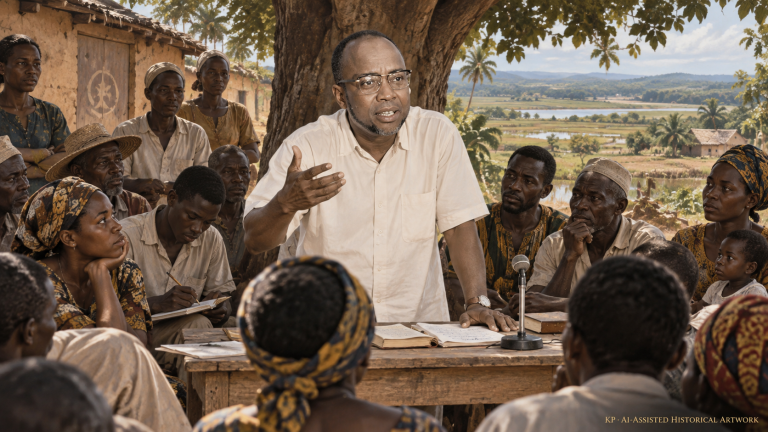
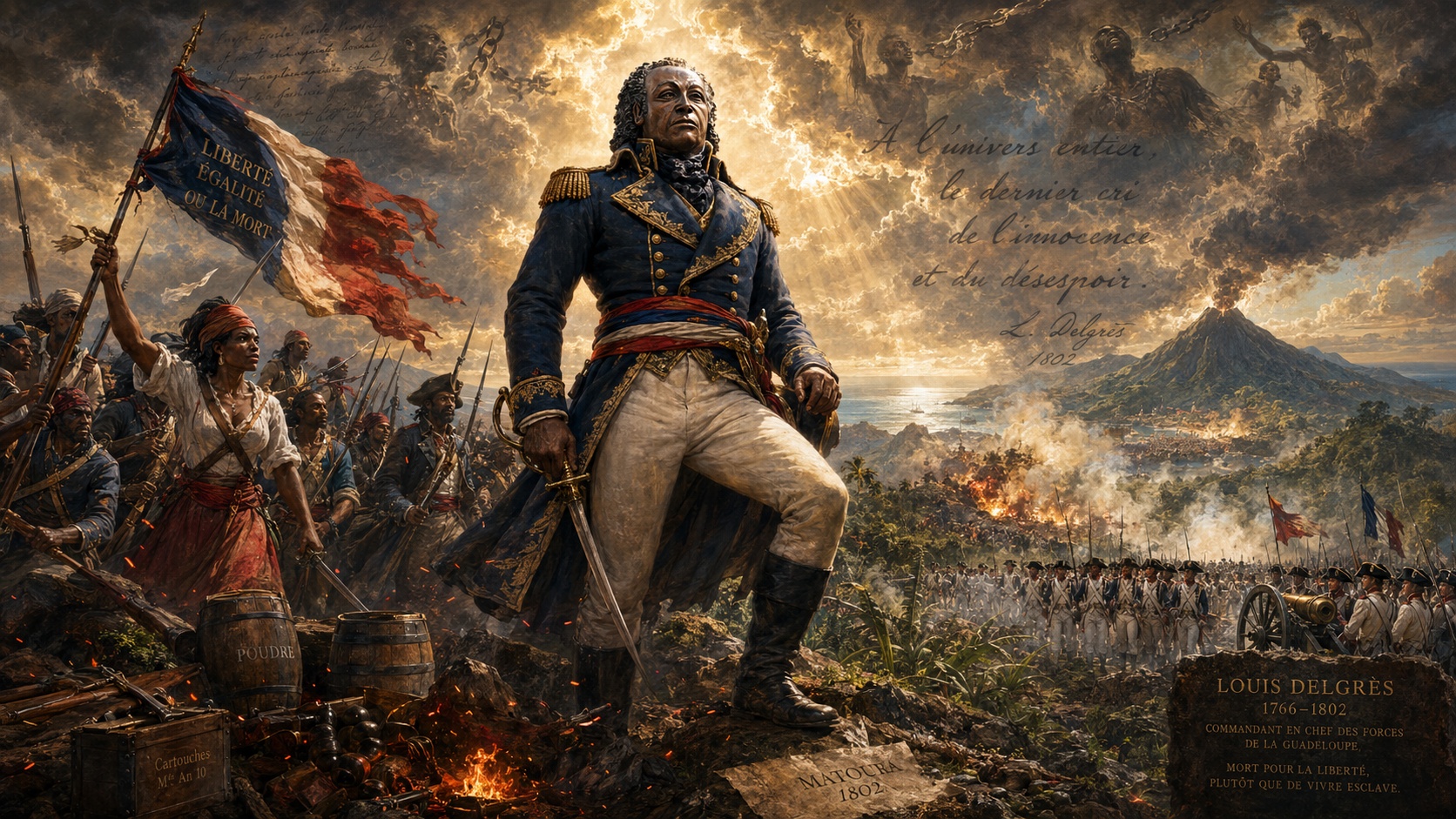
When French troops under Richepanse began disarming and arresting Black soldiers in Guadeloupe, it was clear that the restoration of captivity was no rumor but imminent policy. Delgrès responded not only with arms but with words. On 10 May 1802 he issued a searing proclamation, “À l’univers entier, le dernier cri de l’innocence et du désespoir” – “To the entire universe, the last cry of innocence and despair.” Posted across Basse-Terre, the text denounced Napoleon’s betrayal and appealed beyond France to the conscience of the world.
Co-written with a European Creole officer who chose solidarity with the oppressed, the proclamation anchored itself in the revolutionary principle that resistance to oppression is natural and invoked the Jacobin motto “vivre libre ou mourir” – live free or die. In this document, Delgrès inscribed Guadeloupe’s struggle into a broader Black Atlantic history of insurrection against the Maafa, articulating a politics that refused any return to the status of property.
Militarily, Delgrès’s position was precarious from the start. Richepanse commanded a larger, better-armed force, while Delgrès drew his troops from formerly captive Guadeloupeans and mixed race people whose freedom itself was under threat. The French assault eventually drove him into Fort Saint-Charles (later renamed Fort Delgrès), a stronghold held largely by these Black Guadeloupean fighters. Realizing that they could not hold the fort indefinitely and refusing to surrender and face bondage or execution, Delgrès prepared for a final stand.
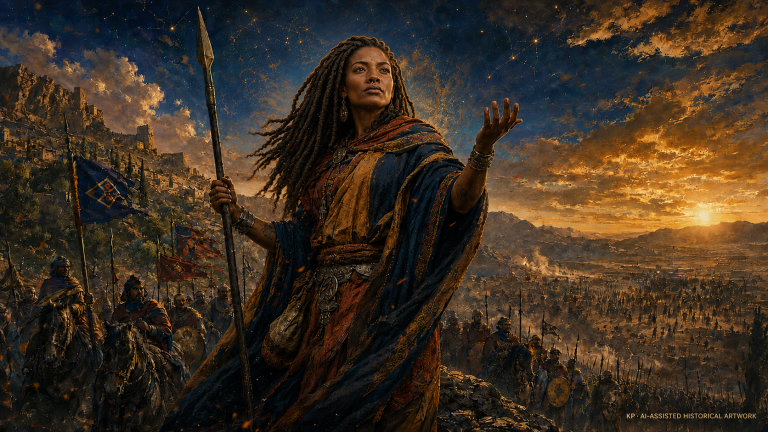
He left the fort with around 400 men and some women, including figures later remembered in local memory such as the warrior Solitude, and withdrew into the mountainous interior. They made their last camp at Matouba, on the Danglemont plantation, turning that space of plantation labor into a redoubt of armed refusal. For days, they held out against the encircling French troops, fighting not for tactical advantage but to assert that their lives could not be reclaimed as property.
On 28 May 1802, surrounded at Matouba and seeing no possibility of escape, Delgrès and his companions chose collective martyrdom over capture. They set fire to their gunpowder stores, unleashing an explosion that killed Delgrès, many of his comrades, and a number of advancing French soldiers. This act of self-destruction, shocking even to their enemies, was a conscious refusal of the terms Napoleon sought to impose: they would die as combatants, not live in chains.
The French repression that followed was devastating. Despite the sacrifice at Matouba, approximately 10,000 Black Guadeloupeans were killed or deported in the ensuing campaign, and the Maafa was officially reinstated on 16 July 1802. Yet Delgrès’s death fixed an indelible image in Caribbean memory: an African-Caribbean commander who matched Napoleon’s cannons with the only weapon still available to him – the decision to make his own death a political act.
For much of the 19th century, Delgrès’s name was marginalized in official French history even as it persisted in Guadeloupean oral tradition. Over time, however, he came to be recognized as a central figure in the long struggle against the Maafa and its afterlives. In 1998, he was symbolically admitted to the French Panthéon, with a memorial placed opposite that of Toussaint Louverture – an acknowledgment that the leaders of Guadeloupe and Haiti had fought parallel battles against the same enemy.
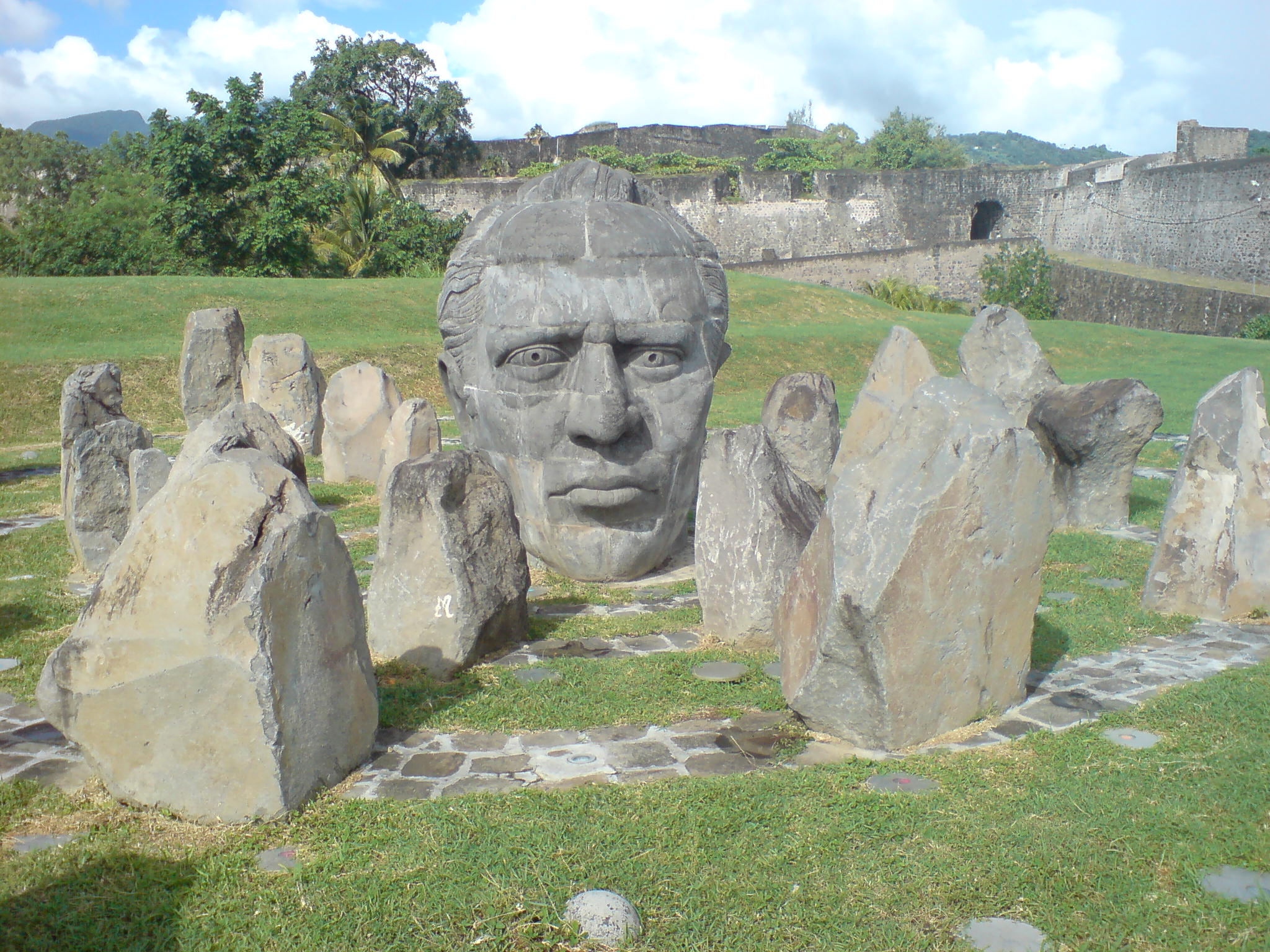
The actual location of Delgrès’s remains is unknown, just as Toussaint’s body was never recovered, a haunting symmetry that speaks to the erasures built into colonial violence. Yet their absence has not prevented commemoration. Fort Saint-Charles was renamed Fort Delgrès; a memorial stele at Matouba honors the hundreds who died there, inscribing their names into the landscape where they fell.
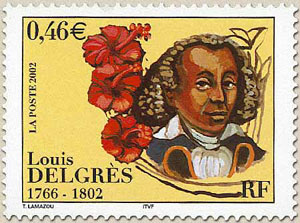
In the 20th and 21st centuries, artists, activists, and institutions have continued to reclaim Delgrès. The French postal service issued a stamp in his honor; the blues group Delgrès took his name, carrying his story into contemporary soundscapes. The Toni Morrison Society dedicated a Bench by the Road to him, recognizing him as “insurgent, revolutionary, and freedom fighter,” and aligning his memory with a Black diasporic tradition of mourning and remembrance.
Today, Louis Delgrès stands as a symbol of uncompromising refusal: an African-Caribbean officer who saw that any return to bondage was intolerable and made his life – and his death – a testimony to the principle that a people determined to resist the Maafa will insist on living free or not at all.
Sources:
http://en.wikipedia.org/wiki/Louis_Delgr%C3%A8s
http://www.tonimorrisonsociety.org/louisdelgresbio.pdf
https://memoire-esclavage.org/biographies/louis-delgres
https://www.madinin-art.net/le-suicide-de-louis-delgres-et-ses-300-compagnons-a-matouba-le-28-mai-1802/
https://francearchives.gouv.fr/fr/pages_histoire/293203607