
Vicente Guerrero was one of the principal military leaders of Mexico’s struggle for independence and the country’s second president. A national hero in Mexico, he took office on 1 April 1829 and remains widely recognized as one of the earliest presidents of African descent in the Americas. The modern Mexican state of Guerrero, created after his death, bears his name.
Guerrero was born in Tixtla, near Acapulco, then part of New Spain and now in the state of Guerrero. Accounts of his family background vary, but he is generally understood to have been of mixed African, Indigenous, and European descent. In a society ordered by colonial racial hierarchies, his rise from a modest family to national leadership was extraordinary.
When the independence movement began in 1810, Guerrero joined the insurgency. He later served under José María Morelos, the priest, military commander, and political thinker who became one of the revolution’s most consequential leaders. After Morelos was captured and executed in 1815, Guerrero continued the struggle in southern Mexico. Through years of military campaigning, shifting alliances, and guerrilla warfare, he helped preserve the insurgent cause until independence was achieved in 1821.
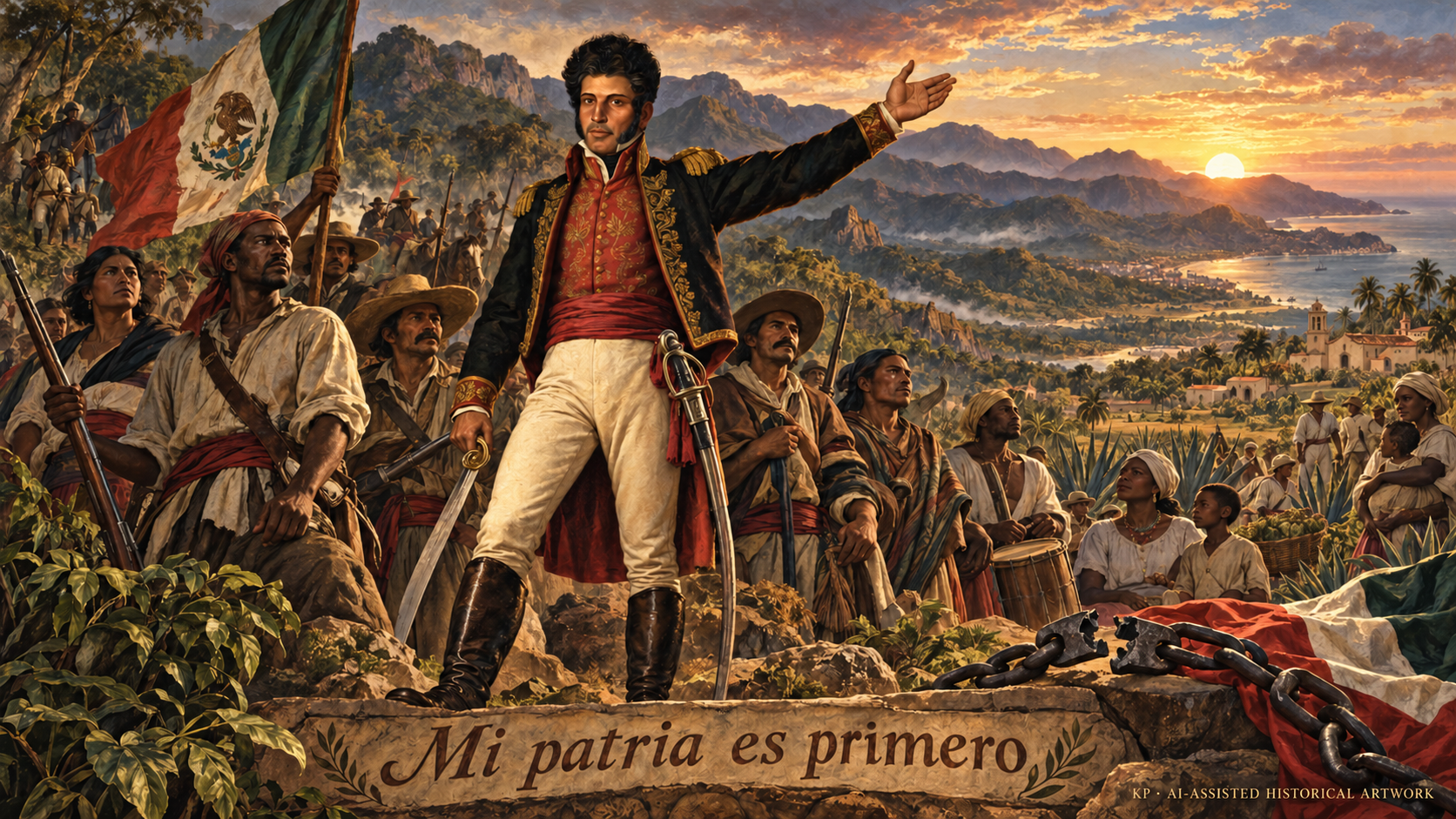
One of the most enduring stories associated with Guerrero concerns his father’s appeal for him to abandon the insurgency and accept the terms offered by the Spanish authorities. The episode is remembered through the phrase “Mi patria es primero”—“My country comes first.” Commemoration and patriotic memory have reshaped the precise wording and circumstances, but the phrase became central to Guerrero’s public legacy and is now the motto of the state named for him.
Following independence, Mexico entered a period of political instability. Guadalupe Victoria became the republic’s first president in 1824. In the contested election of 1828, Manuel Gómez Pedraza initially prevailed over Guerrero, but political unrest prevented Gómez Pedraza from taking office. Congress annulled the election and named Guerrero president, with Anastasio Bustamante as vice president. Guerrero began his term on 1 April 1829.
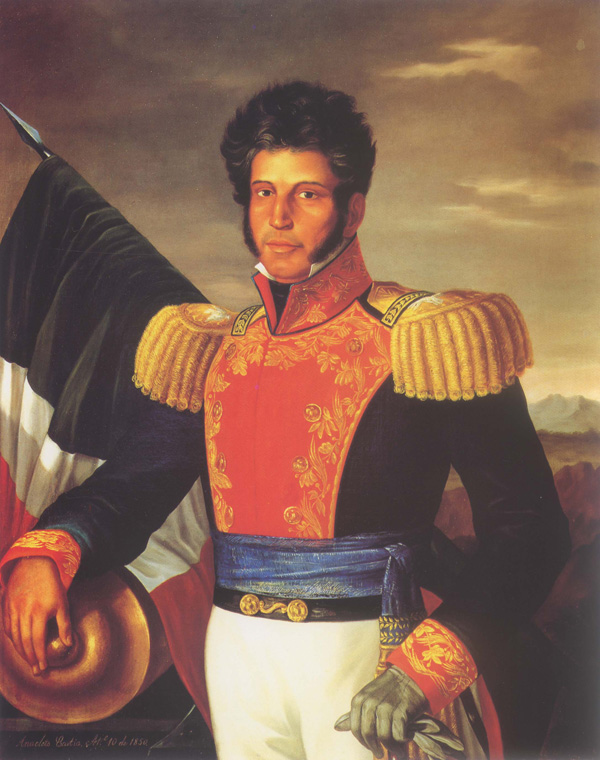
Guerrero’s presidency was brief, lasting until December 1829, but it was consequential. His administration pursued measures associated with liberal reform and social equality, including efforts to expand public education, curb the death penalty, protect poorer citizens, and limit entrenched privilege. He often signed his correspondence “Citizen Guerrero,” signaling his identification with republican citizenship rather than inherited rank.
His most celebrated act came on 15 September 1829, when he issued a decree abolishing captivity (the Maafa) in the Mexican Republic. The decree reaffirmed anti-Maafa principles already proclaimed by insurgent leaders such as Miguel Hidalgo and José María Morelos during the independence struggle, but Guerrero’s government gave those principles renewed force at the national level. The decree initially exempted the Isthmus of Tehuantepec, and its application in Texas—then Mexican territory—became a major point of contention.
The decision alarmed many Anglo-American colonists in Texas, among whom captors held considerable influence. Mexican authorities later made concessions regarding people already held captive in Texas, but the controversy reinforced American settler opposition to Mexican rule. In December 1829, Bustamante and his allies launched the Plan of Jalapa, a rebellion that forced Guerrero from power.
Guerrero returned to armed resistance against the government that replaced him. In January 1831, he was betrayed by Francisco Picaluga, a Genoese sea captain who lured him aboard his vessel and handed him over to government forces. Guerrero was taken to Cuilápam, Oaxaca, subjected to a military trial, and executed by firing squad on 14 February 1831.
Guerrero’s life joined the unfinished struggles of Mexican independence: political sovereignty, the abolition of the Maafa, equality before the law, and the promise that citizenship should not be confined by race, birth, or social rank. His legacy remains especially significant in the history of Afro-Mexican people, whose presence and contributions have too often been marginalized in narratives of Mexico’s national past.
Sources:
http://www.theroot.com/articles/history/2012/11/north_americas_1st_black_president_100_amazing_facts_about_the_negro.html
http://beyondvictoriana.com/2013/02/18/the-americas-first-black-and-native-president-vicente-guerrero/
https://www.inehrm.gob.mx/work/models/inehrm/Resource/437/1/images/el_pais_en%20formacion.pdf