
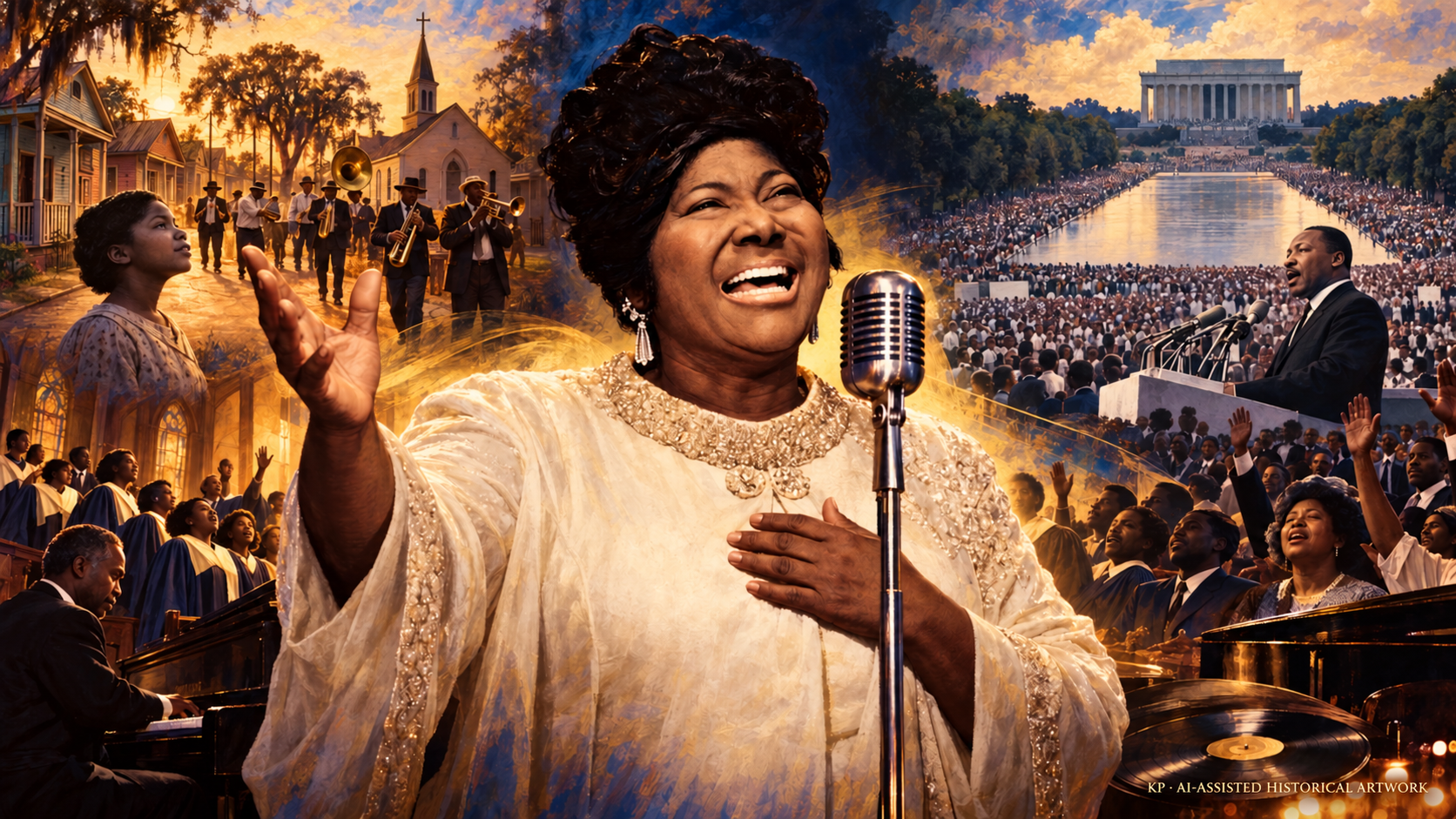
Mahalia Jackson was gospel music’s first superstar and is widely regarded as the greatest gospel singer ever. Entertainer Harry Belafonte described her as “the single most powerful Black woman in the United States.” With her rich contralto voice and deeply expressive delivery, she carried Black church music to international audiences, recording about thirty albums and earning a dozen gold records during her career.
Born in New Orleans and raised in a devout Baptist household, Jackson drew inspiration from church hymns, Bessie Smith’s blues recordings, and the musical traditions of her native city. After moving to Chicago as a teenager, she developed a distinctive style whose Southern rhythms and emotional intensity initially challenged conventions in some Northern churches. Her breakthrough recording, “Move On Up a Little Higher,” brought her national fame in the late 1940s and helped establish gospel as a major commercial force. Yet she remained steadfast in her commitment to sacred music, resisting lucrative offers to pursue a secular career.
Beyond the concert stage and recording studio, Jackson became a devoted supporter of the civil rights movement and a close friend of Martin Luther King Jr. She raised funds, sang at rallies, and brought spiritual encouragement to those confronting racial injustice. Her performances at the 1963 March on Washington and King’s 1968 funeral placed her voice at the heart of two defining moments in American history.
A New Orleans Childhood
Born Mahala Jackson on October 26, 1911, in New Orleans, Louisiana, she grew up in the city’s Uptown Carrollton area, in the Black Pearl section. Her family called her “Halie”; she later added an “i” to her first name. Her mother, Charity Clark, worked as a maid and laundress. Her father, John A. Jackson Sr., worked as a stevedore and barber, later became a Baptist minister, but lived separately from the household where she was raised.
Jackson’s early life was marked by poverty, crowded housing, and work that began long before adulthood. After her mother died when she was five, her maternal aunt, Mahala “Duke” Paul, took her in. Aunt Duke ran a strict household, enforced religious observance, demanded labor, and harshly punished disobedience. Jackson scrubbed floors, helped with laundry, and performed other exhausting chores. Work repeatedly interrupted her schooling, which ended while she was still a child. Music offered an emotional and spiritual world beyond those restrictions. She sang in Baptist churches from an early age, absorbing the rhythms of congregational worship and the expressive force of hymns passed between a leader and the congregation. Nearby Pentecostal worship exposed her to tambourines, shouting, and an uninhibited physical response to faith. Outside the sanctuary, New Orleans brass bands and funeral processions gave her another education in the relationship between music, grief and celebration.
Although her family forbade secular entertainment at home, Jackson listened to blues records when she could. Bessie Smith particularly captivated her. She admired not simply Smith’s powerful voice but the emotional truth of her delivery—the ability to make a listener feel that a song came from lived experience. Jackson would reject a career in secular music, but the blues remained part of her musical vocabulary. Her gospel singing drew strength from the same expressive resources: moans, cries, rhythmic freedom and notes shaped around feeling rather than convention.
Finding Her Voice in Chicago
In the late 1920s, Jackson joined the Great Migration north, moving to Chicago as a teenager to live with relatives. Like many Black Southerners, she brought cultural traditions that would reshape the city. But the transition was difficult. Chicago’s winter, unfamiliar surroundings, and distance from New Orleans left her homesick. The church became her first source of belonging.
At Greater Salem Baptist Church, her singing quickly attracted attention. She joined the choir and subsequently performed with the Johnson Singers, an early Chicago gospel group. Church programs, religious gatherings, and community events became her training ground. These were not glamorous engagements, but they taught her how to hold an audience and make a song speak directly to its circumstances.
Not everyone welcomed her style. Some Northern congregations favored restrained singing and formal arrangements. Jackson’s clapping, movement, and full-bodied delivery seemed too Southern, too emotional, or too close to the blues. A classical singing teacher also urged her to change her approach. She refused to surrender the qualities that made her voice distinctive. When challenged about her expressive church singing, she answered, “This is the way we sing down South!”
That refusal became a defining principle. Jackson was willing to develop her artistry, but she would not accept that refinement required distance from the Black Southern church. Her authority rested in the conviction that the sounds of her upbringing were neither embarrassing nor artistically inferior.
Thomas A. Dorsey and the Making of Gospel History
Jackson found an important collaborator in Thomas A. Dorsey, the former blues musician who became a central architect of modern gospel. Dorsey combined sacred texts with the rhythmic and harmonic language of the blues. Jackson possessed the voice and interpretive imagination to make that combination compelling.
Their early work was practical and unpretentious. She sang his compositions while he promoted sheet music, sometimes on Chicago street corners. They traveled to churches, conventions, and revivals, helping build an audience for a style that religious institutions did not always welcome immediately. Their partnership helped establish solo gospel blues as a major force in Black sacred music.
Dorsey also encouraged Jackson to explore slower songs. Rather than relying only on excitement and speed, she learned to give a phrase room to gather emotional weight. A held note, a delayed entrance, or a repeated line could become the center of a performance. His compositions gave her material through which she could turn personal feeling into a shared experience of grief, endurance and reassurance.
For years, musical work remained financially uncertain. Jackson supported herself through domestic service, laundry work and other employment. She later trained as a beautician and opened a salon in Chicago’s Bronzeville neighborhood. The business provided income while becoming a gathering place for gospel musicians. Her working life, hospitality and artistic ambitions developed together, rooted in the community that sustained her.
“Move On Up a Little Higher”
Jackson made her first commercial recordings for Decca in 1937, but national recognition came a decade later. After joining Apollo Records, she recorded “Move On Up a Little Higher” in 1947. Its extraordinary success changed both her career and gospel music’s commercial standing. The recording sold millions and introduced her to listeners far beyond the churches and revival meetings where she had built her reputation.
The performance captured the urgency and release that made Jackson remarkable. Its spiritual promise was inseparable from its momentum: the voice seemed to be moving toward the freedom the words described. Listeners did not need to share her religious background to understand its emotional power.
Her success proved that a gospel singer could command a national market without turning away from sacred music. Radio exposure and touring expanded her audience, and in October 1950 she performed at Carnegie Hall before a racially integrated audience. A successful European tour followed in 1952. The singer who had once struggled for recognition in Chicago churches was becoming an international figure.
Jackson signed with Columbia Records in 1954. The label brought greater promotional reach and broader arrangements, while radio and television made her a familiar presence in American homes. She appeared on major entertainment programs, including The Ed Sullivan Show, and her recordings reached audiences who might never have attended a gospel concert.
An Art Built on Feeling
Jackson’s rich contralto was powerful, but volume alone did not explain her effect. She understood a lyric’s dramatic possibilities. She might begin quietly, repeat a phrase with a different emphasis, suspend the rhythm and then release the song into a surge of sound. Her use of melisma—stretching a syllable across several notes—served emotional expression rather than ornament for its own sake.
Her longtime pianist, Mildred Falls, was essential to this freedom. Their partnership depended on close attention and instinctive communication. Because Jackson varied her phrasing and did not perform a song identically each time, Falls followed her breathing, gestures and musical direction, providing accompaniment flexible enough to support spontaneous invention.
Jackson’s performances were physical as well as vocal. Hands, feet, posture and facial expression carried meaning. She did not separate the singing body from the believing person. The result could make a concert hall feel like a place of worship without requiring every listener to experience it in the same way.
Her influence traveled into rhythm and blues, soul and rock and roll. Singers including Aretha Franklin, Mavis Staples and Little Richard inherited or adapted aspects of her emotional directness and vocal freedom. Jackson remained a gospel artist, but her artistry reached beyond the boundaries she maintained in her own career.
Sacred Conviction on a World Stage
Jackson repeatedly resisted pressure to pursue more lucrative secular opportunities. Her commitment did not mean avoiding all artistic exchange. Instead, she sought ways to enter new settings without abandoning her music’s spiritual purpose. Her collaboration with Duke Ellington demonstrated that distinction. On his 1958 recording of Black, Brown and Beige, her performance of “Come Sunday” brought gospel feeling into conversation with jazz. The collaboration honored their shared musical inheritance while allowing Jackson to remain within a sacred framework.
Cinema offered another setting for her voice. In Imitation of Life (1959), she sang “Trouble of the World” during the funeral sequence, giving the scene a gravity rooted in Black religious expression. Her on-screen appearances and festival performances expanded gospel’s visibility without reducing it to a novelty in popular entertainment.
She also sang at President John F. Kennedy’s inauguration celebrations in 1961. Yet prestigious invitations did not displace the church benefits, movement gatherings, and community commitments that remained central to her life.
A Voice for Black Freedom
For Jackson, faith and the civil rights struggle were closely connected. Her friendship with Martin Luther King Jr. developed into a partnership of practical and spiritual importance. She performed at movement events, helped raise money and offered encouragement to people confronting intimidation, imprisonment and racial violence.
She supported the Montgomery bus boycott and sang at the 1957 Prayer Pilgrimage for Freedom in Washington. She also helped fundraise for the Southern Christian Leadership Conference and supported people whose pursuit of civil rights threatened their livelihoods. Her prominence attracted attention; her willingness to give made that attention useful.
Jackson encountered racism in her own life despite her fame. When she moved into a previously European Chicago neighborhood, her home became a target of racial hostility. International acclaim did not shield her from the conditions she opposed.
Her most celebrated movement appearance came at the March on Washington for Jobs and Freedom on August 28, 1963. At King’s request, she sang “I Been ’Buked and I Been Scorned,” followed by “How I Got Over” after the audience called for more. Her performance connected the gathering’s political demands with the spiritual language of endurance and deliverance.
During King’s address, she famously called, “Tell ’em about the dream, Martin!” Her encouragement became part of the history of the speech, associated with his movement away from the prepared text into its soaring “I have a dream” passage. She was not the speech’s author, but a trusted presence who recognized and encouraged his gifts as a preacher. King later acknowledged how profoundly her singing had affected him. In a January 1964 letter, he wrote that if the occasion had been his greatest hour, “you, more than any single person helped to make it so.”
After his assassination in April 1968, Jackson sang Dorsey’s “Take My Hand, Precious Lord” at his funeral. The song brought together the defining commitments of her life: gospel music, friendship, faith and the struggle for Black dignity.
Private Struggles and Public Generosity
Jackson’s professional strength coexisted with personal disappointment. Her first marriage, to Isaac “Ike” Hockenhull in 1936, suffered partly from disagreements over her musical direction and his pressure to pursue opportunities outside gospel. Her second marriage, to Sigmond Galloway in 1964, also ended in divorce.
She nevertheless created a generous domestic world around herself. Friends, relatives, musicians and visitors knew her hospitality, especially her love of cooking and feeding others. Her concern for young people also took practical form. Through her foundation and other charitable work, she supported college education for Black students and used benefit performances to raise scholarship funds. Having lost her own opportunities for sustained schooling, she helped others gain theirs.
Her 1966 autobiography, Movin’ On Up, placed her extraordinary journey—from a difficult New Orleans childhood to international recognition—before a wider readership.
Final Years and Enduring Influence
Illness increasingly constrained Jackson’s later life. Sarcoidosis, heart trouble and other health problems led to hospitalizations and interrupted her work. Even so, she continued performing and traveling, undertaking overseas engagements as late as 1971. Her final public concert took place in Munich that year.
She died on January 27, 1972, at age 60. Memorial observances in Chicago and New Orleans drew large crowds, reflecting the affection she commanded as both a world-renowned artist and a figure rooted in Black community life. She was buried at Providence Memorial Park in Metairie, Louisiana.
Her honors include three competitive Grammy Awards and a Grammy Lifetime Achievement Award. Her recordings have received national preservation recognition, and her induction into the Rock and Roll Hall of Fame acknowledged an influence that extended well beyond gospel.
Yet her legacy is most clearly heard in the music itself. Jackson made sacred song intimate enough to comfort an individual and expansive enough to sustain a mass movement. She brought Black church music to international audiences without treating its origins as something to outgrow. In her voice, sorrow never excluded hope, and faith never required indifference to injustice. That union of artistic freedom and moral conviction remains the foundation of her enduring power.
Source:
http://www.biography.com/people/mahalia-jackson-9351242
https://en.wikipedia.org/wiki/Mahalia_Jackson
https://64parishes.org/entry/mahalia-jackson?gad_source=1&gad_campaignid=19552185350&gbraid=0AAAAApCZt2OBCWd6FUnc9VT_P2r3AbDLN&gclid=CjwKCAjw9PvWBhAxEiwAddzYyfWJIPnSGhbex4gt3fVsfPeJTYENRpDposbJEdAmrqC_db5N-t7VfhoCP5gQAvD_BwE
https://nmaahc.si.edu/explore/stories/mahalia-jackson-gospel-takes-flight
https://www.britannica.com/biography/Mahalia-Jackson
https://www.biography.com/musicians/mahalia-jackson