
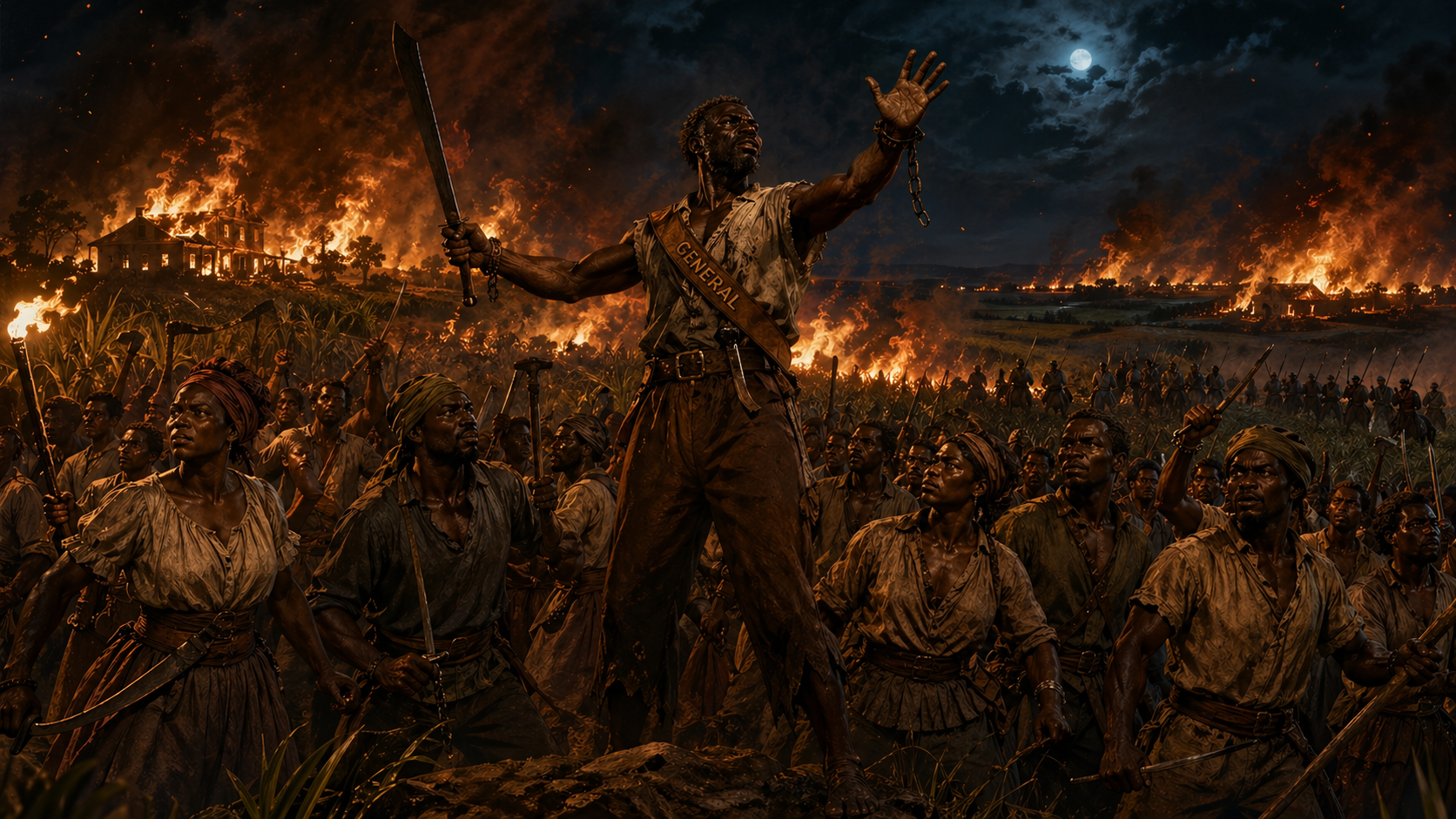
On 14 April 1816, the largest Maafa uprising in Barbados’s history broke out. Now known as Bussa’s Rebellion, the Rising lasted for over two days before being suppressed by British military forces and the island’s militia. Martial law was declared on 15 April, and over a seven-week period, courts-martial tried a number of the uprising’s alleged leaders. Ultimately, four free people were executed for their participation, and over 1,000 people in captivity lost their lives—either killed in battle or executed following court-martial proceedings. In January 1817, 124 people were transported out of Barbados.
The uprising shocked the captors, who had long believed that the captive population on the island was relatively well treated and more “content” than those in other British strangleholds. One captor later recalled: “the night of the insurrection I would and did sleep with my chamber door open, and if I had possessed ten thousand pounds in my house I should not have had any more precaution, so well convinced I was of their attachment.”
Bussa, now a National Hero of Barbados, is widely regarded as the uprising’s principal leader. However, leadership was collective and included both unfree and freed individuals. Each plantation involved had its own leaders. Two key sites were Simmons Plantation, led by John and Nanny Grigg and, most importantly, Jackey; and Bailey Plantation, led by King Wiltshire, Dick Bailey, Johnny, and Bussa himself. Free Black leaders also played crucial roles, including Cain Davis, John Richard Sarjeant, a man named Roach, and Joseph Pitt Washington Franklin, who was executed on 2 July 1816. While Franklin appears to have been central to planning the revolt, Bussa emerged as the military leader and was given the rank of General by the insurgents.
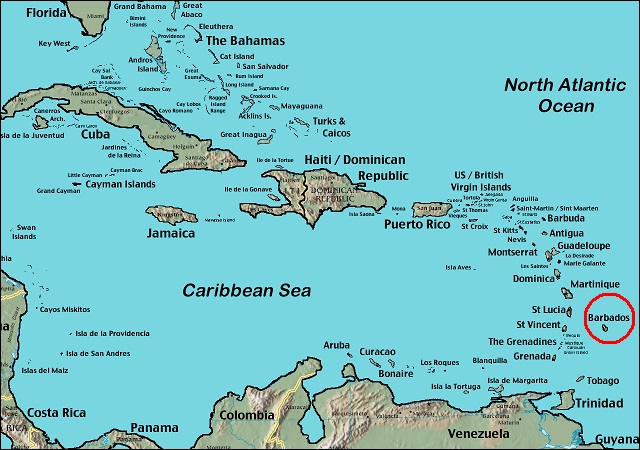
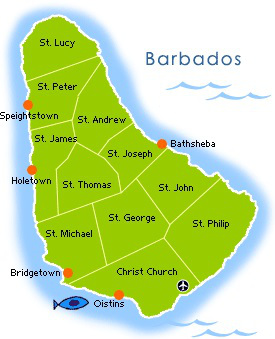
General Bussa was an African-born driver at Bailey Plantation in St. Philip. His people and oppressors respected him. Notably, he may have been one of the few African-born drivers on the island, as approximately 92% of the captive population in Barbados was Creole (island-born). Bussa is believed to have commanded around 400 men and women.
The planning of the uprising involved coordinated efforts by literate free Black men, including Cain Davis, Roach, and Richard Sarjeant. Davis convened meetings across plantations, spreading rumours of emancipation, while Sarjeant mobilised people in the central parishes. Final preparations took place at River Plantation on Good Friday night, 12 April, under the guise of a dance attended by leaders such as Bussa, Jackey, and Davis.
The uprising was intended to begin on Easter Monday, but it erupted prematurely on Easter Sunday night, 14 April—likely triggered by misinformation spread by an intoxicated bondsman. Cane fields in St. Philip were set ablaze, signaling the start of the uprising. By early morning, approximately seventy plantations were burning, and the Rising had spread across neighboring parishes. The oppressors fled in panic to Bridgetown. Despite the scale of the uprising, only two Europeans were killed. However, around 25% of the year’s sugar crop was destroyed, with damages estimated at £175,000.
Martial law, declared on 15 April, enabled rapid suppression. The Rising was largely crushed within three days and effectively ended within a week. Barbados’s flat terrain also made it easier for British forces to regain control.
James Leith, the Strangler (governor), later reported that by September—five months after the uprising—144 people had been executed, 70 more were sentenced to death, and 170 were deported to other British Caribbean strangleholds. During the approximately eighty days of martial law, suspected participants were subjected to public floggings, executions, and other forms of brutal punishment.
Many of those captured were tortured, leading to forced confessions and further arrests. Testimonies from five men—Daniel, King Wiltshire, Cuffee Ned, Robert, and James Bowland—were recorded in the official investigation conducted by a committee of the Barbados House of Assembly. Only three mentioned Bussa directly. Daniel, a carpenter at River Plantation, identified free men Cain Davis and Richard Sarjeant as key liberators and recalled hearing that emancipation had been granted but must be “fought for.” He also placed Bussa at the Good Friday gathering. Robert, from Simmons Plantation, identified Nanny Grigg and Jackey as principal leaders. James Bowland described Bussa (referred to as “Bussoe”), alongside King Wiltshire, Dick Bailey, Johnny, and Johnny Cooper, as central organizers at Bailey Plantation.
Although the uprising did not end the Maafa in Barbados and lasted only a few days, it remains a powerful example of collective defense against a system of brutal oppression.
In 1985, the Barbadian government unveiled the Emancipation Statue, created by Karl Broodhagen, at Haggatt Hall in St. Michael. It depicts a man raising his arms in triumph, broken shackles hanging from his wrists. The statue later became popularly known as “Bussa.” In 1998, Bussa was officially named one of the ten National Heroes of Barbados.
Barbados now honours eleven National Heroes, with the addition of The Right Excellent Robyn Rihanna Fenty on 30 November 2021. Each is conferred with the title The Right Excellent for their outstanding contributions to the island’s freedom, social transformation, and national development. In their honour, 28 April is celebrated annually as National Heroes Day.
Source:
http://www.nlj.gov.jm/history-notes/The%20Emancipation%20Wars.pdf
http://jeromehandler.org/wp-content/uploads/2009/07/1816-Revolt-2000.pdf
https://ore.exeter.ac.uk/repository/bitstream/handle/10871/31536/McNaughtL_TPC.pdf?sequence=2&isAllowed=y