

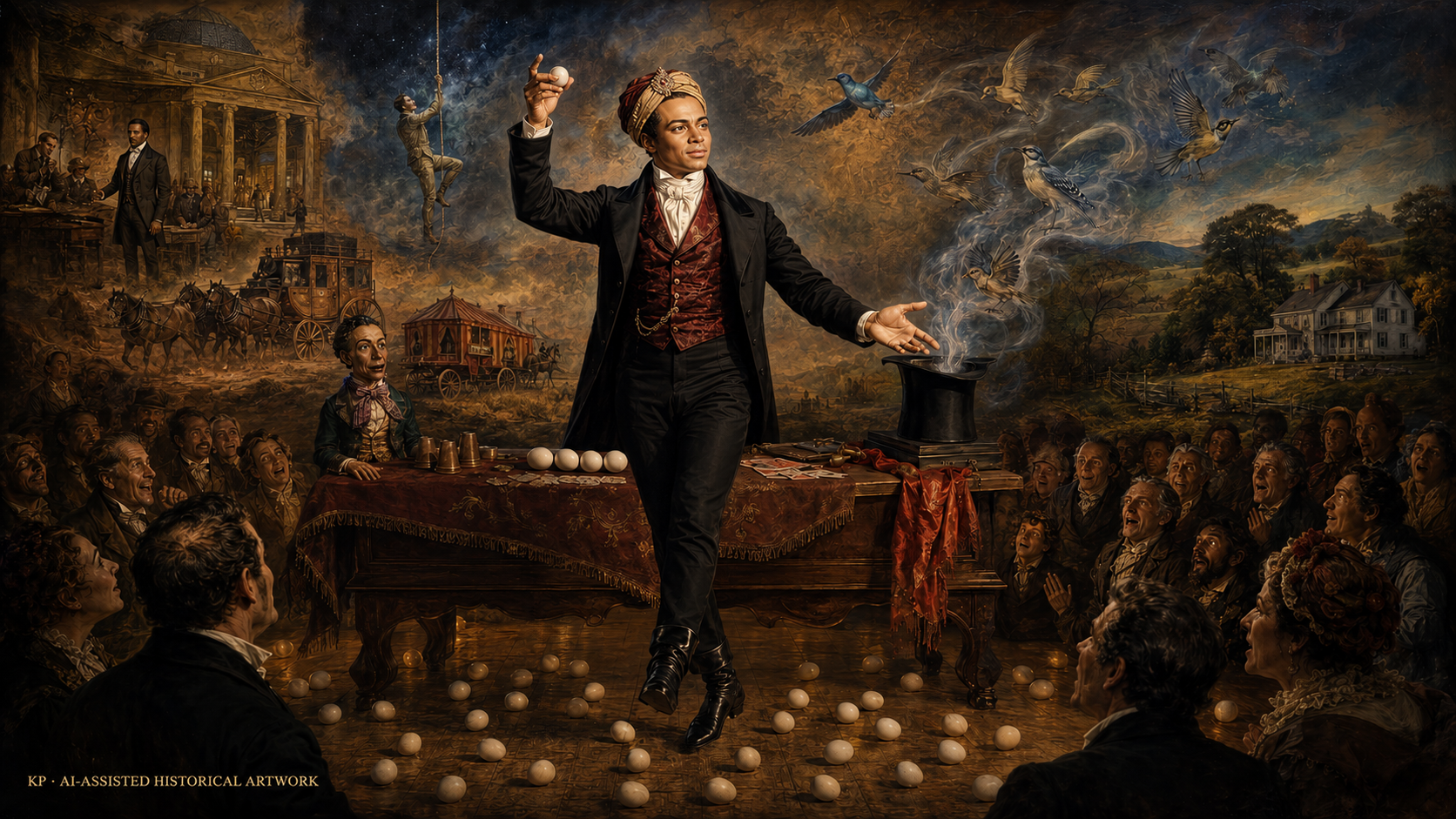
Richard Potter, c. 1783–1835, was a pioneering magician, ventriloquist, and humorist. Widely regarded as the first American-born professional magician to achieve national fame, later historians have also described him as America’s first Black celebrity. Potter styled himself the “Emperor of Conjurors” and became one of the best-known entertainers in the United States during the early nineteenth century. His fame was such that Potter Place in Andover, New Hampshire, still bears his name.
His repertoire reportedly included placing his hands in molten lead, apparently crawling through a solid log, making voices issue from spectators’ hats, and dancing on eggs without cracking their shells. His best-documented specialty was ventriloquism: advertisements described him as throwing his voice into different parts of a room, into hats and trunks, and imitating birds and animals so convincingly that audiences struggled to distinguish imitation from reality.
Potter was born around 1783 in Hopkinton, Massachusetts. His mother, Dinah, was an African woman held in captivity by Charles Henry Frankland, the British customs officer at the Port of Boston before the American Revolution. Historian John A. Hodgson reports that his mother had been trafficked from the Guinea coast as a young teenager and brought to Boston. He had four older sisters born before him. Potter’s paternity has long been uncertain. However, Hodgson identifies his father as Euro-American and a member of a local Massachusetts family with a wife and ten children, and suggests that he probably fathered both Richard and Richard’s younger brother with Potter’s mother. Potter’s paternity has long been uncertain. Older accounts connected him to Frankland’s family, while more recent research has identified George Simmons as his likely father.
At about the age of ten, Potter is believed to have traveled to Britain as a cabin boy with Captain Skinner, a friend of the Frankland household. There, according to accounts of his life, he encountered the Scottish magician and ventriloquist John Rannie. Potter subsequently toured Britain and Europe as Rannie’s assistant, acquiring skills in conjuring, ventriloquism, rope dancing, and stage performance. Around 1800, Potter and Rannie traveled to the United States and joined a traveling circus.
On 25 March 1808, Potter married Sally Harris, who became his stage assistant. Older accounts have described her as Native American or Penobscot, but Hodgson’s research identifies her as a woman of mixed African and European ancestry. They had their first son the following year.
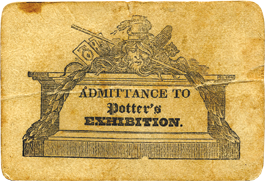
When Rannie returned to Scotland in early 1811, Potter began to establish himself as an independent performer. In November 1811, he appeared in Boston, where his programs of magic and ventriloquism were advertised as “one hundred curious experiments with money, eggs, cards and the like.”
Ventriloquism was still a startlingly new public entertainment for many audiences. Potter’s performances involved voices seemingly emerging from hats, trunks, teapots, distant rooms, and unseen people upstairs. He also imitated birds and animals, combining technical skill with comedy, music, illusion, and showmanship.
Publicity often exploited Potter’s appearance. Advertisements called him a “Black Yankee,” while some audiences or promoters represented him as Native American, Asian, or “Hindoo.” He sometimes performed in a turban, and he was also said to have encouraged mystery about his origins, including the improbable claim that he was Benjamin Franklin’s son. These presentations reflected an era in which audiences associated supposedly “exotic” identities with supernatural knowledge and “real” magic.
Potter performed in Boston, throughout New England, elsewhere in the United States, and in Canada. He traveled widely for nearly three decades and achieved remarkable financial success, but celebrity did not protect him from racism. In Mobile, Alabama, for example, an inn refused him accommodation because of their racism. Yet the engagement was highly profitable: one account reports that he earned $4,800 during a 20-day stay. Fearing robbery, he reportedly left the city during the night and traveled in the opposite direction from his next advertised destination.
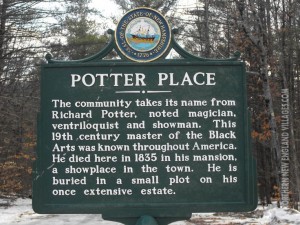
By 1814, Potter had acquired approximately 175 acres in Andover, New Hampshire, where he built an elaborate home and estate known as Potter Place. The house no longer survives, but the site remains associated with him, and the Andover Historical Society maintains the Potter family burial ground.
Richard Potter died on 20 September 1835, aged fifty-two. Sally died the following year. Their graves are now at Potter Place in Andover. Richard Potter’s stone reads: “In memory of Richard Potter, the Celebrated Ventriloquist.”
Source:
http://scottishrite.org/about/media-publications-journal-article/bro-richard-potter-the-great-magician/
http://www.aaregistry.org/historic_events-view-americas-first-black-magician-richard-potter
https://www.youtube.com/watch?v=7c-0jfLJ1u8
https://blackheritagetrailnh.org/nh-black-history-marker-sites/andover-nh-richard-potter



One Response
Hey !!This was a great blog. Thank you for being so open and straight forward. Love to read your post. This post is very helpful for me. Thanks for sharing!!!!