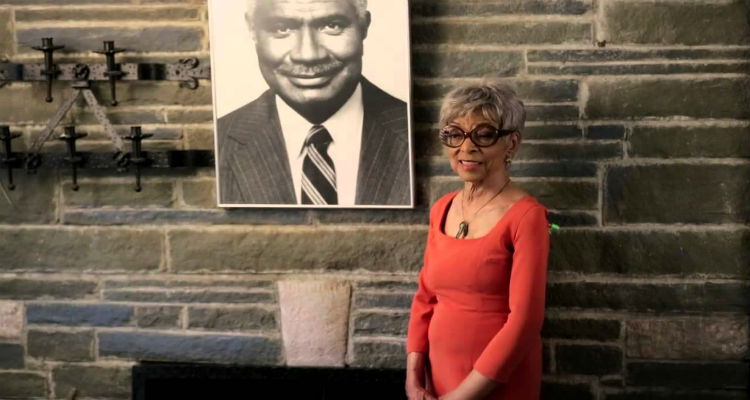


Mary Elizabeth Carnegie was a ground-breaking nurse, educator, and author who championed the cause of African American nurses. She was the first Black nurse to serve as a voting member on the board of a state nursing association. Her extraordinary accomplishments in advancing educational and professional opportunities for African American nurses over a career that spanned more than 50 years earned her numerous honors, including the American Nurses Association’s Mary Mahoney Award, recognition as a Living Legend of the American Academy of Nursing (the profession’s highest honor), and induction into the ANA’s Nursing Hall of Fame.
Dr. Carnegie was born Mary Elizabeth Lancaster in Baltimore, Maryland, on April 19, 1916, but grew up in Washington, D.C. She graduated from Dunbar High School in 1932 and entered the Lincoln School for Nurses in New York at 16, graduating four years later. She later received a bachelor’s degree in sociology from West Virginia State College (1942), a master’s degree from Syracuse University, and a doctorate in public administration from New York University in 1972.
After receiving her bachelor’s degree, Carnegie took a position in a hospital in Richmond, Virginia, before becoming a clinical instructor at St. Philip Hospital School of Nursing. While working at St. Philip, she encountered the segregated social system of nursing in the South, which strengthened her resolve to increase African Americans’ access to professional nursing education. In 1943 she established the first baccalaureate nursing program in Virginia at Hampton Institute (now Hampton University), a historically Black institution.
Carnegie joined the Florida Association of Colored Graduate Nurses (FACGN) in 1945 and was elected president three years later. By tradition, the FACGN president was named a courtesy (non‑voting) board member of the Florida State Nurses Association (FSNA). Following Carnegie’s service, the FSNA board granted her full voting rights, making her the first Black nurse to serve as a voting member on the board of a state nursing association. Between 1945 and 1953, Carnegie was a professor and dean of the nursing school at Florida A&M University.
Carnegie spent 25 years, from 1953 to 1978, on the editorial staff of the American Journal of Nursing and later served as editor of the journal Nursing Research. She wrote, edited, and contributed chapters to nearly 20 books and authored three editions of the award‑winning The Path We Tread: Blacks in Nursing Worldwide, 1854–1994.
She served as president of the American Academy of Nursing and chaired the ANA’s Minority Fellowship Program Advisory Committee. She initiated the baccalaureate nursing program at Hampton University, where the nursing archives are named in her honor, and an endowed chair in nursing focused on health disparities at Howard University also bears her name.
During her long nursing career, Carnegie challenged racism in its many forms. She exhibited courage, integrity, and a steadfast commitment to obtaining quality education and full recognition for the contributions of African American nurses. At a time when Black nurses at some hospitals were not allowed to identify themselves as “Miss,” only “Nurse,” Carnegie insisted on the proper honorific and refused to ride in hotel freight elevators while attending state nursing meetings in Florida. She also served as a mentor to generations of African American nurse leaders and, in historical discussions, consistently called attention to the work of African American nurses in the periods under review.
After retiring in 1978, Carnegie worked as an independent consultant in scientific writing and as a distinguished visiting professor at schools of nursing including Hampton University, the University of North Carolina, Pennsylvania State University, Indiana University, the University of Massachusetts, the University of Michigan, and Virginia Commonwealth University. She also occupied endowed chairs at Adelphi University in New York and Memphis State University in Tennessee.
Carnegie received eight honorary doctorates and numerous awards, including the George Arents Pioneer Medal from her alma mater Syracuse University, the President’s Award from Sigma Theta Tau International, and Living Legend recognition from the American Academy of Nursing; she was also honored by the Association of Black Nursing Faculty in Higher Education and was inducted into the Virginia Nursing Hall of Fame in 2009.
After living for many years with hypertensive cardiovascular disease, Carnegie died on February 20, 2008, at her home in Chevy Chase, Maryland, at the age of 91. She had been married once; her husband of 10 years, Eric Carnegie, whom she married in 1944, died in 1954.
Image Acknowledgement
Commemorative illustration of Dr. Mary Elizabeth Carnegie created by Spruce (ChatGPT, OpenAI) using an original prompt developed by the author. The image is a digitally generated, historically informed artistic interpretation designed to honour Dr. Carnegie’s legacy in nursing education, leadership, and the preservation of Black nursing history.
Source:
http://www.washingtonpost.com/wp-dyn/content/article/2008/03/06/AR2008030603678.html
https://en.wikipedia.org/wiki/Mary_Elizabeth_Carnegie
http://www.nursingworld.org/MaryElizabethCarnegie
https://www.aahn.org/gravesites/carnegie.html
http://www.foundationnysnurses.org/media/courier/2006Carnegie-article.pdf