
“The reuniting of African-American jazz with its African roots.”
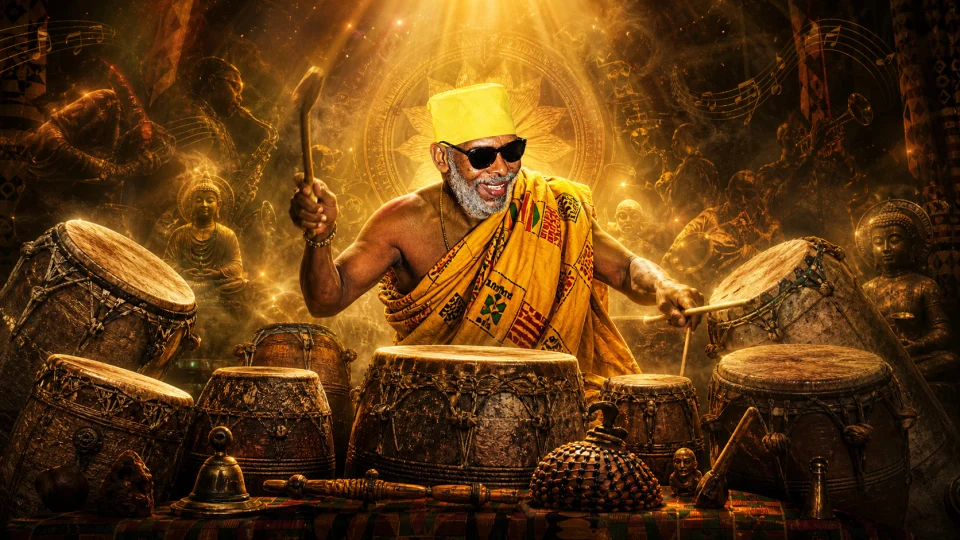
Kofi Ghanaba, also known as Guy Warren, was one of the most influential Ghanaian musicians of the mid‑20th century. By adding Ghanaian percussion instruments and rhythmic concepts to American jazz, he fused African and American musical vocabularies into what came to be known as Afro‑jazz. Celebrated as The Divine Drummer, his landmark 1956 album, Africa Speaks, America Answers, helped establish this new sound and inspired later innovators such as Fela Kuti and the band Osibisa.
Ghanaba was born Warren Gamaliel Kpakpo Akwei on 4 May 1923 in Accra in the then Gold Coast (now Ghana), to Richard Mabuo Akwei and Susana Awula Abla Moore. His parents named him after Warren G. Harding, the 29th president of the United States. In 1943, he adopted the name Guy Warren, and on 1 July 1974, Ghana’s Republic Day, he took the name Kofi Ghanaba (“son of Ghana”) in celebration of his roots and culture.
His mother was famed as a great beauty, while his father was a pioneering educationist who founded and served as the first headmaster of Ghana National School in Accra. Richard Akwei, a strict disciplinarian of the Accra middle‑class gentry, later founded Akwei Memorial School and became the first Ghanaian chief executive of the Central Organisation of Sports (COS), now the National Sports Council. By temperament, the young Ghanaba was a boisterous free spirit, often at odds with his father’s establishmentarian outlook.
Ghanaba’s musical journey began early. At the age of seven, he learned the Charleston from visiting seamen on the Gold Coast, and a decade later, a British army captain in Accra gave him a gramophone and a record of Artie Shaw’s “Non‑Stop Flight,” deepening his lifelong love affair with American jazz. He attended Government Boys’ School, Accra, from 1928 to 1939, playing in the school band, and in 1940 became a founding student at Ordorgonno Secondary School. That same year, he joined the Accra Rhythmic Orchestra under Yeboah Mensah as a drummer and later won a scholarship to Achimota College, where he studied music theory. He also taught himself to dance and to act in pantomime and variety shows, often writing the sketches himself.
In 1943, he left teacher training, later recalling that he was “bored stiff with my studies and the stern discipline of the college, which attempted to change me into an Englishman.” Around this period, he travelled abroad—likely working as a seaman—and made his way to New York via South America. In Greenwich Village, he briefly worked with trombonist and jazz veteran Miff Mole before returning to Accra, where, with a quartet that included saxophonist Joe Kelly, he helped sow the seeds of a more modern music scene playing for Allied servicemen.
Also in 1943, he was recruited by American military intelligence and travelled to Chicago, where he encountered the city’s vibrant jazz scene, before returning to Accra once again. Back home, he joined the Spectator Daily as a reporter under editor Robert Wuta‑Ofei and went on to hold various journalistic posts, including editor of the Daily Echo, Gold Coast Independent, and Star of West Africa between 1950 and 1952. In 1944, he began broadcasting jazz programmes on the Gold Coast Broadcasting Service under the name Guy Warren, which he would continue to use professionally for the next three decades.
After the Second World War, he and Joe Kelly formed the original Tempos Band, which trumpeter E.T. Mensah later re‑formed under his own leadership; the Tempos became one of Africa’s greatest jazz‑inflected dance bands and a key highlife institution. Ghanaba’s path shifted again when he was invited to London to play “bongos” with Kenny Graham’s Afro-Cubists, and he later led an all-Ghanaian group known as the Afro-Cuban Eight. He returned home with new influences, including calypso and Afro‑Cuban percussion, which helped shape the evolving dance‑band highlife sound.
In 1951, Warren left the Tempos—now firmly under E.T. Mensah’s leadership—and moved to Liberia, where he worked as a journalist and radio presenter. There, he became associated with Liberia’s National Broadcasting Service and has often been credited as the first African to present a programme on the BBC World Service, although the precise details of that role remain debated.
Still determined to bring African drums into jazz, he developed his own drumming technique and returned to the United States, eventually basing himself in Chicago. In 1955, he met bebop saxophone legend Charlie Parker, who invited him to play the talking drum at an all‑star concert in New York; Parker’s death shortly afterwards meant the performance never took place. One of the last photographs of Parker shows him draped in Ghanaian kente cloth beside Warren, who is wearing the saxophonist’s overcoat.
Ghanaba moved in the circles of modern jazz’s greats. He rehearsed with John Coltrane and Thelonious Monk, though he later recalled that they struggled with the complexity of his rhythmic approach and he refused to dilute it for their comfort, even as Monk remained a friend. He played briefly with Lester Young and the Sarah Vaughan Trio in the Birdland All‑Stars and received an invitation to join pianist Erroll Garner’s band, but by then he was focused on recording his own work.
His 1956 LP Africa Speaks, America Answers, recorded with Gene Esposito and the Red Saunders Orchestra, blended African, American and European elements into a genuinely multicultural fusion. Contemporary accounts report that the album sold widely and firmly established him as a trailblazer of cross‑cultural sound. Master drummer Max Roach later reflected: “Ghanaba was so far ahead of what we were all doing that none of us understood what he was saying—that in order for African‑American music to be stronger, it must cross‑fertilize with its African origins… we ignored him. Seventeen years later, the African sound of Ghanaba is now being imitated all over the United States.” The album confirmed his reputation as the musician who unapologetically asserted the African presence in jazz. Later generations, including Fela Kuti and Osibisa, would popularise and extend the fusion he pioneered.
He followed this breakthrough with a series of groundbreaking—though now hard‑to‑find—albums for Columbia, Decca and EMI, including Themes for African Drums (1958) and Emergent Drums (1963). By the mid‑1960s, weary of the racism and critical incomprehension he faced in the United States, he returned to Accra. Back home, he published his autobiography, I Have a Story to Tell , and turned more decisively toward traditional African forms, as heard on his 1969/70 recording , The Divine Drummer. Ghanaba likened his drumming to love‑making, imagining the African drum as a woman who could never be fully satisfied. After an intense performance, he said, the drums seemed to ask, “Is that all?” to which he would answer, “I will be back for another session.”
By the end of the 1960s, he had embraced Buddhism and begun experimenting with new musical forms that sometimes baffled Ghanaian critics; characteristically, he remained ahead of his time. In the 1970s, he formally adopted the stage name Kofi Ghanaba and continued to combine music with cultural and spiritual work. In the 1990s, he appeared in the film Sankofa (1993), written and directed by Haile Gerima, and in 2001, at age 78, he returned to the international stage in the musical Yaa Asantewaa: Warrior Queen, performing alongside the Pan African Orchestra and the UK‑based dance company Adzido. Kofi Ghanaba continued to make music and mentor others until his death on 22 December 2008.
Ghanaba was married twice and had six children. His first son, Guy Warren Jr., also known as “Odinga Oginga,” is an artist specialising in sculpture, painting and carving, based in New York City. His second child, Glenn Gillespie Warren—nicknamed “Ghanababa” (“son of Ghanaba”)—is a jazz drummer who played on That Happy Feeling (Safari, 1979) and recorded Bomdigi (Safari, 2008), the last album to feature Ghanaba. Glenn was chosen by his father to carry on his musical legacy, a passing of the torch symbolised when Ghanaba formally handed him his drumsticks. Ghanaba’s third son, Gamal Abdel Nasser Warren (nicknamed “The President”), named with the blessing of Egypt’s President Nasser, pursued political science. His fourth son, Gamaliel Joseph Warren, also inherited his father’s talent as a jazz drummer and is based in Gary, Indiana.
In 1976 Ghanaba married Mrs Felicia Ghanaba, a Togolese woman living in Ghana. They had two daughters: Medie (“mine”), now Medie Ghanaba Lemay, and Gye Nyame Hosanna Ghanaba. At home, he was remembered as a kind husband and loving father, a responsible man who cared deeply for his family even as he reshaped the soundscape of global jazz.
Source:
http://allafrica.com/view/group/main/main/id/00029492.html
https://en.wikipedia.org/wiki/Guy_Warren
http://www.retroafric.com/html/sl_notes/016_3.html
http://www.independent.co.uk/news/obituaries/kofi-ghanaba-drummer-who-pioneered-afro-jazz-1640302.html
http://www.theguardian.com/music/2009/feb/07/obituary-kofi-ghanaba