
Booker Taliaferro Washington (1856–1915) made education the foundation of a far-reaching campaign for Black advancement. An educator, institution-builder, writer, and political strategist, he developed Tuskegee Institute in Alabama into an internationally recognized center of learning. He encouraged business ownership, agricultural improvement, and skilled craftsmanship as pathways toward greater independence for African Americans confronting racial violence, segregation, and exclusion from political life.
His influence carried difficult contradictions. Washington cultivated wealthy benefactors and presidents while working among communities denied basic protections. He publicly emphasized cooperation and economic achievement, yet privately supported legal challenges to racial discrimination. His willingness to postpone confrontation over some fundamental rights drew sustained criticism from other Black leaders. His life illuminates both the possibilities of institution-building and the profound disagreements over how freedom could become meaningful in the generations after emancipation.
Childhood and the Pursuit of Learning
Booker T. Washington was born on April 5, 1856, near Hale’s Ford in Franklin County, Virginia, on a “pile of rags on the dirt floor of a kitchen cabin.” His mother, Jane, worked as a cook on James Burroughs’s tobacco farm, where she and her children were held in hereditary bondage. She named him Booker Taliaferro. He had medium-brown skin, reddish hair, and gray eyes. His father was believed to be a man of European descent from the surrounding neighborhood, but Washington never knew his identity, and he played no part in his upbringing.
Booker grew up with his older brother, John, and younger half-sister, Amanda. His mother married Washington Ferguson, Amanda’s father, while the family was still in bondage. Another boy, James, later joined the family through adoption. Within the severe constraints imposed on her life, Jane nurtured her children and encouraged the ambition that would shape Booker’s future.
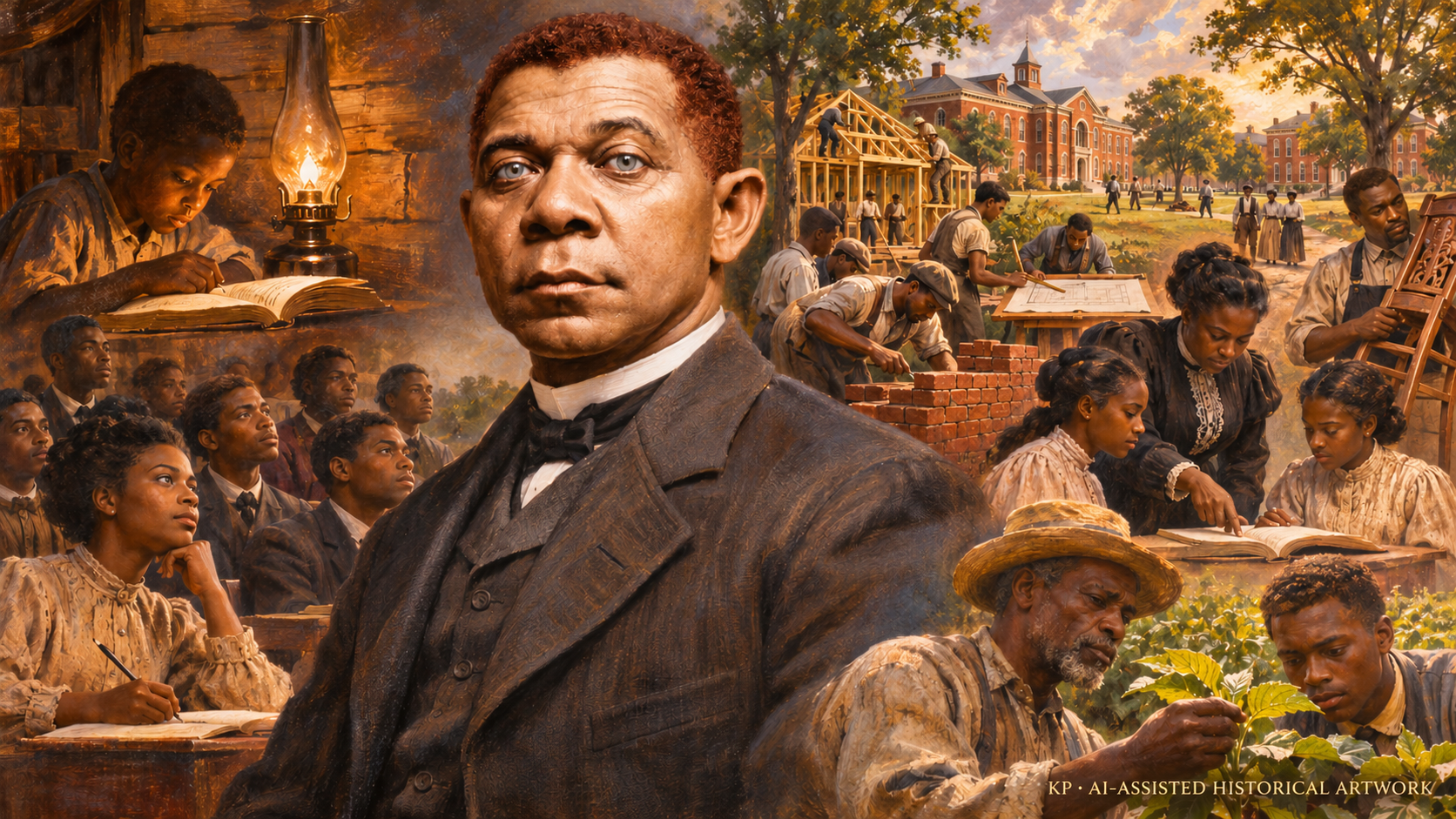
Washington spent his first nine years on the Burroughs farm, the last four against the backdrop of the Civil War. His early longing for education emerged while carrying schoolbooks for the Burroughs family’s daughters. Standing outside a schoolroom he could not enter, he glimpsed possibilities deliberately withheld from Black children. He later remembered admission to such a place as something close to entering paradise.
Emancipation in 1865 brought a moment he never forgot. His mother bent over her children and kissed them as “tears of joy ran down her cheeks.” That year, she took them to Malden, West Virginia, to join Ferguson, who had traveled ahead and found employment in the salt industry. Freedom opened a new chapter, but the family’s survival still depended on demanding physical work.
At nine, Booker began packing salt, sometimes starting before dawn. He later worked underground in coal mines. Yet his determination to learn persisted. Jane obtained a spelling book for him, and he began teaching himself the alphabet. When a school for Black children opened in Malden, his stepfather initially resisted his attendance because the household needed his wages. Booker sought lessons at night and eventually arranged to attend daytime classes while working before and after school. During these early school years, he adopted the surname Washington.
His education depended on his mother’s encouragement, his own persistence, and opportunities carved out of exhausting workdays. Long before he led a school, he understood learning as something worth extraordinary effort—and as a means of widening the possibilities of a life.
The Road to Hampton
As a teenager, Washington became a domestic worker in the home of Viola Ruffner, whose family operated local salt and mining enterprises. Her exacting expectations reinforced habits of cleanliness, punctuality, and careful work that he later incorporated into his educational philosophy. She also recognized his ambition and allowed him time to study.
In 1872, he left for Hampton Normal and Agricultural Institute in Virginia. The journey stretched several hundred miles and exposed him to the barriers confronting a young Black traveler with little money. He walked substantial distances, sought rides, and worked along the way. In Richmond, he slept beneath a wooden sidewalk while earning money unloading vessels.
According to his later autobiographical account, his appearance upon reaching Hampton initially made head teacher Mary F. Mackie hesitate to admit him. She asked him to clean a room, and his meticulous work became an unconventional entrance examination. Once admitted, he worked as a janitor to help meet his expenses.
Hampton’s principal, Samuel Chapman Armstrong, profoundly influenced him. The institution combined academic instruction with practical training and an emphasis on service. Washington embraced its belief that education should equip students to improve both their livelihoods and their communities.
After graduating in 1875, he returned to Malden to teach. He later studied briefly at Wayland Seminary in Washington, D.C., before rejoining Hampton’s staff in 1879. There he taught, supervised Native American students, and helped develop a night-school program for students whose limited resources required them to work during the day. These experiences prepared him for the undertaking that would define his life.
Building Tuskegee
In 1881, Washington accepted the leadership of a new school for Black students in Tuskegee, Alabama. He was twenty-five.
The initiative grew from local organizing, particularly the work of Lewis Adams, a Black craftsman and community leader, alongside businessman George W. Campbell, an American of European descent. Their efforts secured an annual state appropriation of $2,000 for teachers’ salaries. Land, buildings, equipment, and other necessities would have to come from elsewhere.
The school opened on July 4, 1881, with thirty students in borrowed premises associated with Butler Chapel A.M.E. Zion Church. Washington soon arranged the purchase of a nearby hundred-acre property, borrowing money for the initial payment and raising further support through donations and community events.
Tuskegee’s growth was a collective achievement. Black residents contributed resources to an institution they understood as an investment in their children’s future. Teachers combined classroom responsibilities with fundraising and administration. Students helped create the campus itself.
Brickmaking became a particularly important enterprise. Early attempts failed, but persistence produced a successful operation that supplied campus construction and sold bricks locally. Students also made furniture, built wagons, cultivated crops, and erected buildings. Their work helped sustain the institution while providing technical experience.
Washington’s achievement lay not simply in expanding a school but in bringing together teaching, production, fundraising, and community participation within a durable institution. Nevertheless, the model placed substantial demands on students whose access to education already depended on arduous labor.
Education for Economic Independence
Washington regarded practical knowledge as essential to freedom. Literacy mattered, but so did the ability to build a house, improve a farm, manage accounts, produce marketable goods, or establish a business.
Tuskegee combined academic subjects with training in agriculture, carpentry, masonry, printing, shoemaking, and other trades. Women studied subjects including sewing, cooking, dairying, and poultry raising, reflecting the gendered expectations that shaped educational opportunities at the time. Teacher preparation extended the school’s influence into other Black communities.
Personal habits also occupied a conspicuous place in Washington’s program. He emphasized hygiene, neat clothing, punctuality, and responsibility. His insistence that students own and use a toothbrush expressed a broader conviction that education should transform daily living as well as employment prospects.
The campus was never intended to stand apart from its surroundings. Farmers’ conferences and agricultural outreach brought practical instruction to rural families. Traveling instruction later carried tools and demonstrations beyond Tuskegee’s grounds.
In 1896, Washington recruited George Washington Carver to lead agricultural work at the institute. Carver’s research and teaching strengthened efforts to improve soil, diversify crops, and reduce rural poverty.
Washington’s philosophy challenged the degradation historically attached to Black physical work. Skilled labor, he insisted, possessed dignity. Yet his emphasis also raised an enduring question: could vocational opportunity expand freedom if racial exclusion continued to restrict the occupations, wages, and political protections available to Black workers?
Family, Partnership, and Women’s Leadership
Washington’s family life was closely connected to Tuskegee, but the women beside him brought their own educational commitments and institutional contributions.
He married Fannie N. Smith in 1882. From Malden and educated at Hampton, she helped sustain Tuskegee’s early household and community life. Their daughter, Portia, was born in 1883. Fannie died the following year.
In 1885, Washington married Olivia A. Davidson, who had joined Tuskegee as a teacher and assistant principal in 1881. Educated at Hampton and the Massachusetts State Normal School at Framingham, Davidson was central to the institution’s early development. Her fundraising journeys and organizational work helped secure its financial foundations. Washington acknowledged the exceptional importance of her contribution. They had two sons, Booker Taliaferro Jr. and Ernest Davidson, before her death in 1889.
Margaret James Murray, a Fisk University graduate who became Tuskegee’s lady principal, married Washington in 1893. She helped raise his children while maintaining an extensive career in education and Black women’s organizing. Her work included community meetings and leadership among Southern Black women’s clubs.
These women were more than supporting figures in Washington’s biography. Their teaching, fundraising, administration, and community work formed part of the infrastructure that made his public achievements possible.
Atlanta and National Prominence
On September 18, 1895, Washington addressed the Cotton States and International Exposition in Atlanta, delivering the speech that established him as a national figure. He presented economic development, practical education, and cooperation across racial divisions as the most promising foundations for Black advancement in the South. His address attracted influential supporters while raising difficult questions about the political and social concessions his strategy appeared to require.
Urging Black Americans to “Cast down your bucket where you are,” Washington encouraged them to develop opportunities in agriculture, skilled trades, commerce, and the professions. He also called on Americans of European descent to invest in their Black neighbors, whose labor, knowledge, and enterprise were indispensable to the region’s prosperity.
The speech’s most memorable image offered economic cooperation alongside social separation:
“In all things that are purely social we can be as separate as the fingers, yet one as the hand in all things essential to mutual progress.”
Washington made his priorities still more explicit when he declared:
“The wisest among my race understand that the agitation of questions of social equality is the extremest folly, and that progress in the enjoyment of all the privileges that will come to us must be the result of severe and constant struggle rather than of artificial forcing.”
He added:
“The opportunity to earn a dollar in a factory just now is worth infinitely more than the opportunity to spend a dollar in an opera-house.”
These statements helped make the address both celebrated and controversial.
Many Euro-American listeners welcomed a program that emphasized economic development without demanding an immediate dismantling of social segregation. Yet Washington did not explicitly renounce legal equality. He affirmed that “all privileges of the law” should belong to Black Americans, while placing greater immediate emphasis on preparing to exercise those rights. His language asserted a claim to equal protection while appearing to defer the public struggle necessary to secure it.
The address became known as the Atlanta Compromise. To its supporters, Washington offered a practical strategy for expanding opportunity within a deeply hostile society. To his critics, accepting social separation and placing economic progress ahead of an uncompromising demand for equal citizenship risked strengthening the barriers that restricted Black advancement.
His growing prominence also widened his access to wealthy benefactors. Andrew Carnegie became a particularly important supporter of Tuskegee. In 1900, he agreed to provide $20,000 for a library, a project Washington presented as both an educational resource and an opportunity for students to learn construction skills. Carnegie also contributed $10,000 annually, according to contemporary reporting. In 1903, he gave $600,000 in support of Tuskegee’s endowment, substantially strengthening the institution’s financial foundations.
Enterprise, Writing, and Political Influence
Washington understood that Tuskegee’s future depended not only on its classrooms and workshops but also on how its story reached the wider world. His most influential means of telling that story was Up from Slavery, published in 1901 after appearing in installments in The Outlook. More than a personal memoir, the book became a powerful vehicle for publicizing his educational program, strengthening his reputation, and encouraging support for Black education.
The autobiography traced his journey from childhood bondage through the salt furnaces and coal mines of West Virginia to Hampton and the building of Tuskegee. Washington presented these experiences as evidence for his central convictions: education should cultivate practical ability, skilled work possessed dignity, and economic independence could strengthen a community’s capacity to shape its future. His own life became the persuasive example through which he explained the institution’s purpose.
The book’s appeal rested partly on its recognizable American success narrative. A child denied opportunity became an educator of international standing through persistence, resourcefulness, and service. Yet Washington also described the contributions of teachers, students, local families, and benefactors. Tuskegee emerged as both the achievement of a determined leader and an institution sustained by many people’s commitment.
Washington wrote with a wider purpose than recording the past. His accessible prose, memorable anecdotes, and emphasis on achievement invited readers to regard Tuskegee as a practical investment in a more prosperous society. Accounts of fundraising explained how contributions became classrooms, equipment, training, and opportunities for students. The autobiography joined personal testimony to institutional advocacy, making Washington himself the most recognizable representative of his program.
Its conciliatory tone also revealed the tensions within that strategy. Washington emphasized cooperation and expressed gratitude toward supporters of European descent, presenting progress in terms calculated to encourage participation rather than provoke defensiveness. This approach helped make his message persuasive to potential benefactors, but it left racial violence and political exclusion less prominent than perseverance and individual conduct. The narrative’s optimism was both a source of its appeal and a limitation of its account of advancement.
The book strengthened an existing fundraising campaign rather than beginning it. Carnegie’s commitment to Tuskegee’s library preceded its publication in book form: Washington reproduced his December 1900 appeal within its pages. A gift would provide a library, while students would gain construction experience by building it. Philanthropy, education, and practical work appeared as mutually reinforcing parts of the same undertaking.
Washington’s other books included The Future of the American Negro, Character Building, Working with the Hands, and My Larger Education. His European observations informed The Man Farthest Down, which examined poverty and working lives beyond the United States.
Beyond Carnegie, Washington cultivated support from John D. Rockefeller, George Eastman, Julius Rosenwald, and other wealthy donors. His partnership with Rosenwald helped initiate a rural school-building program that continued after Washington’s death and eventually supported nearly five thousand school buildings for Black children across the South.
Writing complemented his other efforts to expand Black economic opportunity. In 1900, he founded the National Negro Business League to connect entrepreneurs and encourage business ownership. He also advised presidents on racial questions and federal appointments. President Theodore Roosevelt’s invitation to dinner at the White House in 1901 brought further recognition—and a racist backlash that exposed the hostility surrounding even symbolic gestures of equality.
Up from Slavery remained his most enduring literary statement because it united the personal and institutional dimensions of his work. It offered an influential narrative of possibility, a persuasive case for Tuskegee, and a revealing expression of the compromises he made in seeking resources for Black advancement.
Disagreement Within Black Leadership
Washington’s prominence never amounted to universal agreement among African Americans. W. E. B. Du Bois initially welcomed aspects of his work but became a forceful critic. In The Souls of Black Folk in 1903, Du Bois argued that economic security could not be separated from voting rights, civil equality, and access to advanced education. Without political protection, property and livelihoods remained vulnerable.
William Monroe Trotter likewise challenged Washington’s willingness to accommodate racial restrictions. These disagreements concerned strategy, but also the right to define the community’s priorities.
Washington’s extensive network of donors, political contacts, newspapers, and associates became known as the Tuskegee Machine. It could direct resources toward schools and businesses, but it could also disadvantage opponents. His financial relationships with Black publications and his efforts to monitor competing organizations revealed a leader prepared to manage dissent and cultivate support.
The emergence of the Niagara Movement in 1905 and the NAACP in 1909 reflected a growing insistence on organized, public demands for equal rights. These movements developed within a broader struggle in which Black Americans pursued multiple, sometimes conflicting paths toward collective advancement.
The Legal Campaign Behind the Public Image
Washington’s private activities complicate any portrayal of him as simply accepting racial inequality. Behind the scenes, he supported legal challenges to voting restrictions, segregation in transportation, exclusion from juries, and coercive debt labor. He helped finance litigation and worked through trusted intermediaries, including his secretary, Emmett J. Scott.
His involvement included supporting challenges to discriminatory voting practices and the legal campaign surrounding Alonzo Bailey, whose case confronted the use of criminal penalties to compel labor.
Secrecy protected his relationships with donors and reduced risks to Tuskegee in a hostile political environment. It also meant that many contemporaries judged his public position without knowing the extent of his legal interventions.
These activities do not erase the consequences of his public concessions or his treatment of opponents. They demonstrate that his strategy operated on more than one level: reassurance before influential audiences, institution-building within Black communities, and selective confrontation through the courts.
Final Years and an Unsettled Legacy
By 1915, Tuskegee had grown into a large campus with more than 100 buildings, about 1,500 students, and an extensive program of academic and vocational instruction.
In the fall of that year, after a punishing schedule of travel and public speaking, Washington became gravely ill in New York City. Physicians diagnosed advanced kidney disease and warned that he had little time left. He insisted on returning to Tuskegee, declaring, “I was born in the South, I have lived and labored in the South, and I expect to die and be buried in the South.”
He survived the train journey home and died hours after reaching Tuskegee on November 14, 1915, aged fifty-nine. Nearly eight thousand people attended his funeral on the campus he had spent thirty-four years helping to build. His death was long associated with Bright’s disease and exhaustion; a 2006 reassessment of his medical records, undertaken with his descendants’ permission, identified severe hypertension as the underlying cause of his fatal kidney failure.
Washington’s educational influence reached beyond the United States. Visitors and correspondents from Africa and the Caribbean studied Tuskegee’s methods. Marcus Garvey drew inspiration from his emphasis on Black enterprise and institutional independence, even as Garvey developed a different political vision.
Washington left no simple formula for liberation. His institutions expanded opportunity, but economic achievement alone could not dismantle racial exclusion. His caution protected important work, yet it also limited his public defense of rights.
His life remains significant because it brings these tensions into focus. He helped create places where Black people could acquire knowledge, develop skills, organize resources, and imagine futures beyond imposed deprivation. At the same time, the criticism he faced affirmed an equally essential principle: education and economic independence could strengthen freedom, but they could not replace the claim to full citizenship and human dignity.
Sources:
Zeringue, Joshua Thomas. “Booker T. Washington and the Historians: How Changing Views on Race Relations, Economics, and Education Shaped Washington Historiography, 1915–2010.” Master’s thesis, Louisiana State University and Agricultural and Mechanical College, 2015. https://repository.lsu.edu/cgi/viewcontent.cgi?article=2153&context=gradschool_theses.
https://en.wikipedia.org/wiki/Booker_T._Washington
https://www.gutenberg.org/files/2376/2376-h/2376-h.htm
https://npshistory.com/handbooks/historical/bowa/handbook-1972.pdf
https://religiousfreedominstitute.org/wp-content/uploads/2024/02/Heritage_Collection_Booker_T._Washington.pdf
https://www.uni-heidelberg.de/md/zegk/schurman/studium/hsjansen_ss11_bauerlein.pdf
https://teachingamericanhistory.org/document/of-booker-t-washington-and-others/
https://www.tuskegee.edu/legacy/booker-t-washington.html
https://encyclopediavirginia.org/entries/washington-booker-t-1856-1915/
https://www.loc.gov/static/classroom-materials/usa-alabama/documents/Washington-Address.pdf
https://voicesofdemocracy.umd.edu/washington-atlanta-exposition-address-speech-text/
https://www.gutenberg.org/files/2376/2376-h/2376-h.htm
https://www.nytimes.com/1903/04/24/archives/600000-for-tuskegee-and-bt-washington-andrew-carnegies-contribution.html
https://www.carnegiebirthplace.com/blog/2020/10/14/andrew-carnegie-and-booker-t-washington
https://dlc.library.columbia.edu/carnegie/cul:3r2280gcs6
https://www.cambridge.org/GB/universitypress/subjects/history/early-republic-and-antebellum-history/slavery-autobiography?format=PB&isbn=9781108079402