
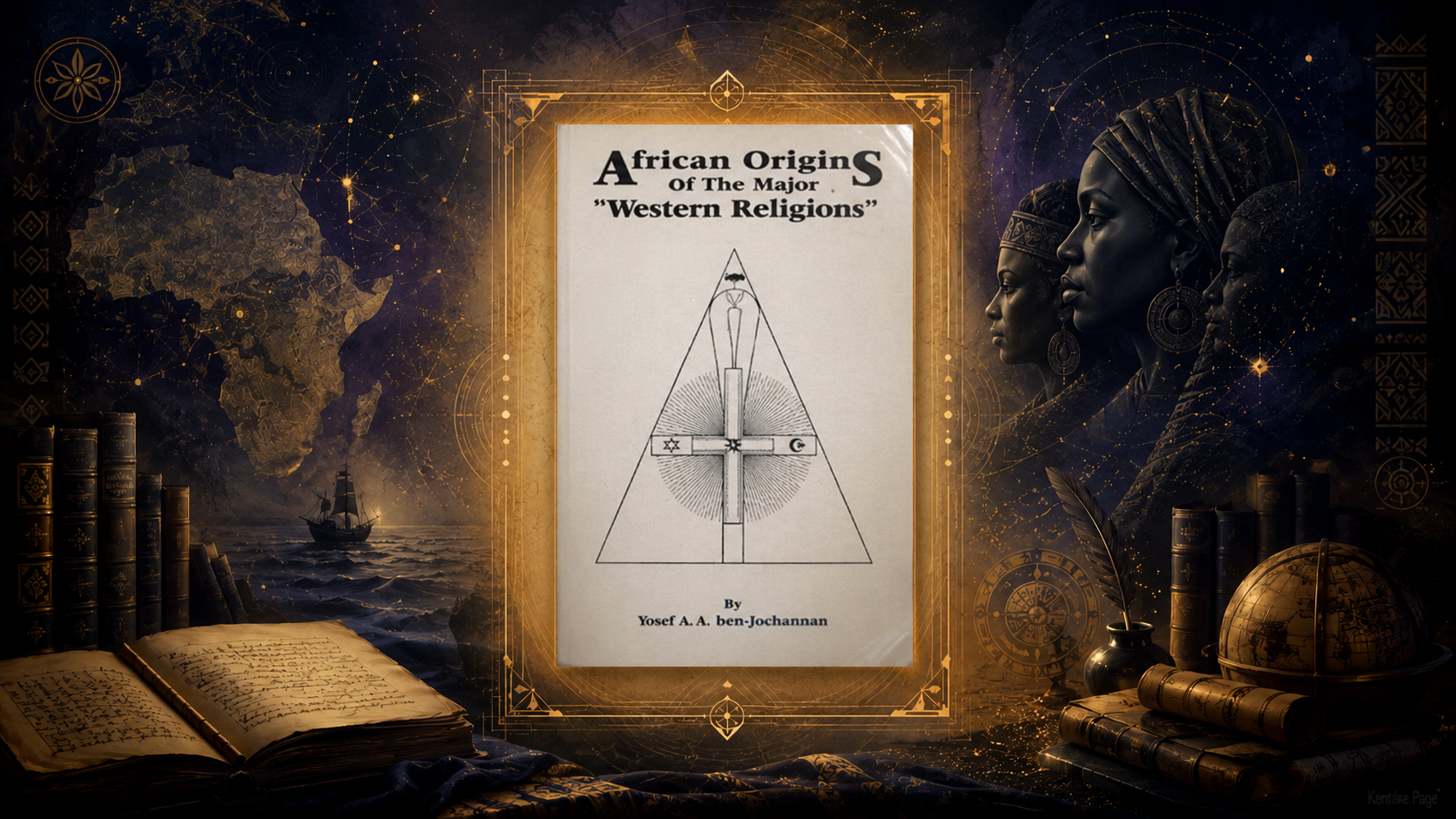
African Origins of the Major “Western Religions” stands as one of Yosef ben‑Jochannan’s most sustained and provocative efforts to re‑inscribe Africa at the heart of global religious history. First published in 1970 and repeatedly reissued in subsequent decades, the book challenges the assumption that Judaism, Christianity, and Islam are purely “Western” or Near Eastern creations. For Ben‑Jochannan, these religions emerged from, and remained deeply indebted to, African religious cultures, especially the Nile Valley civilizations of Kemet and the wider zones of Ethiopia and the Sudan. The book’s polemical energy is directed as much against Euro‑American theological and academic establishments as against the spiritual self‑understanding of Black Jews, Christians, and Muslims who have been taught to view their own ancestral religious systems as primitive or demonic.
At the core of Ben‑Jochannan’s thesis is the insistence that Judaism, Christianity, and Islam are “as much African as they are Asian in origin.” He argues that the doctrinal foundations, ritual forms, and symbolic repertoires of these religions are unintelligible without reference to pre‑existing African systems, most notably the Nile Valley Mystery System. In his reading, the scriptures and traditions of these faiths are palimpsests: sacred narratives layered over, and often obscuring, older African mytho‑historical materials. The book therefore operates as an extended act of excavation, stripping away what he sees as a later Eurocentric veneer to recover the African matrices from which “Western” religions emerged. This project is explicitly corrective. Ben‑Jochannan regards the prevailing religious historiography as part of a wider “Greek‑centric Anglo‑Iron Judaeo‑Christian oriented society” that has systematically denied Black people their role as originators and shapers of world civilization.
To make this case, Ben‑Jochannan draws upon a hybrid method that combines Egyptology, comparative religion, and Afro‑diasporic historical experience. His narrative moves geographically from ancient Kemet and Kush, through Ethiopia and the Levant, and out into Europe and the Americas, tracing the circulation and transformation of religious symbols and practices. He juxtaposes Biblical and Qur’anic accounts with older African cosmologies, reading canonical texts historically rather than devotionally and treating their miraculous episodes as reworkings of pre‑existing African mythic patterns. Etymological parallels, ritual analogies, and iconographic continuities occupy a central place in his argument: practices such as circumcision, fasting, pilgrimage, liturgical processions, and monastic withdrawal are presented as survivals or adaptations of African religious forms rather than innovations of later “Western” faiths. Through this comparative lens, elements like Black Madonna iconography and early desert asceticism appear not as European inventions but as signs of an African religious substratum lingering within Christianity and Islam.
His treatment of Judaism begins with the claim that its “literary beginnings” lie along the banks of the Blue and White Nile, in Egypt and Ethiopia, rather than in a purely Asiatic environment abstracted from Africa. Ben‑Jochannan foregrounds arguments, some echoing earlier heterodox writers such as Gerald Massey, that the earliest Hebrews were “in all probability Negroes,” and he entertains the possibility that the Jews originated in Africa rather than Asia. The long sojourn of the Hebrews in Egypt, sometimes framed in Biblical tradition as a period of four hundred years, is interpreted as a phase in which they themselves formed a community of “Black Jews” whose religious life was profoundly shaped by African patterns of worship and law. In this view, the subsequent emergence of Euro‑Jewish dominance in modern times reflects a historical re‑imagining that gradually decentered these African origins and recast the biblical dramatis personae in a European image.
Christianity, in his account, appears as an outgrowth of Judaism which had already absorbed key concepts and motifs from African religious systems. Ben‑Jochannan identifies a series of parallels between Christian doctrine and Nile Valley religious themes: resurrection motifs reminiscent of Osirian cycles, trinitarian configurations echoing earlier divine triads, virgin‑child iconography that recalls Isis and Horus, and monastic forms that resemble earlier African ascetic practices. For him, these parallels are not incidental; they signal a deep structural continuity. Christianity becomes, in this framing, a religion that takes an African‑mediated Judaism, rearticulates it in a Greco‑Roman world, and then re‑enters Africa as a colonizing faith armed with European power. The tragedy he identifies is that a religion whose roots are entwined with African sacred traditions returns to the continent in the hands of enslavers, missionaries, and imperial administrators, now deployed to delegitimize those very traditions and render African peoples spiritually dependent upon Europe.
Islam receives somewhat less extended treatment but is nonetheless woven into the same narrative of African entanglement. Ben‑Jochannan points to the early expansion of Islam into North and East Africa, emphasizing that Black Muslims were present from the formative centuries of the faith. He reads Islamic rites—pilgrimage, ablutions, communal prayer, the chanting of scripture, and the formation of Sufi orders in African contexts—as practices that both absorbed and re‑shaped earlier African religious forms. Islam, on this reading, is not an external imposition upon a static Africa, but part of a long, complex history of religious interaction in which African cultures played a constitutive role. Yet, as with Christianity, the subsequent history of Islam in many African regions becomes entangled with systems of hierarchy, including the legitimation of slavery and racial stratification, creating a layered and often contradictory legacy for African and diasporic Muslims.
One of the most politically charged dimensions of the book is the way it juxtaposes so‑called “Western” religions with Juju, Vodun/Voodoo, and other indigenous African traditions. Ben‑Jochannan explicitly sets out to show the “definite links” between these systems, insisting that the religions of the Atlantic‑world African diaspora cannot be understood without recognizing the persistence of African spiritual logics. In the Caribbean and the Americas, he notes, captive Africans were subjected to Christianization under conditions of extreme violence, but African religious structures survived in syncretic formations such as Afro‑Christian churches, spirit possession cults, and the “spirituals” that encoded multiple layers of African cosmology and resistance. By demonstrating parallels between the ritual sophistication of Vodun or Juju and that of Judaism, Christianity, and Islam, he seeks to dismantle Eurocentric stereotypes that cast African religions as superstition while presenting Euro‑Christianity as the pinnacle of spiritual refinement.
Underlying this comparative religious argument is a sharp critique of race and knowledge production. Ben‑Jochannan does not write as a detached historian; he writes as a combatant in a struggle over memory and identity. He charges that Euro‑American religious institutions and academic disciplines have systematically stripped African peoples of their status as originators, presenting them instead as late recipients of spiritual truth mediated through white or “Near Eastern” intermediaries. In this light, the erasure of Black Hebrews, Black Christians of antiquity, and Black Muslims from standard narratives is not a mere oversight but part of a broader ideological project that rationalizes both historical and contemporary domination. For African‑descended Jews, Christians, and Muslims in the diaspora, accepting these Eurocentric histories amounts, in his view, to a form of “mental bondage” in which they worship under the sign of traditions that have effaced their own ancestral authorship.
Stylistically, African Origins of the Major “Western Religions” reflects Ben‑Jochannan’s identity as a “master teacher” who operated as much in community forums and lecture halls as in formal academic spaces. His prose, like his widely circulated lectures, blends historical citation with wit, anecdote, and an often abrasive humor designed to shock readers and listeners out of inherited assumptions. Publishers and commentators frequently note his “forceful command” of historical material and his use of “common sense” appeals, which make the text accessible to lay readers even as it advances a radical reconfiguration of religious historiography. The book is therefore both an interpretive synthesis and a pedagogical tool, meant to be taken up in grassroots study circles, Black churches and mosques, and Pan‑African political education as well as in university classrooms.
The reception of the work mirrors its dual character. Within Afrocentric, Pan‑African, and Black nationalist intellectual circles, African Origins of the Major “Western Religions” is often described as one of Ben‑Jochannan’s most “thought‑provoking” and influential texts, a gateway for many readers into a broader reconsideration of religion, race, and history. It has informed the thinking of later Black theologians, historians, and activists who grapple with decolonizing religious practice and recovering African agency in the formation of “world religions.” At the same time, mainstream academic scholars have frequently criticized aspects of his method, especially some of the more speculative historical claims, contested etymologies, and the limited engagement with contrary evidence. Yet even when his conclusions are disputed, his work is acknowledged as a powerful catalyst, forcing difficult questions about why African contributions to Judaism, Christianity, and Islam have been minimized or ignored in dominant narratives.
In the larger landscape of Black intellectual history, African Origins of the Major “Western Religions” can be read as a decisive intervention in the spiritual dimension of the Maafa and its afterlives. By arguing that the very creeds used to justify enslavement and colonization are themselves rooted in African religious creativity, Ben‑Jochannan both indicts the violence of historical misrepresentation and opens a path toward reappropriation. The book offers African‑descended peoples a way of re‑imagining themselves not as perpetual converts at the margins of someone else’s sacred story, but as foundational authors and practitioners whose cosmologies preceded and shaped those stories.
Please click the link for an essay by Jared Ball on Kemetic Mythology as the Origins of Judaism and Christianity, citing Dr. Ben’s work.