
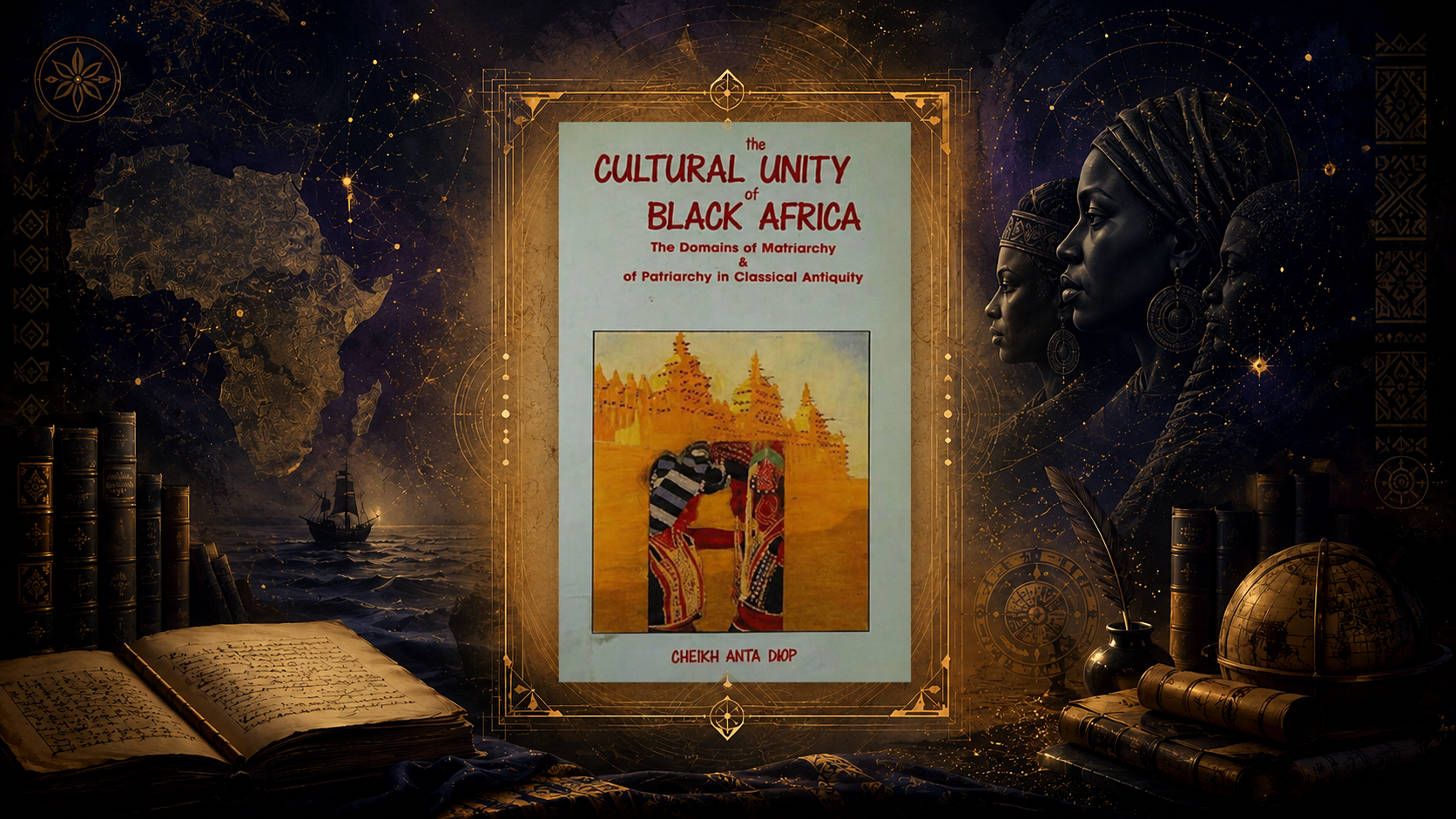
The Cultural Unity of Black Africa occupies a central place in Cheikh Anta Diop’s lifelong effort to reconfigure how Africa is seen in the story of world civilization. Written in the wake of formal decolonization, it is less a narrow academic monograph than a civilizational meditation: Diop sets out to show that, beneath the immense diversity of languages, polities, and local histories, Black Africa forms a coherent cultural whole with its own internal logic and trajectory. Against the grain of European scholarship that habitually fragmented Africa or treated it as a peripheral appendage of the Mediterranean world, he insists on Africa as a civilizational bloc with distinctive values, social structures, and historical experiences, systematically misread through foreign categories.
At the heart of the book stands the framework that later becomes known as Diop’s “Two Cradle Theory.” He imagines human social development as emerging from two broad ecological and historical zones: a “Southern Cradle,” centered on Africa (with the Nile Valley as its most elaborated classical expression), and a “Northern Cradle,” encompassing much of Eurasia, especially Northern Europe. In his account, the Southern Cradle’s comparatively abundant climate and long agricultural continuity encouraged sedentary life, stable communities, and an ethos grounded in hospitality, reciprocity, and the integration of the individual into the group. The Northern Cradle, by contrast, is marked by harsher climates, recurrent scarcity, and a history of migrations and invasions; these conditions, he argues, fostered nomadism, warrior cultures, a high valuation of conquest, and more rigid, patriarchal hierarchies. For Diop, these are not superficial differences but deep civilizational templates: they generate distinct attitudes toward power, gender, property, and the sacred, and they continue to shape how African and European societies enter into contact, conflict, and domination.
Within this Southern Cradle, Diop locates what he regards as the core organizing principle of African cultural unity: a matricentric or matriarchal ethos. Importantly, he is careful to distinguish his use of “matriarchy” from the crude notion that women simply rule over men. Instead, the term names an entire socio‑ethical pattern in which the mother, the maternal line, and the extended family occupy the center of social life. Identity is tied to maternal kin; inheritance frequently follows uterine lines; and the moral imagination is oriented around nurture, care, and the cohesion of the family group. In such a framework, women are not marginal adjuncts to a male order but foundational to economic, social, and spiritual life, even where formal political authority is often exercised by men. Diop reads this matricentric pattern as generating certain characteristic features: extended kinship networks, collective child‑rearing, communal responsibility for the vulnerable, and an emphasis on balance rather than aggressive expansion.
Patriarchy, as he sketches it in the Northern Cradle, is something qualitatively different. There, the nuclear family under male authority becomes central; lineage is traced through the father; and the social imagination is shaped by war, competition, and the glorification of conquest as a means of securing resources and status. Such societies, in his view, place loyalty to the clan, tribe, or state above the intimate bonds of maternal kinship, and they normalize violence as a legitimate and even celebrated instrument of policy. The contrast is sharp: matricentric systems tend toward cohesion and moral reciprocity; patriarchal systems tend toward hierarchy, antagonism, and domination. Diop is not naïve about conflict within Africa, but he sees in the matricentric pattern a distinct civilizational orientation that makes certain types of institutions, ethical codes, and political forms more likely to emerge.
The Cultural Unity of Black Africa is thus a work of comparative political and cultural philosophy, not merely a catalogue of customs. Diop repeatedly juxtaposes African social norms—especially as crystallized in ancient Egypt and Nubia—with Indo‑European patterns, refusing to let Europe serve as the default measure of “civilization.” He insists that the Nile Valley must be understood as the apex of a broader African development rather than as an ambiguous “Mediterranean” or Near Eastern exception. In so doing, he challenges an entrenched scholarly habit: the extraction of Egypt from Africa’s story. For him, Kemet is not an anomaly on African soil but a central node in a Black African cultural zone whose language families, kinship patterns, spiritual concepts, and artistic forms can be traced across the continent. When he links Egypt to the rest of “Negro Africa,” he is not only arguing about race; he is mapping civilizational continuity.
This mapping extends beyond antiquity. Diop is concerned with how matriarchal and patriarchal systems manifest historically, how they shift, and what forces drive those shifts. He charts the ways that patrilineality and patriarchal norms entered or hardened in parts of Africa—through contact with Indo‑European and Semitic societies, through the spread of certain religious formations, through trade and war—and he reads these incursions as disruptive. Where African societies move toward patriarchy under these pressures, he often sees a corresponding rise in social imbalance, gender antagonism, and political volatility, a departure from the older, more balanced matricentric foundations. The book thus doubles as a diagnosis: it asks what happens when a civilization whose strength lies in communal, familial ethics is subjected to structural transformations imposed from outside or accelerated by internal crisis.
In this sense, The Cultural Unity of Black Africa is inseparable from Diop’s broader project in works such as The African Origin of Civilization: Myth or Reality. In that earlier volume, he marshals linguistic, archaeological, and anthropological evidence to argue that ancient Egyptian civilization was fundamentally Black and that many of its achievements have been systematically whitened or detached from African peoples. The later book takes that recovered African Egypt as a starting point for a wider analysis of social systems. If African Origins focuses on the question, “Who were the Egyptians, and what does that mean for Africa’s place in world history?”, The Cultural Unity of Black Africa asks, “What are the underlying social and ethical structures that link Egypt to the rest of Black Africa, and how do those structures contrast with Indo‑European ones?” The shift is from the identity of a single civilization to the deep grammar of an entire civilizational family.
What distinguishes this work, too, is its refusal to treat European models as universal. Diop insists that African social and political development must be understood on its own terms, rather than as a defective or incomplete version of the European path. European patriarchy, with its particular arrangements of gender, property, and power, becomes in his hands a regional variant, not a teleological endpoint. This reversal has far‑reaching implications in the era of decolonization, when newly independent African states face the temptation—or the pressure—to copy European institutional forms wholesale. By articulating the logic of matricentric African societies, Diop offers an alternative repertoire: ways of thinking about governance, social welfare, and moral obligation that draw from indigenous foundations rather than imported templates.
The style of The Cultural Unity of Black Africa matches this ambition. It is dense with historical references yet openly polemical, weaving together classical antiquity, precolonial African polities, and modern colonial experience. Diop moves between anthropological description and normative claim, between close attention to kinship patterns and sweeping civilizational comparison. The tone is that of a scholar who understands himself to be writing in a context of epistemic struggle: he is not only presenting data, he is actively contesting the categories through which that data has been interpreted. The result is a text that can feel, at times, like both a treatise and a manifesto—anchored in documentation, but unapologetic about its political stakes.
Unsurprisingly, the book’s reception has been mixed, though undeniably impactful. For Afrocentric and decolonial thinkers, it has frequently been hailed as a profound contribution, one that opens a new door onto African history by treating cultural unity as an object of serious analysis rather than a rhetorical flourish. It has shaped how generations of scholars and activists think about the place of Africa in world history, especially by challenging the severing of Egypt from the rest of the continent and the assumption that patriarchal European norms are universal. At the same time, critics have interrogated some of Diop’s typologies and generalizations. They note that not all African societies fit neatly into his Southern Cradle model, that warfare and hierarchy also existed on African soil, and that the matriarchy–patriarchy binary can sometimes oversimplify complex gendered realities. Yet even when particular claims are disputed or revised, the questions he raises—about climate, economy, gender, and their role in shaping civilizational paths—have remained central to serious debate.
From the vantage point of Black Atlantic and Maafa‑centered work, the stakes of Diop’s argument are especially clear. If Black Africa possesses a deep cultural unity grounded in matricentric ethics, then the violence of transatlantic slavery and colonial rule appears not only as economic and political domination but as an assault on a particular kind of social world—a world organized around extended kin, maternal lines, and communal obligation. The imposition of Euro‑Christian patriarchal structures, plantation discipline, and colonial administration can be read as a Northern Cradle order attempting to overwrite a Southern Cradle civilization. In that light, the survival of African‑derived kinship practices, gendered roles, and communal ethics in the diaspora takes on additional meaning: it becomes a form of civilizational continuity and resistance, a reappearance of the cultural unity Diop describes under new and often catastrophic conditions.
In this way, The Cultural Unity of Black Africa does more than make a claim about the past. It offers a lens for understanding the present and imagining the future. Diop’s insistence that African societies generate their own philosophies of balance, cohesion, and moral reciprocity invites contemporary readers to look to those inheritances as resources, not obstacles, in the work of rebuilding after conquest and displacement. Whether one accepts every element of his Two Cradle scheme or not, the book’s central gesture—refusing to subordinate African cultural logics to European models and insisting on a deep, historically grounded unity of Black Africa—continues to provide a powerful framework for rethinking African history, and for tracing the lines of that history through the scattered geographies of the African diaspora.
Praise for Cheikh Anta Diop
“…Let us venture to say that we in America needed a guide and teacher like Diop. Africa, above all, needed a leader like Diop. History teaches us that men like these do not die at the time of their deaths. Often, it is that the fall of a great teacher or prophet is the beginning of the rise of his ideas. So let it be with Diop.” -Ivan Van Sertima, author of They Came Before Columbus: The African Presence in Early America
“I do not think it is too much for me to say that Cheikh Anta Diop is a resourse for the whole of the African World and his contribution to a new concept of African History is universal. We must preserve him in order to preserve ourselves.” Dr. John Henrik Clarke, author of African World Revolution: Africans at the Crossroads