
Nat Turner (c. 2 October 1800–11 November 1831) was a Black preacher, religious visionary, and revolutionary whose leadership of the 1831 Southampton uprising in Virginia made him one of the most consequential figures in the history of the Maafa and resistance in the United States. His life has been interpreted through a limited and difficult archive, above all The Confessions of Nat Turner, a narrative recorded and published after his capture by Thomas R. Gray, an Anglo-American lawyer. The document preserves important elements of Turner’s voice and thought, but it is not a transparent autobiography: it was produced within the coercive conditions of imprisonment and edited for a European reading public.
Turner was born in captivity in Southampton County, Virginia, most likely on 2 October 1800, on Benjamin Turner’s property. He described himself as having been born “the property of Benj. Turner” and recalled that, as a small child, his mother and others interpreted his striking memory, intelligence, and bodily marks as signs that he was destined for an exceptional purpose. His own recollections suggest that he acquired literacy early, learning to read and write and using every available opportunity to study books. In a society built upon the enforced illiteracy of Black people, literacy became an important part of his intellectual and spiritual formation.
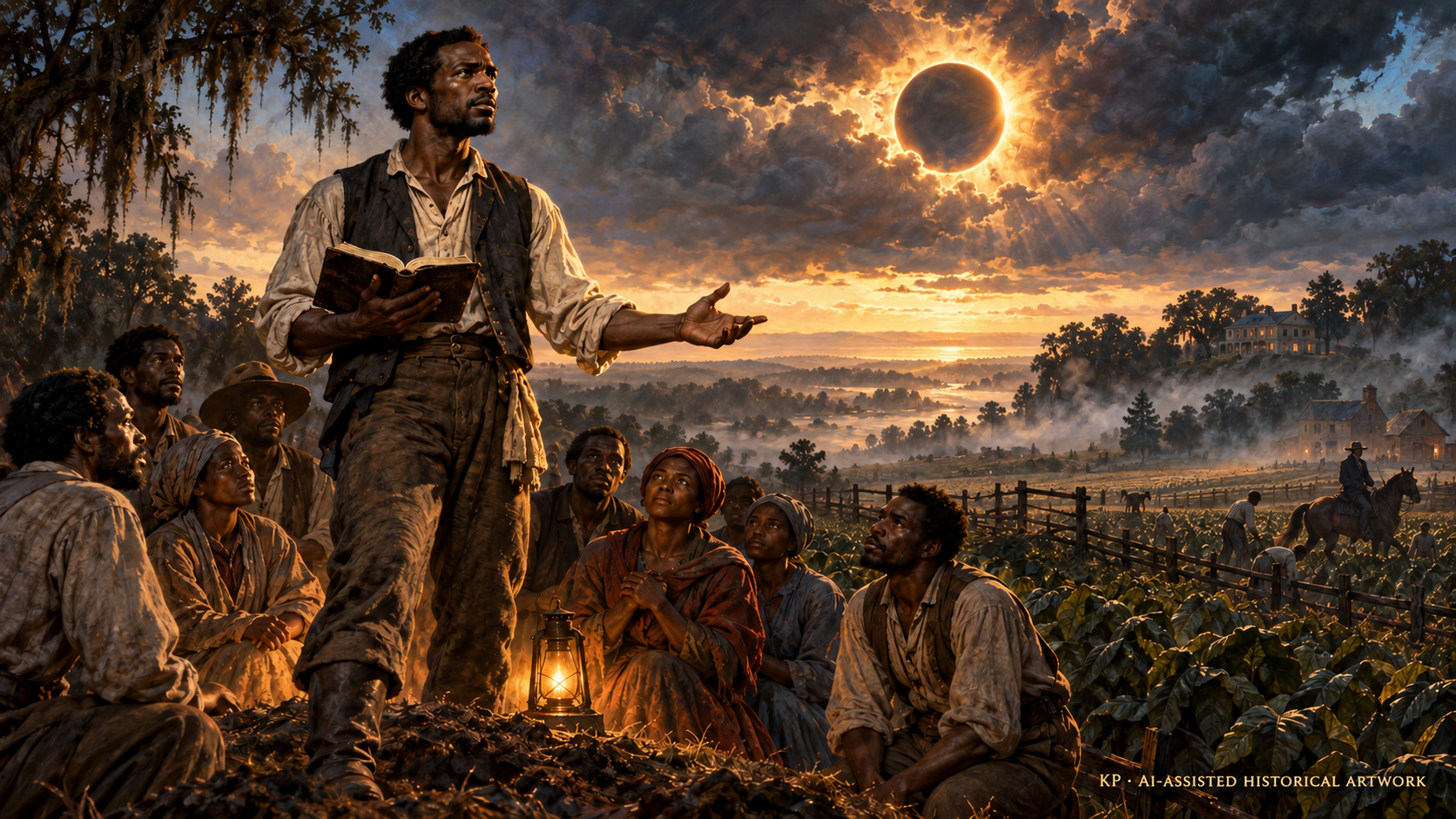
Turner’s religious life shaped both his self-understanding and his authority among other captive people. He recalled devoting much of his free time to fasting, prayer, reflection, and religious study. He believed that the Spirit communicated with him through visions, natural phenomena, and biblical revelation. He understood these experiences not as private consolation but as a divine summons: he had been chosen to confront the system that held Black people in bondage. His spiritual world was deeply biblical, but it was also rooted in the lived realities of captivity, kinship, work, surveillance, punishment, and the longing for freedom.
The surviving evidence indicates that Turner was separated from the Benjamin Turner household as a young man and later lived under several captors. He recalled being placed under an overseer, fleeing into the woods for about thirty days, and returning after interpreting a spiritual vision as an instruction to return temporarily to his “earthly [captor].” By 1830, Joseph Travis held him in Southampton County. His life reminds us that captive people were continually subject to sale, transfer, separation, and the arbitrary oppression of captors.
Turner became known as a preacher and religious leader among people in the Southampton County area. In his own account, he believed that his influence came not through “conjuring” but through what he and others understood as communion with the Spirit. He shared revelations with trusted people and increasingly interpreted signs in the natural world as confirmation that the existing order of the Maafa would be overturned. For Turner, divine judgment and Black liberation were inseparable.
In August 1831, Turner and a small group of trusted men initiated an uprising in Southampton County. The Rising expanded rapidly before local and state forces suppressed it. Rather than retell those events here, the fuller history of the uprising, its participants, its victims, the retaliatory terror that followed, and its legal and political consequences belong in a separate discussion.
After evading capture for roughly two months, Turner was discovered near the place where he had been held in captivity. He was imprisoned in Jerusalem, the Southampton County seat, tried on 5 November 1831, convicted of insurrection, and executed by hanging on 11 November. He was thirty-one years old.
Turner’s death did not end the struggle over his meaning. Anglo-Americans used the uprising to justify harsher surveillance, repression, and restrictions upon Black assembly, education, preaching, movement, and communication. At the same time, Turner’s life became an enduring symbol of Black people’s refusal to accept bondage. He has been remembered as a prophet, freedom fighter, militant abolitionist, martyr, and revolutionary. What remains undeniable is that he rejected the fiction that Black people accepted their captivity, and he placed Black freedom at the center of his religious and political vision.
Sources::
http://www.pbs.org/wgbh/aia/part3/3p1518.html
https://docsouth.unc.edu/neh/turner/turner.html
https://www.britannica.com/biography/Nat-Turner
https://encyclopediavirginia.org/entries/turners-revolt-nat-1831
https://www.natturnerproject.org/