
Sarah Jane Woodson Early was an African American educator, author, and temperance organizer whose career connected the classroom to the broader struggle for Black advancement. Widely recognized as the first African American woman to serve on a college faculty in the United States, she joined Wilberforce University in 1858. Over the following decades, she taught in community schools, served as a principal, addressed audiences across several states, and championed Black women’s capacity to organize and lead.
Her significance extended beyond the distinction of being a “first.” Through education, church work, public speaking, and historical writing, Early helped strengthen institutions through which African Americans pursued knowledge, independence, and collective progress. At the World’s Congress of Representative Women in Chicago in 1893, she brought that work before an international audience, presenting Black women not as passive recipients of assistance but as organizers responsible for transforming their own communities.
A Childhood Rooted in Community
Sarah Jane Woodson was born free in Chillicothe, Ohio, on November 15, 1825. She was the youngest of eleven children born to Thomas Woodson and Jemima Riddle Woodson. Her parents had moved from Virginia to Ohio several years before her birth, and the family became closely associated with Black religious life, education, and community building.
Around 1830, the Woodsons were among the families who established Berlin Crossroads, a Black farming settlement in Jackson County, Ohio. The community developed its own schools, churches, and businesses, creating opportunities for families living within a society that restricted African American advancement. It also became part of the Underground Railroad, and the Woodson home offered shelter to people escaping captivity in the South.
This environment gave Sarah an early example of education as a shared responsibility. Learning was not simply a means of individual achievement: it helped sustain the community and prepare its children for greater independence. Her family’s religious commitments reinforced that outlook. She joined the African Methodist Episcopal Church in 1839, and its networks would remain central to her professional and public life.
Education at Oberlin
In 1852, Woodson entered Oberlin College in Ohio. She completed her studies in 1856, joining the small but growing number of African American women to graduate from the institution. Oberlin’s own register records her qualification as an L.B.
Her commitment to teaching was already evident during her student years. While pursuing her education, she taught in schools associated with the AME Church. After graduating, she continued teaching in Black community schools in Ohio, bringing her education into classrooms where opportunities remained sharply limited by racial discrimination.
For Woodson, teaching became a sustained form of public service. The classroom offered a place to cultivate intellectual confidence and prepare young people for responsibilities extending well beyond school.
A Pioneering Appointment at Wilberforce
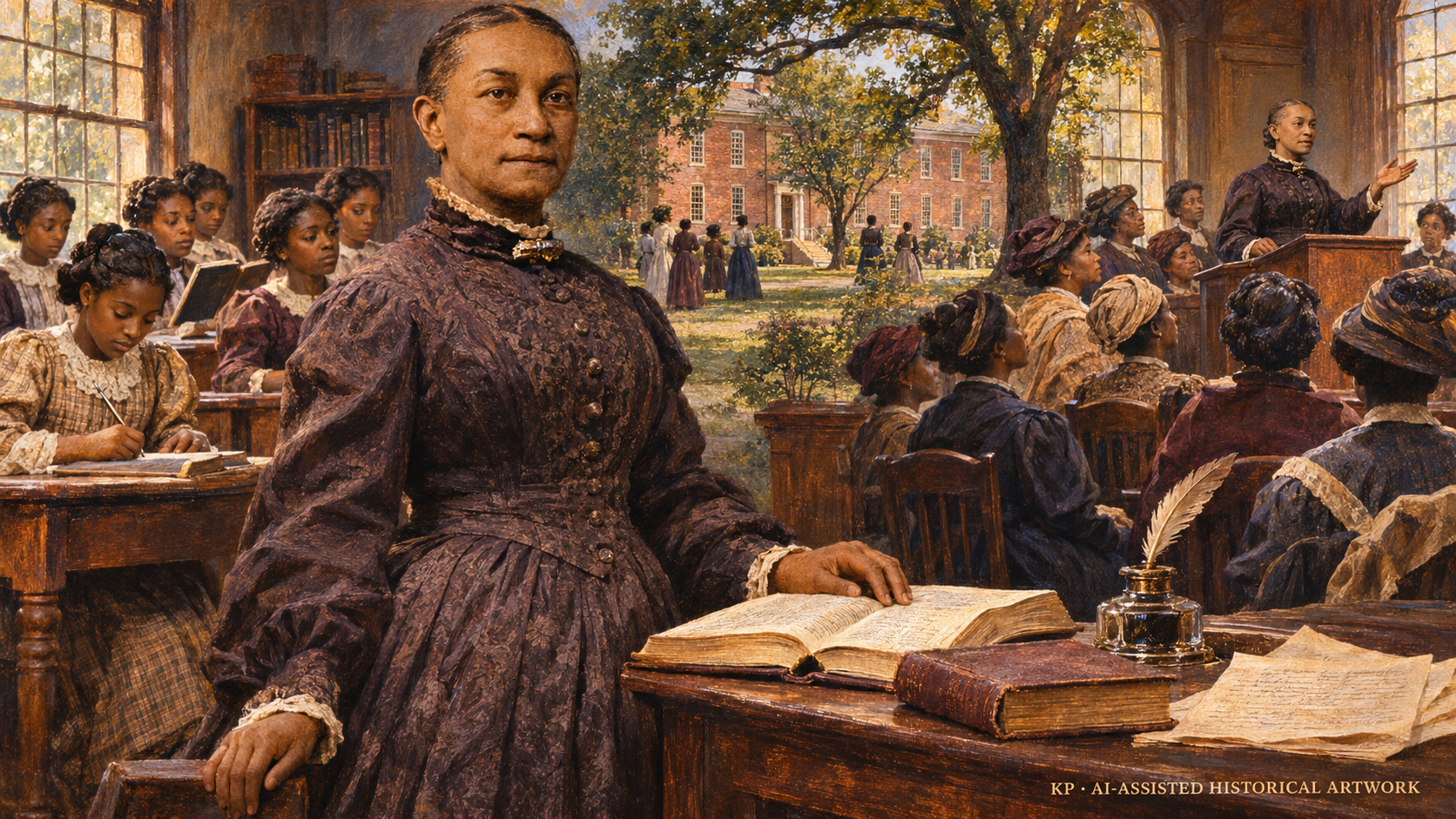
In 1858, Woodson joined the faculty of Wilberforce University near Xenia, Ohio. Her appointment is widely recognized as the first held by an African American woman on a college faculty in the United States. A scholarly account of early Black classicists identifies her position as “Preceptress of English and Latin.”
Founded in 1856 through cooperation between the Methodist Episcopal Church and the African Methodist Episcopal Church, Wilberforce was part of an expanding effort to provide higher education for African Americans. Woodson’s older brother, the minister and educator Lewis Woodson, was one of its founding trustees. Her appointment therefore reflected a broader family commitment to building lasting educational institutions.
The Civil War disrupted Wilberforce’s finances, and the university closed in 1862. The AME Church purchased and reopened it in 1863, establishing its place in history as the first college owned and operated by African Americans. Woodson subsequently returned to its faculty, teaching English and Latin and serving as Lady Principal and Matron. Her responsibilities combined academic instruction with oversight of students’ daily lives.
Her work at Wilberforce challenged the restrictions placed on both African Americans and women in higher education. At a time when Black women had few opportunities to enter college, she occupied a position of intellectual and institutional responsibility.
Teaching in the Post-Emancipation South
In 1868, Woodson went to Hillsborough, North Carolina, to teach at a school for Black girls established with the support of the Freedmen’s Bureau. Her move placed her in the educational rebuilding that followed the Civil War, when newly freed communities pursued schooling with determination.
On September 24 that year, she married the Reverend Jordan Winston Early, a minister whose work had helped establish and expand the AME Church in the western and southern United States. Their marriage brought together two people already devoted to education, religious organization, and community service.
The couple subsequently lived in Tennessee, where Sarah continued her educational career. Over the next two decades, she taught in communities where her husband received ministerial appointments and served as principal of schools in four cities. Their work frequently overlapped: schools, congregations, Sunday schools, and charitable activities formed interconnected parts of community life.
Her contribution was not confined to formal teaching. In her account of their shared work, she described involvement in Sunday schools, prayer meetings, visits to the sick, assistance to people in need, fundraising, and educational activities. These responsibilities reveal the breadth of public service undertaken by women whose influence was not always reflected in official church titles.
By 1888, Sarah had retired from teaching, and Jordan had ceased accepting regular ministerial appointments. They settled in Nashville, Tennessee, but her retirement from the classroom did not end her public work.
Temperance and Women’s Public Leadership
Early became increasingly active in the temperance movement, which advocated abstinence from alcohol. From 1888 to 1892, she served as national superintendent of the Black division of the Woman’s Christian Temperance Union, then designated the “Colored Division.” In this role, she traveled extensively and delivered more than one hundred lectures across five states.
Temperance organizing gave her another platform from which to address questions of family welfare, education, and community responsibility. It also extended the leadership she had exercised in schools and churches into a national women’s organization. Her work involved not only speaking but encouraging collective action across dispersed communities.
The scale of her lecturing demonstrates that she was an experienced public advocate as well as an educator. Long before she appeared at the Chicago congress, she had developed a public voice through years of teaching, organizing, and addressing audiences.
Speaking for Black Women’s Collective Achievement
In 1893, Early participated in the World’s Congress of Representative Women in Chicago, held in connection with the World’s Columbian Exposition. She was one of six African American women invited to speak, alongside Hallie Quinn Brown, Anna Julia Cooper, Fanny Jackson Coppin, Frances Ellen Watkins Harper, and Fannie Barrier Williams.
Her address, “The Organized Efforts of the Colored Women of the South to Improve Their Condition,” examined what Black women had accomplished in the twenty-eight years since emancipation. Rather than presenting progress as something bestowed from outside, Early emphasized the initiative, foresight, and collective labor of African American women themselves.
She described women forming associations to improve their communities and argued that this work had taught them “the art of self-government.” Their organizations were not merely charitable enterprises: they were places where women developed leadership, managed resources, and shaped a shared future.
Early also looked ahead. What might appear modest to outside observers, she argued, contained the promise of much greater change:
“These feeble efforts at organization to improve our condition seem insignificant to the world, but this beginning, insignificant as it may seem, portends a brighter and nobler future.”
Her speech expressed a conviction that had guided her own career: meaningful advancement rested on people’s capacity to educate themselves, build institutions, and act together.
Writing and Preserving Black Religious History
In 1894, Early published Life and Labors of Rev. Jordan W. Early, One of the Pioneers of African Methodism in the West and South. Issued in Nashville by the Publishing House of the AME Church Sunday School Union, the book traced her husband’s life and his work in establishing congregations and extending the church’s reach.
Although centred on one minister, the biography also preserved a broader history of Black religious institution building. Its introduction explained the importance of recording the experiences of the early pioneers of African Methodism, whose work had not always been documented. Early recognised that the absence of written records could obscure the achievements of people who had devoted their lives to creating institutions for others.
The book therefore added another dimension to her educational work. After decades of teaching, she became a custodian of historical memory, preserving an account of the people and networks through which African Americans developed religious independence and community leadership.
Final Years and Legacy
Sarah Jane Woodson Early died on August 15, 1907, aged eighty-one. She was buried in Greenwood Cemetery in Nashville.
Her life joined several generations of Black institution-building: the free community of her Ohio childhood, the early development of Wilberforce University, the expansion of education after emancipation, and the growing public influence of Black women’s organizations. Across these settings, she worked as a teacher, principal, organizer, speaker, and author.
Her pioneering college appointment remains an important milestone, but it represents only one part of her achievement. In classrooms, congregations, public meetings, and print, Early helped make knowledge a collective resource—and insisted that Black women’s work to create a better future deserved recognition.
Sources:
http://madamenoire.com/260874/black-women-pioneers-sarah-jane-woodson-early-paves-the-way-for-black-educators/
http://www.womenhistoryblog.com/2015/03/sarah-jane-woodson-early.html
http://www.aaregistry.org/historic_events/view/sarah-jane-early-fought-education-black-women
https://www.womenhistoryblog.com/2015/03/sarah-jane-woodson-early.html
https://camws.org/meeting/2007/program/abstracts/10A4%20Ronnick.htm
https://libguides.oberlin.edu/c.php?g=1395168&p=10318986
https://amsterdamnews.com/news/2019/10/17/sarah-jane-woodson-early-notable-teacher-and-membe/
https://manifold.sc.edu/read/community-and-critique-the-rhetorical-activism-of-black-american-women-s-memory-work/section/90e6cbdd-9b0a-4ce5-9ef6-101f74b5cfc9
https://docsouth.unc.edu/neh/early/early.html