
“Samuel Coleridge-Taylor is today all but forgotten in the country of his birth. The works of this talented composer are now out of fashion; and little of his music is available in printed form.”
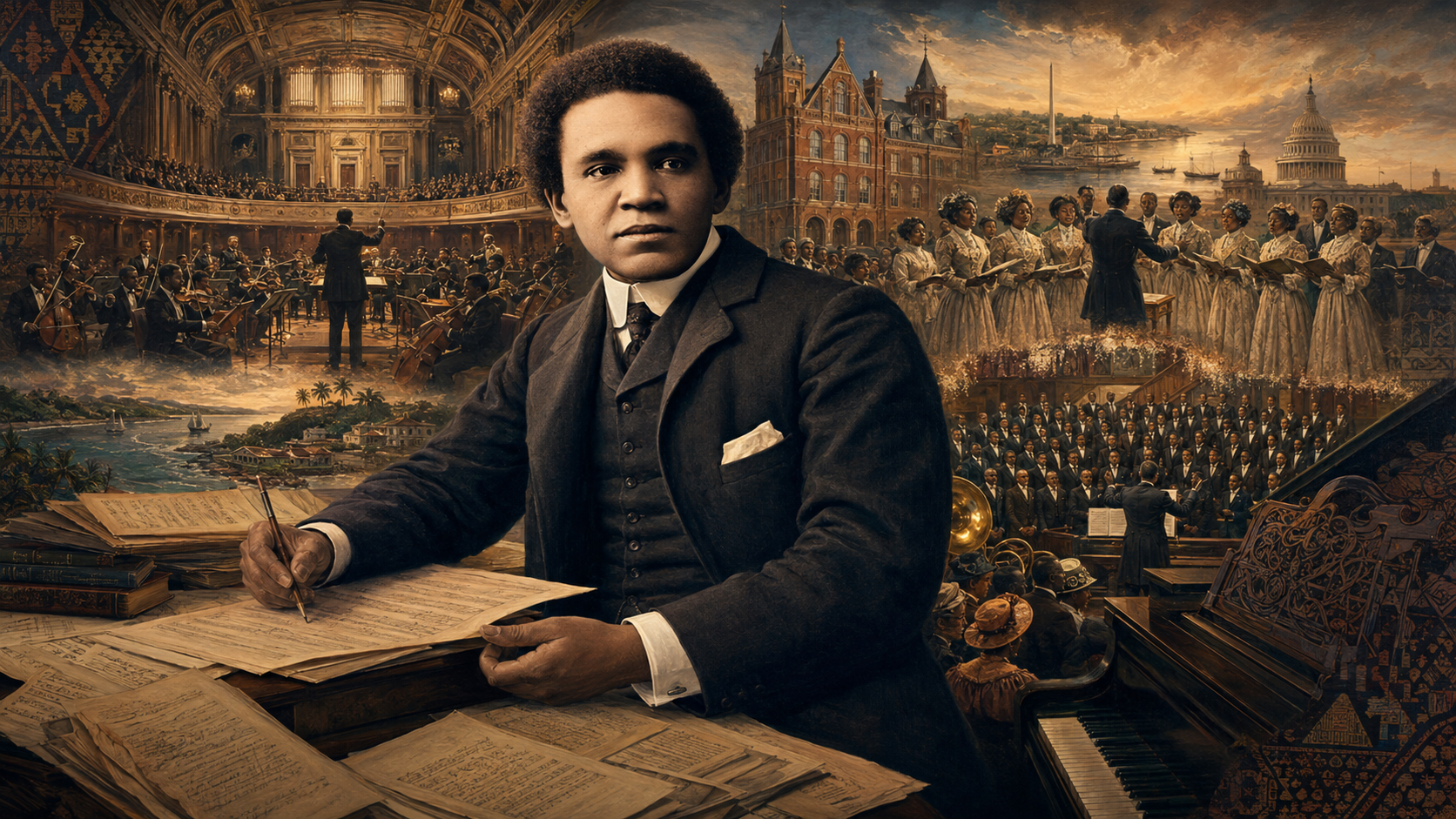
Samuel Coleridge-Taylor was one of Britain’s most celebrated young composers of the late Victorian and Edwardian periods. A British composer and conductor of African and English heritage, he identified himself as an “Anglo-African” and became an important cultural figure for Black audiences on both sides of the Atlantic. His work included compositions with African and African-diasporic titles and themes, among them African Romances, African Suite, and Twenty-Four Negro Melodies.
Samuel Coleridge-Taylor was born on 15 August 1875 at 15 Theobalds Road, Holborn, London. His mother, Alice Hare Martin, was English. His father, whom he never knew, was Dr Daniel Peter Hughes Taylor, a Krio man from Sierra Leone who had come to London to study medicine.
At fifteen, Coleridge-Taylor entered the Royal College of Music as a violin student. His aptitude for composition soon became unmistakable, and he transferred to composition, studying under Charles Villiers Stanford. He attended the College from 1890 to 1897 and won the Lesley Alexander composition prize in successive years, 1895 and 1896. During this period, he produced substantial chamber works, including the Nonet of 1894 and the Clarinet Quintet of 1895. When the Clarinet Quintet was revived at the Newport Music Festival in 1973, a New York Times critic called it “something of an eye-opener” and “an assured piece of writing in the post-Romantic tradition, sweetly melodic without being cloying.”
In 1896, Coleridge-Taylor met the African American poet Paul Laurence Dunbar in London. He set several of Dunbar’s poems, including those grouped as African Romances, and the two men collaborated in public performances. He also encountered Frederick J. Loudin, a former director of the Fisk Jubilee Singers, whose work helped introduce African American spirituals to British audiences.
By 1898, Edward Elgar was describing Coleridge-Taylor as “far and away the cleverest fellow amongst the young men.” That same year, the premiere of Hiawatha’s Wedding Feast, based on Henry Wadsworth Longfellow’s poem The Song of Hiawatha, brought him extraordinary public success. It was later joined by The Death of Minnehaha (1899) and Hiawatha’s Departure (1900), forming the Song of Hiawatha trilogy. These cantatas became among the most widely performed choral works in Britain in the early twentieth century.
Hiawatha also had a remarkable afterlife among Black musical communities in the United States. The all-Black Coleridge-Taylor Choral Society of Washington, DC, invited the composer to conduct performances during his American tours of 1904, 1906, and 1910. In the United States, he was widely celebrated as an international Black cultural figure at a time when African Americans faced systematic exclusion from many artistic and educational institutions. During his first American visit, he was received by President Theodore Roosevelt at the White House.
Coleridge-Taylor was also involved in Pan-African circles. He participated in the First Pan-African Conference held in London in 1900, and his friendship with Dunbar, engagement with African American audiences, and musical interest in Black cultural traditions made him a significant figure in transatlantic Black intellectual and artistic life.
Despite his prominence, Coleridge-Taylor had to sustain himself through a demanding combination of composition, teaching, conducting, adjudicating, and private tuition. From 1903 until his death, he taught composition at Trinity College of Music, and he later also held a composition post at the Guildhall School of Music. He conducted the Handel Society and the Rochester Choral Society, as well as orchestras and choral societies around Britain.
In late August 1912, Coleridge-Taylor collapsed at West Croydon station. Already exhausted by overwork, he developed pneumonia and died at his home, Aldwick, on St Leonard’s Road in Croydon, on 1 September 1912. He was thirty-seven years old.
He was buried in Bandon Hill Cemetery, Wallington. His funeral was a major public event, and a memorial concert at the Royal Albert Hall raised more than £1,400 for his widow, Jessie, and their children. King George V later granted Jessie Coleridge-Taylor an annual pension of £100. Their children, Hiawatha and Gwendolen Avril, both went on to become professional musicians.
Coleridge-Taylor’s death also intensified public concern about the economic vulnerability of composers. Although The Song of Hiawatha had been enormously successful, he had sold its copyright to the publisher Novello early in his career and did not share fully in its subsequent commercial rewards. His case became part of the wider discussion that contributed to the establishment of the Performing Right Society in 1914, which sought to secure income for composers from public performances of their work.
Sources:
http://www.100greatblackbritons.com/bios/samuel_coleridge-taylor.html
http://en.wikipedia.org/wiki/Samuel_Coleridge-Taylor
http://www.bbc.co.uk/music/artists/4ade7e9d-cb1d-4d35-b711-dd970a7c4341
http://www.bl.uk/onlinegallery/features/blackeuro/pdf/coleridge.pdf