
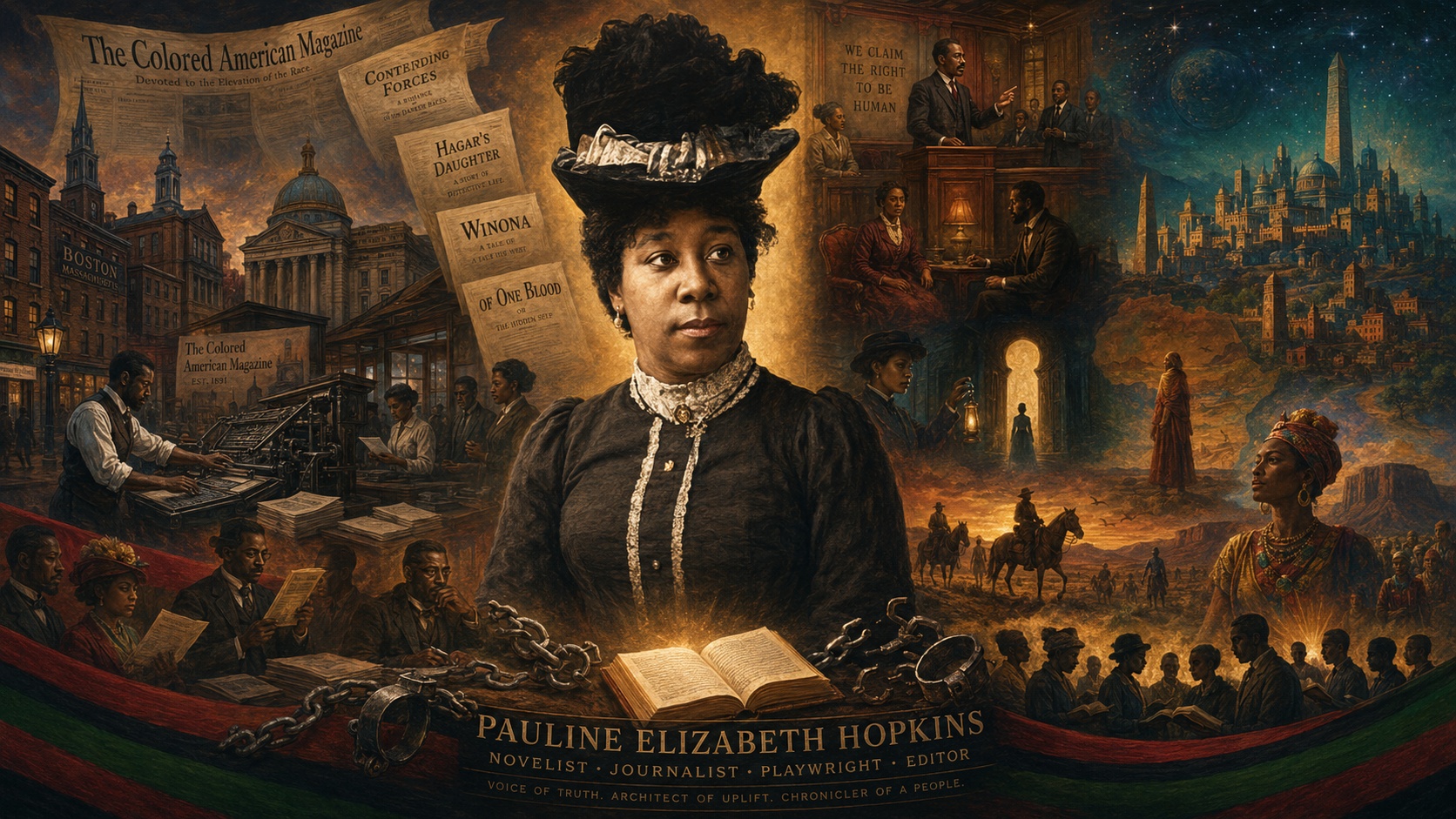
Pauline Elizabeth Hopkins (1859 – August 13, 1930) was a prominent African American novelist, journalist, playwright, historian, and editor. Hopkins was one of the first writers to introduce racial and social themes—notably the advancement of Black people—into nineteenth‑century romance novels, and she believed fiction had great significance for Black life. In the preface to her first novel, she wrote:
“It is a record of growth and development from generation to generation. No one will do this for us: we must ourselves develop the men and women who will faithfully portray the innermost thoughts and the feelings of the [Black] with all the fire and romance which lies dormant in our history.”
Born in Portland, Maine, Hopkins was taken to Boston as a young child and graduated from Boston Girls’ High School. She had her first writing success at fifteen, winning a prize for best essay on “Evils of Intemperance and Their Remedy” in a contest among Black students in local schools. She became a playwright in 1879, when the Hopkins Colored Troubadours (including her and her family) performed her musical drama Escape from Slavery, later renamed Peculiar Sam.
Her short story “Talma Gordon,” published in 1900, is often named as the first mystery story by an African American author. That same year, she published her most noted novel, Contending Forces: A Romance Illustrative of Negro Life North and South. Hopkins began to achieve wider recognition as a fiction writer in her forties through her association with The Colored American Magazine. She authored serialized novels (some under the name Sarah A. Allen), short stories, and dramas for the journal, and when the magazine changed hands in May 1903, she was appointed literary editor; under her editorship, its circulation rose to around 15,000. Among the writers the journal published were Frances E. W. Harper and Angelina Weld Grimké.
She traveled and lectured throughout the USA, seeking support for The Colored American, and was a founder of the Colored American League, which sought subscriptions and business for the magazine. Eventually, the magazine was sold and moved to New York; Hopkins initially served as assistant editor but resigned some months later. She continued to write and later edited the short‑lived New Era, then spent the remainder of her years working as a stenographer at the Massachusetts Institute of Technology.
Hopkins died in Cambridge, Massachusetts, in 1930, from burns sustained in a house fire.
In 1988, Oxford University Press released The Schomburg Library of Nineteenth‑Century Black Women Writers, with Professor Henry Louis Gates Jr. as the series’s general editor. Hopkins’s Contending Forces: A Romance Illustrative of Negro Life North and South (with an introduction by Richard Yarborough) was reprinted as part of this series, along with her magazine novels, which were issued with an introduction by Hazel Carby.
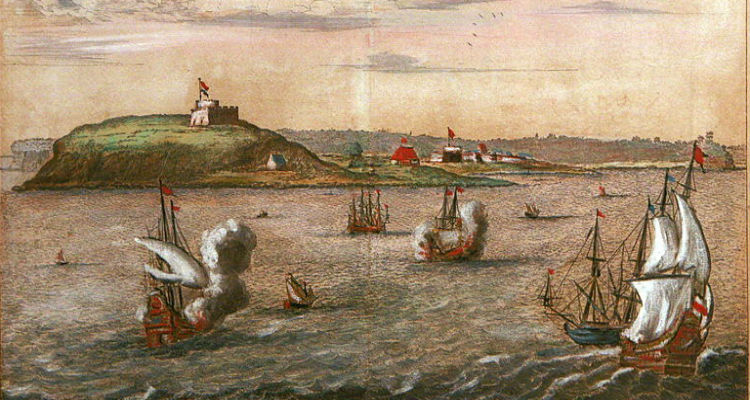
Across four major novels, Hopkins used popular romance and adventure forms to confront the afterlives of the Maafa, racial violence, and caste prejudice. Together they trace a continuous argument: that Black survival, self‑knowledge, and collective uplift require both economic power and a fearless reckoning with history. Her debut, Contending Forces: A Romance Illustrative of Negro Life North and South (1900), follows a mixed‑race family from captivity in Bermuda and the U.S. South into the precarious respectability of post‑Civil War Boston, braiding courtroom drama, sentimental romance, and social critique to expose how the “contending forces” of European oppression and Black resistance still shape Black lives long after formal emancipation.
Hagar’s Daughter: A Story of Southern Caste Prejudice (1901–1902) is a sensation and detective novel that centers on a light‑skinned Black woman separated from her mother and raised as white. Through hidden identities, investigations, and revelations of ancestry, the book attacks the absurdity of racial “caste” and is often noted as the earliest known African American novel to feature Black detectives.
Winona: A Tale of Negro Life in the South and Southwest (1902) turns to the U.S.–Mexico borderlands, following Winona, the daughter of a Native American leader, and Judah, her Black foster brother, amid Reconstruction‑era conflict. Here Hopkins layers questions of race, gender, empire, and Indigenous dispossession, using melodrama and frontier adventure to insist on the possibility of ethical relations across violently policed racial lines.
Her final novel, Of One Blood: Or, The Hidden Self (1902–1903), sends the passing Black doctor Reuel Briggs from Boston to a hidden Ethiopian city, where he uncovers buried histories of African civilization and his own lineage. Combining gothic romance, spiritualism, and Pan‑African vision, Hopkins uses this story to challenge scientific racism and to argue that humanity is literally “of one blood,” even as European oppression denies that kinship.
Source:
Daughters of Africa by Margaret Busby
https://en.wikipedia.org/wiki/Pauline_Hopkins
https://www.ebsco.com/research-starters/literature-and-writing/magazine-novels-pauline-hopkins-analysis-major-characters
https://multoghost.wordpress.com/2020/06/17/women-writers-of-folklore-and-the-fantastic-pauline-e-hopkins/