
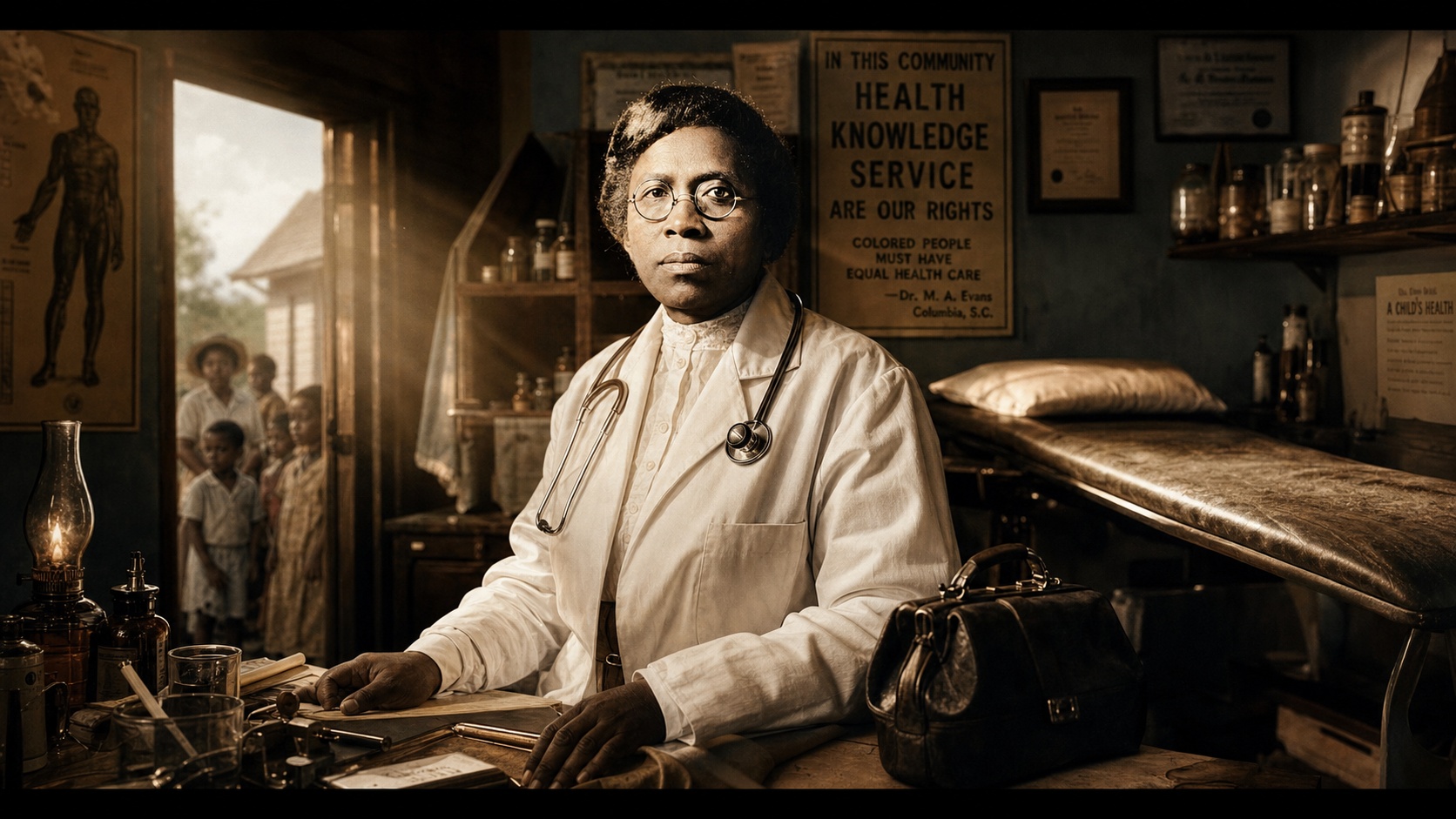
Matilda Arabella Evans was the first African American woman licensed to practice medicine in South Carolina. She became a powerful advocate for improved health care for African Americans, particularly children, insisting that health care was a basic right of citizenship. Her survey of Black schoolchildren’s health in Columbia became the basis for a permanent health examination program within the South Carolina public school system. She also founded the Columbia Clinic Association, which provided health services and health education to families, and later extended this work through the Negro Health Association of South Carolina to educate families across the state about sound health practices and sanitation.
Matilda Arabella Evans was born on May 13, 1866 (some sources give 1872) to Anderson and Harriet Evans in Aiken, South Carolina, the eldest of three children. She spent much of her early life working in the fields alongside her family. Evans attended the Schofield Industrial School, founded by Philadelphia Quaker educator Martha Schofield. Encouraged by Schofield, she enrolled at Oberlin College in Ohio, attending on scholarship for almost four years before leaving in 1891 to pursue a medical career.
After teaching at the Haines Institute in Augusta, Georgia, and at the Schofield School, Evans entered the Woman’s Medical College of Pennsylvania in 1893. She earned her medical degree in 1897 and gave up her earlier plan to become a medical missionary in Africa, choosing instead to return to South Carolina. Evans moved to Columbia, where she opened a private practice and became the city’s first Black woman physician and, according to some sources, its first woman physician of any race. As the first African American woman licensed to practice medicine in the state, she treated both whyte and Black patients and was soon in great demand. Evans built a large clientele of affluent whyte women whose fees enabled her to care for poor Black women and children at little or no cost. A skilled surgeon, she also practiced obstetrics and gynecology and, for several years, cared for patients in her own home.
In 1901, Evans founded Taylor Lane Hospital in Columbia, the first Black-owned hospital in the city and an institution that allowed other Black physicians to admit and treat patients. After a fire destroyed the facility, she rebuilt and later established St. Luke’s Hospital and Training School for Nurses, which she directed until 1918. Through this work she created spaces for both medical care and professional training, helping to build a cadre of Black nurses and health workers in Columbia.
Evans was deeply rooted in community work. In addition to her hospitals, she helped create a community health organization, a community center, and a boys’ swimming pool—Dr. Evans Park and Swimming Pool—among many other initiatives that benefited Columbia’s Black community. Throughout her life she adopted or fostered numerous children (some accounts say at least seven adopted and more than a dozen fostered), often taking in children left at her practice or sent by relatives who had died. She provided them with a stable home and made it possible for many to attend college. People of all ages enjoyed the recreational facilities she developed on her 20‑acre farm, where she also ran a program of structured activities for underprivileged boys.
Evans had a special concern for Black children and for public health. She believed that health care, like education, should be guaranteed by the government. She strongly advocated public health measures and petitioned the South Carolina State Board of Health to provide free vaccines for Black children. In 1916 she founded the Negro Health Association of South Carolina to promote health education and preventive care, and in 1930 she established the Columbia Clinic Association, which offered free or low‑cost health services—such as vaccinations, check‑ups, and health instruction—to economically marginal families, especially children. She also founded the Good Health Association of South Carolina to encourage people to improve their own health through better hygiene and sanitary practices.
During World War I, Evans volunteered with the Medical Service Corps of the United States Army. In 1922, she became the only Black woman in the United States to serve as president of a state medical association when she was elected president of South Carolina’s Palmetto Medical Association. She also served as a regional vice president of the National Medical Association and held leadership roles in local medical societies and her Episcopal church. Evans founded and edited The Negro Health Journal of South Carolina, a weekly or monthly publication that promoted public health education and shared practical advice on disease prevention, hygiene, and child welfare.
Charity, compassion, and a love of children were the hallmarks of Evans’s career. She often charged only nominal fees and traveled by bicycle, horse, or buggy to reach patients who could not come to her surgery. Her school physical examinations and immunization programs saved the lives of countless young children, and by 1930 she was operating a clinic that provided free treatment and vaccinations for African American children in Columbia. Outside of medicine, Evans enjoyed swimming, dancing, knitting, and playing the piano, and she ran her own farm much like the one on which she had grown up. Richland Memorial Hospital in Columbia later established an award in her honor, acknowledging the immense legacy she left to the city and the state.
Evans never married. She died at the age of 69 on November 17, 1935, in Columbia, South Carolina.
Source:
https://www.nlm.nih.gov/changingthefaceofmedicine/physicians/biography_107.html
https://en.wikipedia.org/wiki/Matilda_Evans