

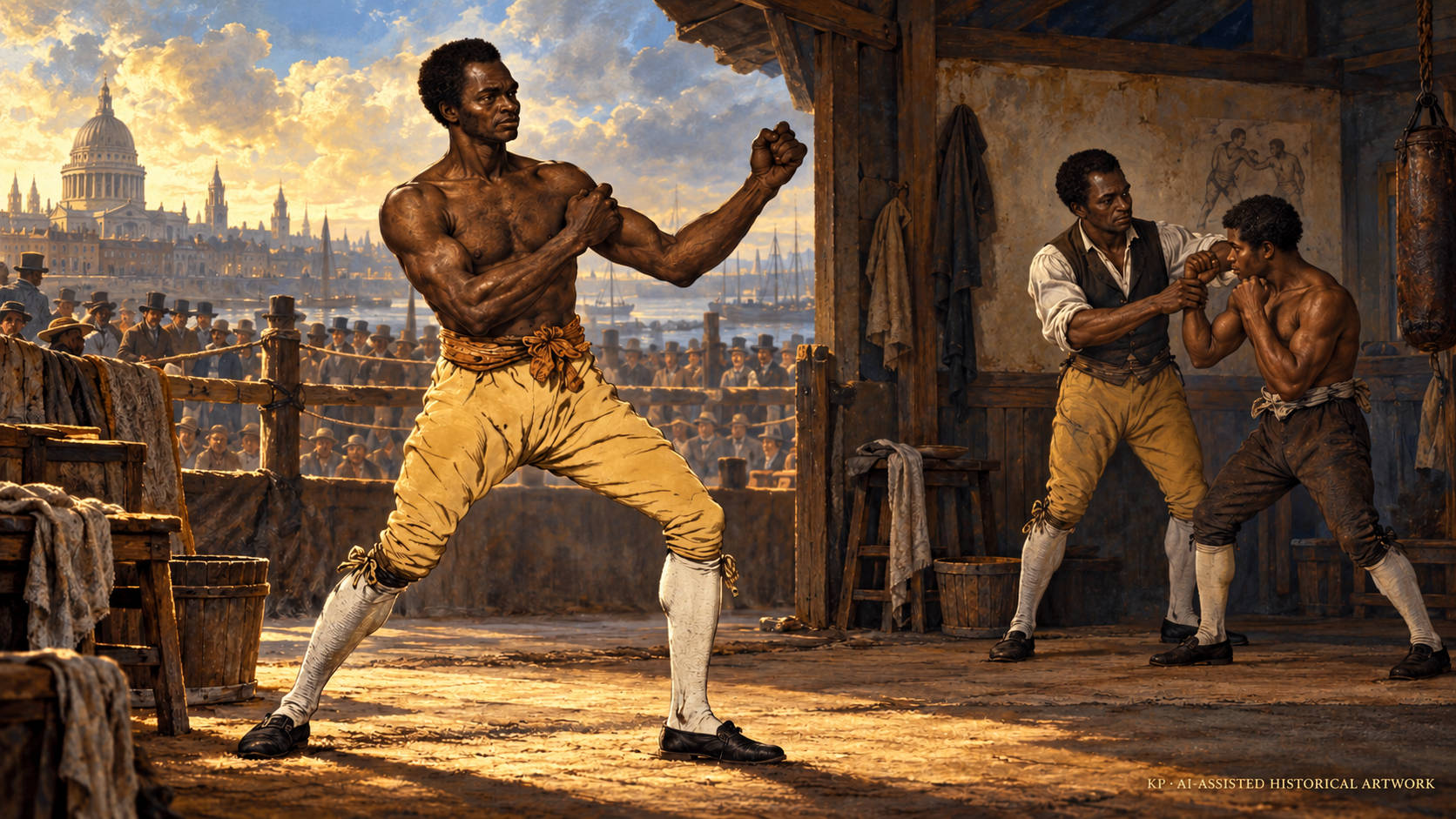
Bill Richmond was an American-born, British-based bare-knuckle boxer who rose from captivity to become one of Britain’s earliest Black sporting celebrities. Celebrated for his intelligence, quick hands, and elusive footwork, he became both an accomplished fighter and a respected boxing instructor in Georgian England. His achievements challenged racial prejudice in a society where Black people’s abilities and claims to equality were routinely questioned.
Richmond was born on 5 August 1763 in Cuckold’s Town, now Richmond Town, on Staten Island, New York. During the American War of Independence, he attracted the attention of the British officer Hugh Percy. According to accounts of his early life, Percy noticed the teenager’s fighting ability during a tavern brawl involving British soldiers and later arranged contests in which Richmond fought soldiers for his guests’ entertainment.
In 1777, Percy helped secure Richmond’s freedom and brought him to England. There, he supported Richmond’s education and arranged an apprenticeship with a cabinetmaker in Yorkshire. Richmond married a local woman named Mary and had several children before establishing himself in London.
His life in England was not free from racial hostility. The boxing chronicler Pierce Egan described incidents in which Richmond fought men who had insulted or threatened him. In one account, he was abused for walking with an English woman. Such stories reveal both the prejudice he encountered and his determination to defend his dignity.
Making His Name in the Prize Ring
Although Richmond had fought earlier contests, his career in the London prize ring took shape relatively late in life. In 1804, at 40, he challenged the experienced boxer George Maddox and lost. Accounts differ over the date and duration of this early encounter, but the defeat did not discourage him.
In 1805, Richmond defeated a Jewish boxer known as Youssop and then overcame Jack Holmes. These victories established his reputation and led to a contest with Tom Cribb at Hailsham, Sussex, on 8 October 1805. Cribb would later become England’s champion, but their encounter was not a championship bout.
Known in boxing circles as the “Black Terror,” Richmond developed a style built around speed, judgment, and evasive movement. Rather than relying on strength alone, he sidestepped opponents’ attacks and countered as they advanced. His ability to fight effectively while retreating helped him compete against younger and heavier men.
Richmond was forty-two when he faced the twenty-four-year-old Cribb. The contest lasted about ninety minutes, and Cribb eventually prevailed. Although Richmond lost, his performance against a much younger, heavier opponent demonstrated his skill and endurance. It was the second of the two defeats generally recorded in his boxing career.
Richmond subsequently returned to winning form. In 1809, he avenged his earlier defeat by beating Maddox in a contest reported to have lasted fifty-two rounds. His success enhanced his standing among boxing enthusiasts and helped him acquire the Horse and Dolphin public house near Leicester Square.
Trainer, Publican and Mentor
Richmond became an influential figure beyond his own contests. As a publican, trainer and boxing instructor, he moved within a sporting world that brought working men into contact with aristocrats, politicians and writers. Among those who sought his instruction were George Gordon Byron and the essayist William Hazlitt.
One of his most important partnerships was with Tom Molineaux, another formerly enslaved American who came to England to pursue boxing. Recognizing Molineaux’s potential, Richmond trained and supported him as he challenged Tom Cribb for the English championship. Their collaboration put two Black men at the center of some of the period’s most significant sporting events.
Molineaux’s first championship contest with Cribb, in December 1810, ended in controversy. A crowd invasion and an alleged delay that gave Cribb extra time to recover fueled the enduring argument that Molineaux was denied a fair chance to win. Cribb also won their rematch in 1811. These encounters carried significance beyond the ring: contemporary commentary revealed considerable anxiety about a Black man becoming England’s boxing champion.
Richmond also continued to fight successfully into his fifties. In 1814, he defeated Jack Davis, and the following year he overcame the much younger Tom Shelton. His longevity, tactical intelligence, and accomplishments as an instructor secured his place among the leading figures of British boxing.
Later Life and Legacy
In 1821, Richmond was among the boxers selected to serve as ushers at George IV’s coronation. This was a notable public honor, although it should not be described as a royal decoration for introducing boxing to Britain.
In later life, Richmond and his former opponent Tom Cribb became close friends. Richmond spent his final evening at Cribb’s public house, the Union Arms, before his death in London in December 1829, aged sixty-six.
Bill Richmond never became England’s boxing champion, but his importance extends far beyond a title. Born enslaved, he built a life as a skilled craftsman, fighter, entrepreneur, and teacher, becoming a prominent Black figure in British public life. In 2005, the International Boxing Hall of Fame inducted him in recognition of his pioneering contributions to the sport.
Source:
https://en.wikipedia.org/wiki/Bill_Richmond
http://www.blackpast.org/gah-richmond-bill-1763-1829
http://bleacherreport.com/articles/266164-the-black-terror-in-trafalgar-square
http://www.ibhof.com/pages/about/inductees/pioneer/richmond.html
http://billrichmond.blogspot.com/2016/

One Response
I have written a lot about Bill Richmond, including a whole, as yet, unpublished novel. You may like this piece. http://idiscoveredamerica.com/?p=292.