
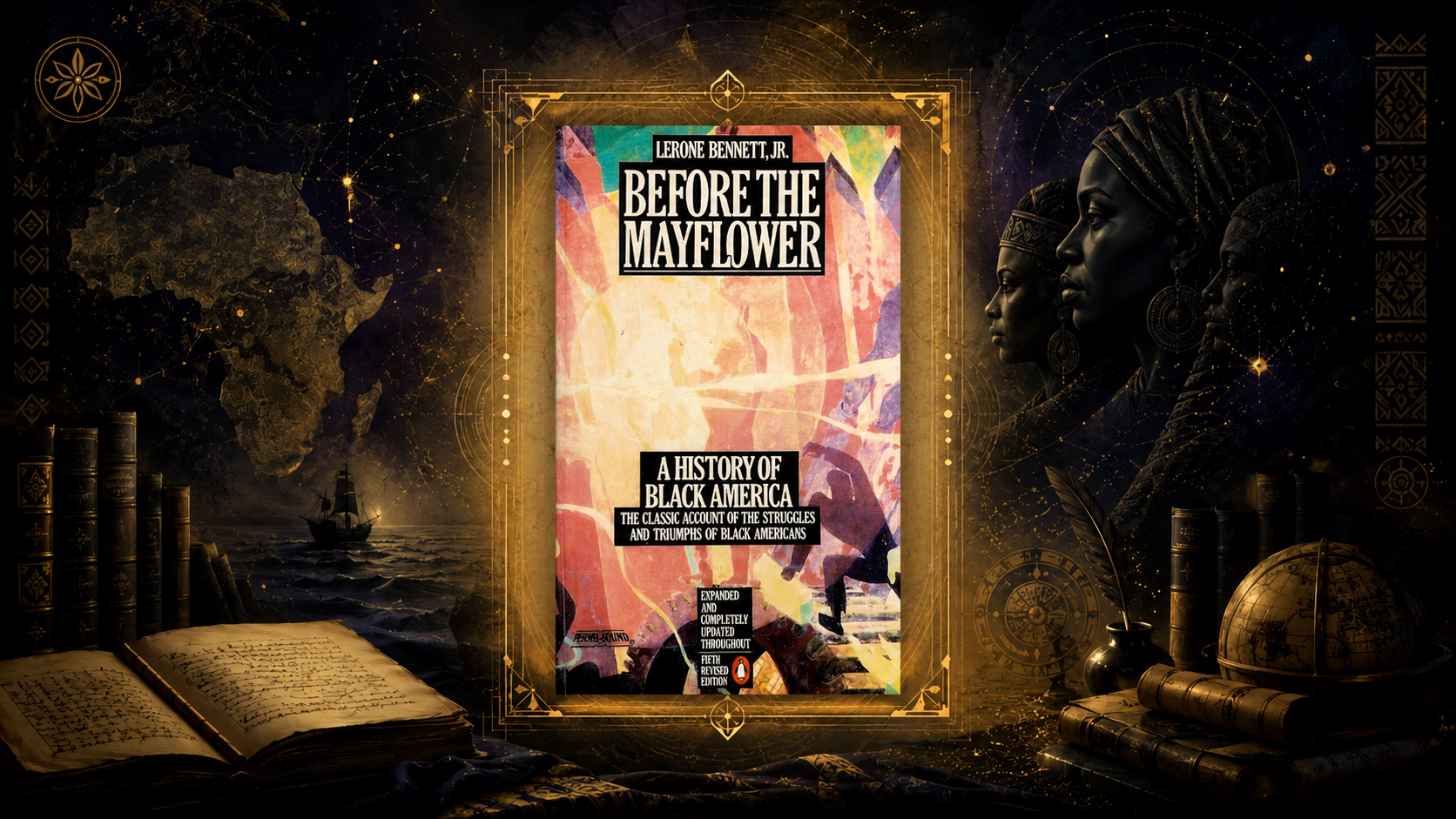
Lerone Bennett Jr.’s Before the Mayflower: A History of Black America is a landmark work of popular history: expansive, assertive, and written to correct the profound exclusions of traditional United States narratives. Originally published in 1962 and revised repeatedly in later editions, the book grew out of Bennett’s work at Ebony and traces Black life from African societies before the transatlantic trafficking through captivity, emancipation, Reconstruction, Jim Crow, the Great Depression, war, migration, and the twentieth-century freedom struggle.
Its title makes a pointed historical intervention. Bennett reminds readers that Africans were present in English North America before the arrival of the Mayflower in 1620: the “twenty [Africans]” brought to Virginia in 1619 predate the celebrated Puritan landing. More importantly, he contests the assumption that Black history begins with bondage. His opening movement restores Africa as a place of civilization, political organization, artistic achievement, and historical agency, thereby challenging a national story that too often treats African-descended people as late arrivals or passive subjects of history.
Bennett’s great strength is his ability to make a vast history readable without stripping it of conflict. He moves fluently between institutions and individual lives, showing how law, labor, religion, war, racial violence, and political struggle shaped Black communities across generations. Enslaved people appear not simply as victims but as thinkers, workers, parents, rebels, organizers, soldiers, and creators of culture. The chapters on Reconstruction are especially valuable for emphasizing that Black political participation and institution-building followed emancipation, before white supremacist violence and law worked to reverse many of those gains.
The book’s prose has the urgency of a journalist and the ambition of a public educator. At moments, its broad survey form can compress regional differences, historical debate, and the complexity of individual periods. Readers should therefore approach it alongside more recent specialist scholarship, particularly when researching particular events or claims. Yet this limitation does not diminish its importance.
Before the Mayflower remains an indispensable entry point into African American history because it insists that Black people belong at the center of the American story, not at its margins. Its lasting achievement is to make historical recovery a form of intellectual and civic justice.
“Before the Mayflower grew out of a series of articles Bennett published in Ebony magazine in 1962, regarding “the trials and triumphs of a group of Americans whose roots in the American soil are deeper than the roots of the Puritans who arrived on the celebrated Mayflower a year after a ‘Dutch man of war’ deposited twenty [Africans] at Jamestown.” Bennett’s history is infused with a desire to set the record straight about the powerful African of antiquity. While not a fresh history, it provides a solid synthesis of current historical research and a lively writing style that makes it accessible and engaging reading. The book is comprehensive and detailed, providing little-known and often overlooked facts about the lives of Black folks through slavery, Reconstruction, America’s wars, the Great Depression, and the Civil Rights Movement. The book includes a useful timeline and some fascinating archival images.” –Sacred Fire: The QBR 100 Essential Black Books