
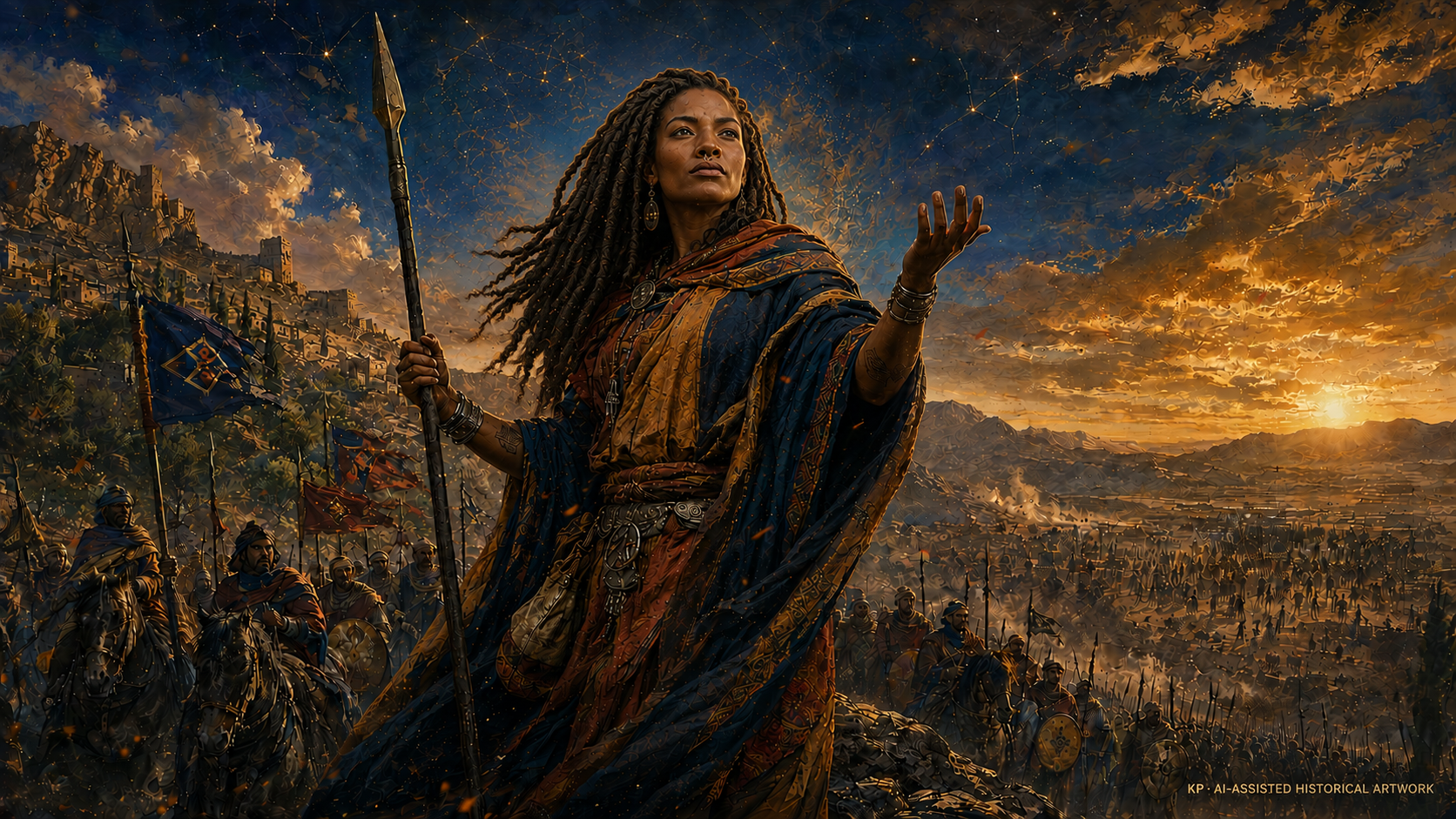
Dihya, later remembered as al-Kāhina, was an Amazigh political and military leader associated with the Aurès region of what is now northeastern Algeria. She led one of the most significant resistance movements to Umayyad expansion into the Maghreb at the end of the seventh century.
Her name appears in later sources in several forms, including Dihya, Dahia, Damya, and Damiya (Dihya means “the beautiful gazelle” in the Tamazight language of the Imazighen). She is best known by the Arabic epithet al-Kāhina, commonly translated as “the seer,” “priestess,” or “soothsayer.” Later traditions attribute prophetic gifts to her and portray her as able to foretell future events. Her own biography, however, survives principally through Arabic narratives composed after the period in which she lived, making it difficult to separate history from legend. Therefore, surviving accounts of Dihya’s life combine historical memory with later Arabic chronicles, oral tradition, and legend.
Later Arabic accounts describe Dihya as dark-skinned, with a mass of hair and huge eyes. Other traditions portray her as tall and “great of hair,” which is usually interpreted to mean she wore her hair long and bunched in dreadlocks. She was represented as a woman endowed with prophetic powers and was consequently depicted as a seer, sorceress, or witch. Some accounts say that she had three sons: two biological sons and an adopted Arab captive officer. In later folklore, these details were woven into portrayals of her supernatural authority.
Another legend recounts that, in her youth, Dihya liberated her people from a tyrant by agreeing to marry him and then killing him on their wedding night. These stories are best understood as elements of her evolving legend rather than verified history.
Her religious identity remains uncertain. Later writers variously described her as Jewish, Christian, or a follower of indigenous Amazigh religious traditions. Some traditions associate her with the Jarawa, a group later placed within the wider Zenata confederation, but neither her precise tribal affiliation nor her status as a princess or queen of an autonomous state can be firmly established. Claims that she descended from the Beta Israel community of Ethiopian Jews belong to a much later and unverified genealogical tradition.
The Muslim conquest of Egypt began in 639–42. Campaigns westward into Cyrenaica, Tripolitania, and Ifriqiya followed over several decades; this was not the immediate conquest of all North Africa. At the time, the region included Byzantine-held coastal cities, autonomous and semi-autonomous Amazigh communities, and a range of local political formations. Umayyad armies faced persistent resistance, often from Amazigh leaders and, at times, from Amazigh-Byzantine alliances.
Before Dihya emerged as the foremost leader of resistance, the Amazigh leader Kusayla—also rendered Aksel, Kusaila, Caecilius, or Kusiela—had organized a major challenge to the advancing armies. Later traditions sometimes describe Dihya as his daughter or niece, and that she proved herself in battle as a competent military commander, alongside him. Kusayla was killed in fighting before 688. Dihya thereafter became associated with the most formidable phase of resistance in the Aurès and adjoining regions.britannica+1
Little is known of Dihya’s life outside her conflict with the Umayyad commander Ḥassān ibn al-Nuʿmān, who led a major campaign in Ifriqiya during the 690s. Dihya’s forces inflicted a serious defeat on Ḥassān’s army and compelled it to withdraw eastward for a period. The chronology of these campaigns differs among surviving accounts, but her victory temporarily halted Umayyad expansion in the region.
Later legends elaborate on her military successes by attributing them to prophecy. One tradition claims that she could foresee the formation and movements of enemy armies; another says that birds warned her of approaching forces. A further story describes her use of fire and wind against an advancing army. According to legend, during this engagement she was outnumbered by the Arab forces and fell back in retreat. Recognizing the direction of the wind, however, she ordered her army to set fires which the wind then carried to the enemy. The Arab army was forced to retreat, and the land was so badly burned that any future campaigns would have to cross an arid wasteland without resources.
Arabic accounts also attribute to Dihya a scorched-earth policy after her victories over the invading forces. According to this tradition, she ordered the destruction of settlements, fortifications, orchards, fields, and gardens, believing the invaders sought the land’s wealth and productive resources. The story holds that this decision alienated communities dependent on towns, agriculture, and trade, weakening support for her rule.
Ḥassān eventually returned with a stronger force and with support from Amazigh groups opposed to Dihya. Accounts differ concerning the role of Khalid ibn Yazid, said in some traditions to have been an Arab officer captured and adopted by Dihya, as well as concerning the fate of her sons. These narratives commonly claim that she sent her sons to Ḥassān before the final battle in an attempt to secure their future.
Dihya was defeated and killed in the early eighth century, though the precise date and circumstances remain uncertain. Later accounts variously state that she died fighting, was captured and executed, or took poison rather than submit. The tradition of her warrior’s death has endured most strongly, but it cannot be verified with certainty.
Her defeat did not mean the disappearance of Amazigh peoples or the end of their political agency. Umayyad rule in Ifriqiya was consolidated in 705, but the incorporation of the Maghreb remained incomplete and contested. Amazigh soldiers later became central to Umayyad military campaigns, including the invasion of Iberia in 711, while subsequent Amazigh oppositions challenged Umayyad authority across North Africa.
Dihya’s memory has consequently endured as a symbol of Amazigh resistance, women’s leadership, and opposition to invasion. Her historical importance lies both in the collective defense of her people that she led and in the enduring, contested legend that later generations constructed around her.
Source:
When We Ruled by Robin Walker
Black Women in Antiquity by Ivan Van Sertima
Mark, Joshua J.. “Kahina.” World History Encyclopedia, 16 Mar 2018, https://www.worldhistory.org/Kahina/.