
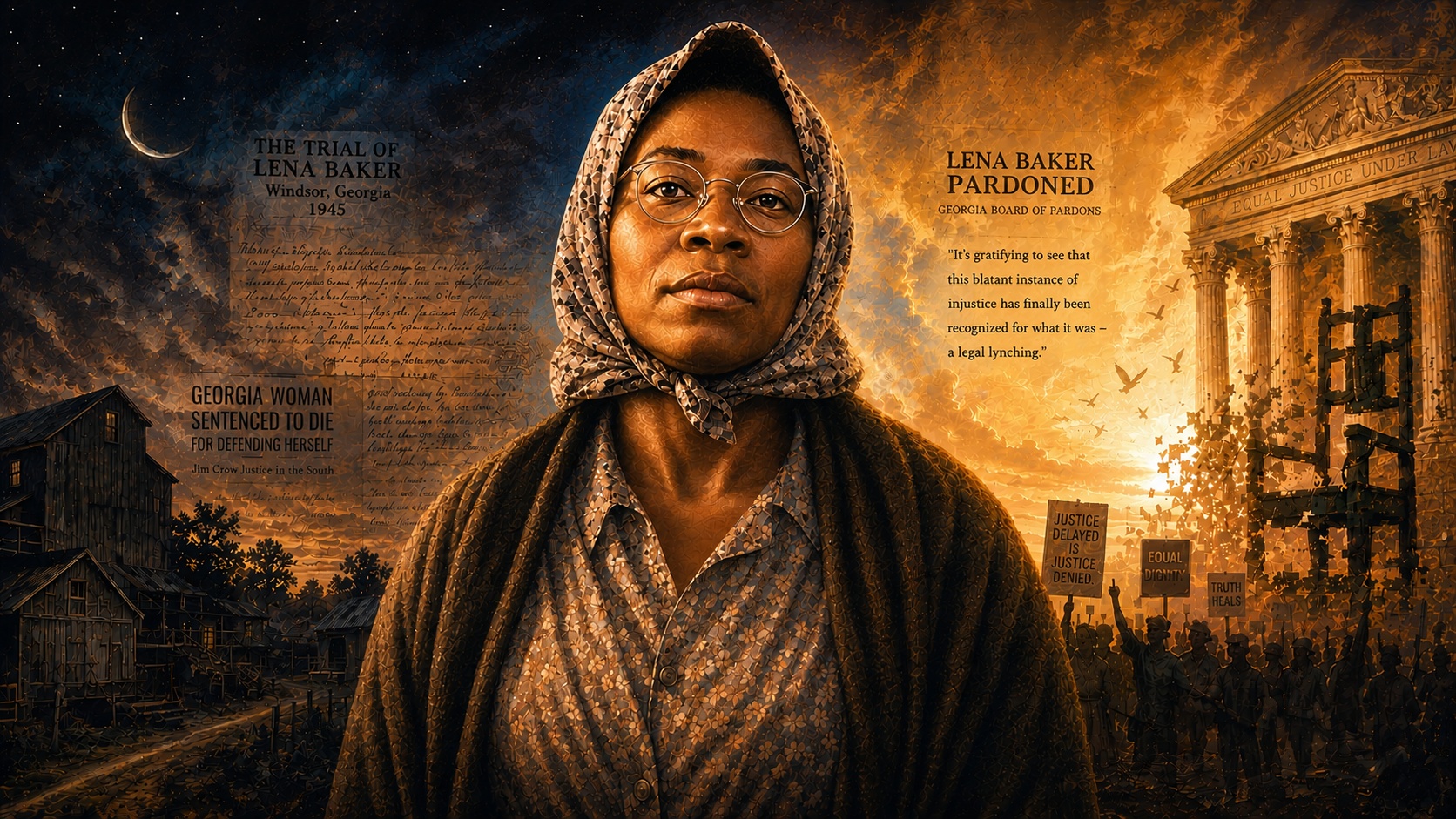
Lena Baker, an African American maid, was executed by the State of Georgia in 1945 for the murder of her employer, Ernest Knight, the previous year. Knight, an abusive and violent man, forced Baker into a coerced sexual relationship, frequently imprisoning her and threatening her life. In the segregated town of Cuthbert, Georgia, their relationship drew widespread hostility, yet it was Baker who was criminalized after killing Knight in an act of self-defense. She became the first and only woman executed in Georgia’s electric chair. Sixty years later, in 2005, the State of Georgia granted Baker a full posthumous pardon, conceding that she should have been charged with voluntary manslaughter—a crime with a typical sentence of about fifteen years, rather than death—and that denying her clemency had been “a grievous error” in a case “crying out for mercy.” The feature film Hope & Redemption: The Lena Baker Story (2008) dramatizes the events of her life and execution.
Born on June 8, 1900, Lena Baker grew up in a poor Black sharecropping family near Cuthbert, Georgia. As a child, she worked for a local farmer, J. A. Cox, chopping cotton. Later, she and her parents relocated to Cuthbert, where Baker supported herself and her three children by cleaning houses and doing laundry.
In 1944, Baker was hired to care for Ernest Knight, a local gristmill owner who had broken his leg. Their relationship soon became abusive, with Knight confining Baker in the gristmill for days, physically assaulting her, and threatening her if she tried to leave. This situation fueled animosity in the small Southern town. At her trial, Knight’s son testified that he had warned Baker to stay away from his father. He recounted finding them together, stating, “I took her and beat her until I just did leave life in her,” revealing the normalization of violence against Black women. One night, after Knight threatened her during a heated argument, Baker shot and killed him while trying to escape. She immediately reported the incident, claiming self-defense. Nevertheless, Baker was charged with capital murder and went to trial on August 14, 1944.
At her trial, Lena Baker testified that on the evening of April 29, 1944, Knight arrived at her home drunk and demanded she accompany him to the gristmill. Reluctant but fearful of refusing, Baker stalled by asking for money to buy whiskey. After finding the tavern closed, she lingered, hoping Knight would leave, but on returning and finding him still there, she was forced to go with him to the mill. She later managed to escape and hide in some bushes, eventually purchasing whiskey and sleeping at a nearby convict camp. The next morning, as she returned to Cuthbert, Knight confronted her again, this time locking her in the mill house while he attended a “singing” with his son. Baker endured the stifling heat throughout the day. When Knight returned, she told him she intended to leave. According to her testimony, Knight threatened to kill her before letting her go and raised a metal bar to strike her as she reached for a gun. In the ensuing struggle, the pistol discharged, fatally wounding Knight.
After the incident, Baker went to the home of J. A. Cox, the town coroner, and confessed that she had shot Knight. Cox instructed her to report to the sheriff while he proceeded to the gristmill to investigate. Instead of going directly to the sheriff, Baker returned home, where she was later picked up by law enforcement. She cooperated with authorities throughout the process, but was initially detained to sober up before being questioned further.
Although Knight was not well-liked in Cuthbert, Baker’s case unfolded against the backdrop of legalized racial segregation and the systematic denial of Black citizens’ civil rights in Georgia. As a poor Black woman accused of killing a European man who had held her in sexual bondage, Baker faced an all-European, all-male jury and a trial that lasted just one day. She was swiftly convicted of capital murder and sentenced to death. Her court-appointed attorney filed a cursory appeal, then abandoned her case. In later years, advocates would call Baker’s execution a “legal lynching,” emphasizing how the machinery of the state was used to punish Black resistance much like extrajudicial mob violence.
On March 5, 1945, as she entered the execution chamber at Georgia State Prison, Baker calmly took her seat in the electric chair and declared, “What I done, I did in self-defense, or I would have been killed myself. Where I was I could not overcome it. God has forgiven me. I have nothing against anyone… I am ready to go. I am one in the number. I am ready to meet my God. I have a very strong conscience.”
Lena Baker was buried in an unmarked grave behind Mount Vernon Baptist Church in Cuthbert, where she had sung in the choir. In 1998, church members placed a simple concrete marker at her grave. By the early 2000s, her story had become a local cause célèbre, with annual commemorations at her graveside on the anniversary of her execution and special ceremonies on Mother’s Day.
In 2001, Baker’s grand-nephew, Roosevelt Curry, with support from the Georgia-based Prison and Jail Project, began petitioning for an official pardon; a formal application followed in 2003. In August 2005, the Georgia Board of Pardons and Paroles granted Baker a full and unconditional posthumous pardon, acknowledging that denying her clemency in 1945 was a “grievous error” in a case that “called out for mercy.” The board noted that Baker could have been tried for voluntary manslaughter rather than murder. Though the pardon stopped short of declaring her innocent, it implicitly recognized that the state had imposed its harshest punishment on a Black woman whose own testimony and the available evidence supported a claim of self-defense.
Lena Baker’s Children and a Living Legacy
Lena Baker’s execution not only ended her own life but also shattered the futures of her three children, whose names and experiences are largely absent from historical accounts. Contemporary reports portray Baker as a devoted mother who worked tirelessly—chopping cotton, doing laundry, and performing domestic labor in and around Cuthbert, Georgia—to provide for her children amid the harsh realities of Jim Crow. Following the killing of Ernest Knight and Baker’s subsequent arrest, a family friend swiftly removed her children from Cuthbert for their safety, while other relatives fled to Florida, New Jersey, and other parts of the South to escape the stigma and fear that enveloped the family.
Decades later, a Los Angeles Times article identified Baker’s daughter Nelsie as her last surviving child, living in Florida in fragile health. The report observed that, like so many Black families scarred by racial violence, Baker’s descendants held only fragments of their story. Even Nelsie did not know the location of her mother’s grave. This absence of a marked burial site, public recognition, or legal redress left Baker’s children and grandchildren with a wound both private and public: their mother executed by the state, then largely erased from the very landscape where she had lived and struggled.
In recent years, Baker’s legacy has gained renewed visibility through her great-granddaughter, the Jacksonville rapper, songwriter, actress, and filmmaker KaMillion. Across social media and in televised interviews, KaMillion names Baker as her great-grandmother and emphasizes her descent through Nelsie Baker, establishing a direct matrilineal connection. She speaks candidly about discovering that her great-grandmother was the only woman executed in Georgia’s electric chair, and how the state’s belated acknowledgment of its “grievous error”—six decades later—came too late for most of Baker’s immediate children, who had already lived and died in the shadow of that injustice.
For KaMillion, preserving Baker’s legacy goes beyond recounting the tragic events of the trial and execution; it is about embodying the enduring strength of a family whose matriarch was criminalized for defending herself. As an artist, KaMillion leverages her platform to honor Lena Baker—sharing film clips depicting the execution, posting tributes during Black History Month, and insisting that her great-grandmother’s name be remembered alongside other Black women lost to state violence. In doing so, the descendants of the children once forced to flee Cuthbert now reclaim Lena Baker’s place in public memory, turning a story of silenced suffering into a living testament to Black familial endurance and the intergenerational refusal to forget.
Sources:
http://www.georgiaencyclopedia.org/…/histor…/lena-baker-case
http://murderpedia.org/female.B/b/baker-lena.htm
https://en.wikipedia.org/wiki/Lena_Baker
https://www.theguardian.com/world/2005/aug/17/usa.garyyounge1
https://www.latimes.com/archives/la-xpm-2003-mar-16-adna-maid16-story.htmlhttps://www.georgiaencyclopedia.org/articles/history-archaeology/lena-baker-case/https://gumptownmag.com/the-lena-baker-story-the-only-woman-ever-to-be-executed-in-georgia/https://vocal.media/history/baker-burns-the-wrongful-execution-of-ms-lena-bakerhttps://www.news4jax.com/news/local/2026/02/25/lena-baker-was-executed-in-ga-and-later-pardoned-her-legacy-carries-on-with-her-great-granddaughter-kamillionhttps://www.facebook.com/itskamillion/videos/talking-about-lena-baker-on-lovehiphopmiami/203423484265910/https://www.youtube.com/watch?v=ORrvdrH3QSw