


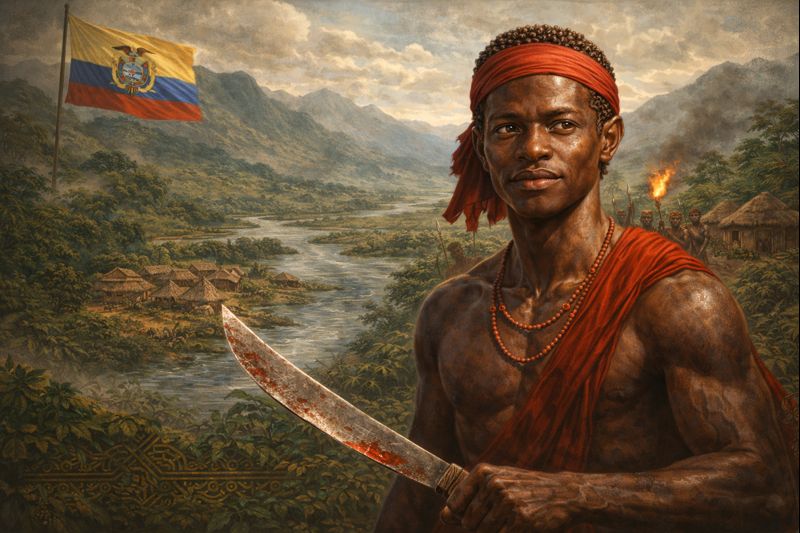
Alonso de Illescas was an Afro‑Ecuadorian leader and an icon for people of African descent in Ecuador. A symbol of struggle, resistance, and intelligence, Illescas was regarded as the single most powerful person in the Esmeraldas region of colonial northwestern Ecuador in the sixteenth century. In 1997, the National Congress of Ecuador officially declared 2 October the national day of Black Ecuadorians, thereby formally recognising Alonso de Illescas as a national hero.
Alonso de Illescas was born around 1528, probably in West Africa, with sources variously identifying his origins in Cape Verde or Senegal on the Upper Guinea coast. Around the age of ten, he was captured by slave traders and taken to Spain, where he was baptised and confirmed in Seville with the name Enrique. He later took the surname of his captor, the merchant Alonso de Illescas, and lived in Seville for about seventeen years, learning the Spanish language, Catholicism, urban culture, and how to play the vihuela (a form of Spanish guitar), before being sent to the Caribbean to assist his captor’s mercantile ventures.
Illescas first spent time on the island of Santo Domingo, where his captors built an enterprise that dealt in clothing, cured meats, swords, horses, olive oil, wine, and the trafficking of Africans. From the Caribbean, he travelled to Panama and then to Peru, the silver‑producing core of the early Spanish empire; records indicate that he and Álvaro, one of his captors, were active in Peru by 1551. In 1553, Illescas and about twenty‑three other Africans from Guinea” embarked from Panama on a southbound voyage to Lima, Peru, but their ship ran aground in San Mateo Bay on the Esmeraldas coast, stranding crew, passengers, and captives on shore and forcing them to trek along the rugged coastline toward the nearest settlement, Puerto Viejo. During this journey, Illescas and the other Africans reclaimed their freedom by going into the dense forest.
Illescas and the others initially struggled to survive and had to forge alliances with the local Nigua Indigenous communities. The first leader of the group was an African man named Antón, but after Antón’s death, Illescas was recognised as the new leader and, by the late 1560s, officially headed the maroon community. Over the rest of the sixteenth century, under his leadership, the settlement grew to include Africans, Amerindians, and even some Europeans, including a Trinitarian friar, Alonso de Espinosa, who served as minister at Illescas’ request, and a Portuguese soldier, Gonzalo de Ávila, who became his principal assistant and remained with the maroons after the failed military campaign of Martín de Carranza.
Like other maroon societies, Illescas’ community intermarried with neighboring Indigenous groups, creating mixed-heritage families and consolidating both political authority and military power in the region. Illescas nevertheless had to establish his dominance over another maroon formation, the Mangaches, another community of African that emerged after a separate coastal shipwreck. The remoteness of Esmeraldas—with its dense forests, mangroves, and difficult terrain—combined with the long‑standing resistance of Indigenous inhabitants to Spanish rule, enabled these maroon communities to endure for generations.
By the 1570s, Illescas’ people were trading with Spanish ships that periodically stopped along the Esmeraldas coast. Illescas sought to negotiate peace with Spanish authorities in exchange for official recognition of his people as free, and in 1577 the Real Audiencia proposed to appoint him governor of the region and to grant him the honorific title “Don,” an unprecedented royal concession for an African maroon that would have made him the legal ruler of the province. In return, he was expected to persuade other local leaders and rival maroon bands to resettle at the mouth of the Esmeraldas River, a project that provoked internal warfare among maroon communities and lowland Indigenous societies.
Near the end of his life, Illescas governed with the assistance of two sons, Sebastián and Antonio. There is no documentary trace of Alonso de Illescas after the 1590s, and historians infer that he likely died in Esmeraldas sometime between 1587 and 1596. Although he did not live to see a formal peace concluded with the Real Audiencia of Quito, that agreement was eventually reached: by 1600, his son Sebastián had obtained the title of Don and was recognized as leader of the Illescas maroons, taking Alonso as his confirmation name. The Illescas family continued to rule in Esmeraldas for at least two more generations, leaving a lasting political and cultural legacy in the region.
Source: https://www.jstor.org/stable/4491180 https://www.cambridge.org/core/books/slave-portraiture-in-the-atlantic-world/slave-portraiture-colonialism-and-modern-imperial-culture/ https://en.wikipedia.org/wiki/Alonso_de_Illescas”>https://en.wikipedia.org/wiki/Alonso_de_Illescas https://kwekudee-tripdownmemorylane.blogspot.com/2012/10/african-descendants-in-ecuador-afro.html”>https://kwekudee-tripdownmemorylane.blogspot.com/2012/10/african-descendants-in-ecuador-afro.html
