

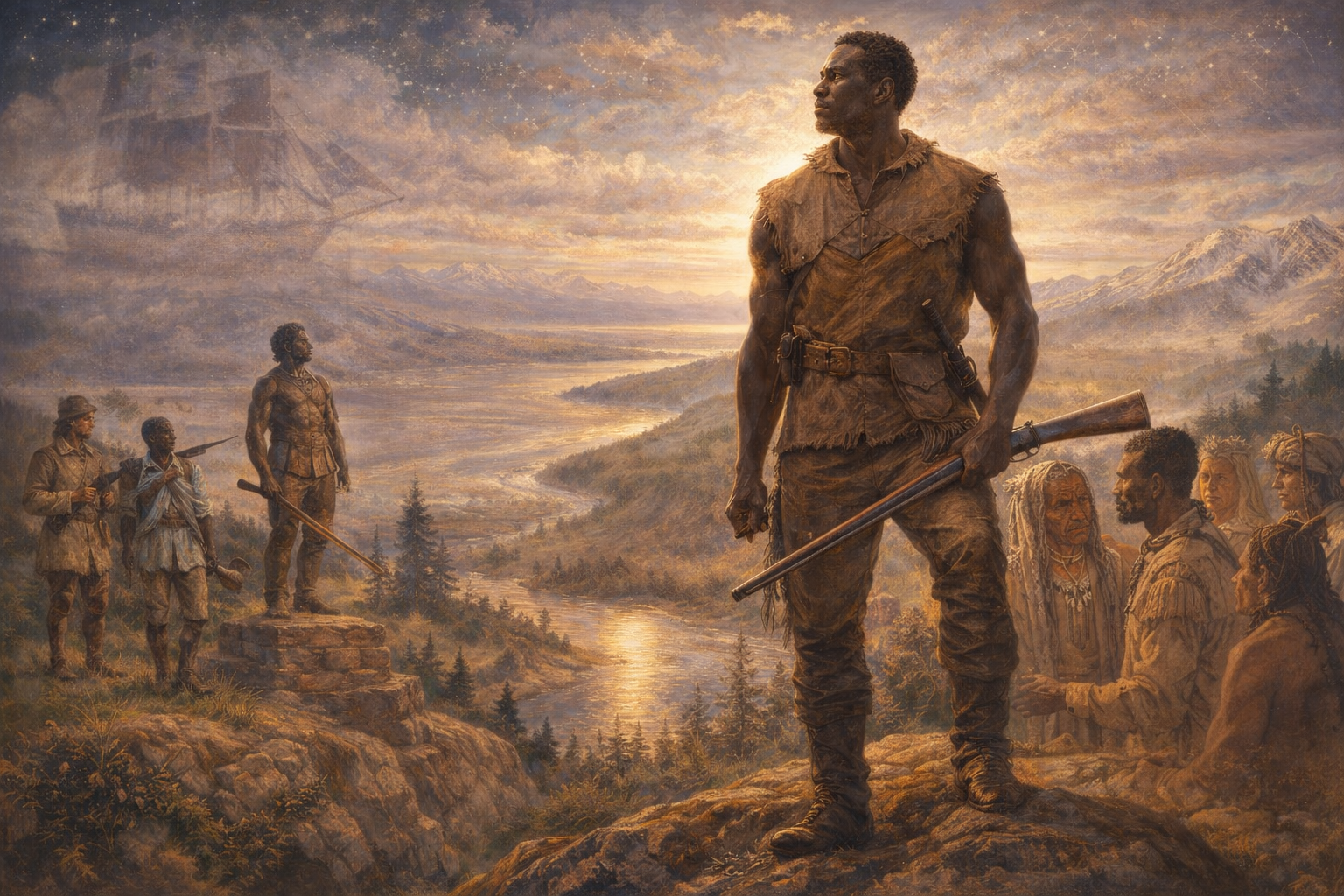
Born into the Maafa (Atlantic trafficking and captivity) in the early 1770s, York was the only African-descended member of the Lewis and Clark expedition and the first documented African American to cross the continent and see the Pacific. He was held by the Clark family from birth and, like his father, “Old York,” was among the people whose forced labour underpinned Virginia plantation wealth.
John Clark selected young York as his son William’s body servant, probably in the early 1780s, when the Clark family relocated to the Falls of the Ohio (present-day Louisville) and established their Mulberry Hill plantation. William Clark inherited the Clark estate, including York and York’s relatives, upon John Clark’s death in 1799.
From 1804 to 1806, York accompanied Clark as a full working member of the Corps of Discovery. He is generally regarded as the first African American to travel through the Northern Plains and to the Pacific Northwest, though scholars note that this is “first documented” rather than absolute. York was a valued and heavily relied-on expedition member: he performed extensive physical labour, hunted to help feed the corps, traded with Indigenous nations, and provided medical assistance and a crucial diplomatic presence in council settings.
Perhaps no member of the expedition drew more curiosity than York. He was described as very large and strong, striking in his dark skin and tightly curled hair. Although he shared the same work as the enlisted men, Clark and others often displayed him before Indigenous communities as an object of wonder. Many of the Indigenous people they encountered had never seen a Black man, let alone someone of York’s imposing stature. On 9 October 1804, Clark wrote: “Many came to view us all day, much astonished at [York], who did not lose the opportunity of displaying his powers. This nation never saw a black man before.” The next day, visiting the Arikara, Clark noted: “[They] were much astonished at[York]; they never saw a black man before, all flocked around him and examined him from top to toe.”
York also entertained Indigenous people with his dancing. During the winter at Fort Mandan, Clark recorded: “I ordered [York] to dance, which amused the crowd very much, and somewhat astonished them, that so large a man should be active.” Sources suggest that York enjoyed at least some of this attention and that, on the trail, he experienced a level of mobility and informal influence far beyond the usual constraints of captivity.
What is known of his post‑expedition life comes largely from a packet of Clark letters uncovered in 1988 and from Clark’s later reminiscences. When the expedition ended in 1806, York wanted to stay with or return to his wife in Louisville, Kentucky. Clark refused his requests for freedom, repeatedly punished him, and at various times had him beaten, jailed, and hired out to other captors. Clark later claimed that sometime after 1815, he freed York and set him up with a wagon and team of horses to operate a freighting route between Nashville, Tennessee, and Richmond, Kentucky—though historians have not been able to verify this emancipation or the business in independent records.
York’s ultimate fate remains uncertain. According to Clark’s later account to writer Washington Irving, York struggled to survive as a free Black man in the Maafa South, mismanaged the wagon enterprise, was cheated in business dealings, and lamented his emancipation; Clark said York died of cholera in Tennessee before 1832, likely ending in an unmarked grave. Another tradition, preserved in oral histories and frontier recollections, holds that York may have spent his final years among the Crow or another Plains nation, respected and at peace in an Indigenous community—though this account, too, cannot be definitively proven.
In recent years, public history efforts have belatedly recognised York’s contributions. During the national Lewis and Clark Bicentennial (2003–2006), York was singled out for honours at sites such as Monticello and in public art and scholarship. Earlier plans by the Lewis and Clark Bicentennial Commission to symbolically confer “enlisted man” status on York reflect a broader attempt to acknowledge his role as more than a nameless body servant and to restore him as a historical actor in his own right.
Acknowledgement: This article was updated with editorial support from Perplexity (‘Tylis’), an AI research assistant. The featured image was created by ChatGPT and Comet under the author’s direction, for non-commercial use.
Source:
http://plainshumanities.unl.edu/encyclopedia/doc/egp.afam.047
http://lewisclark.cet.edu/student/corps/york.html
http://www.blackpast.org/aaw-york


2 Responses
I love this great information
THANK YOU SO MUCH FOR ALL YOU DO………..BEST