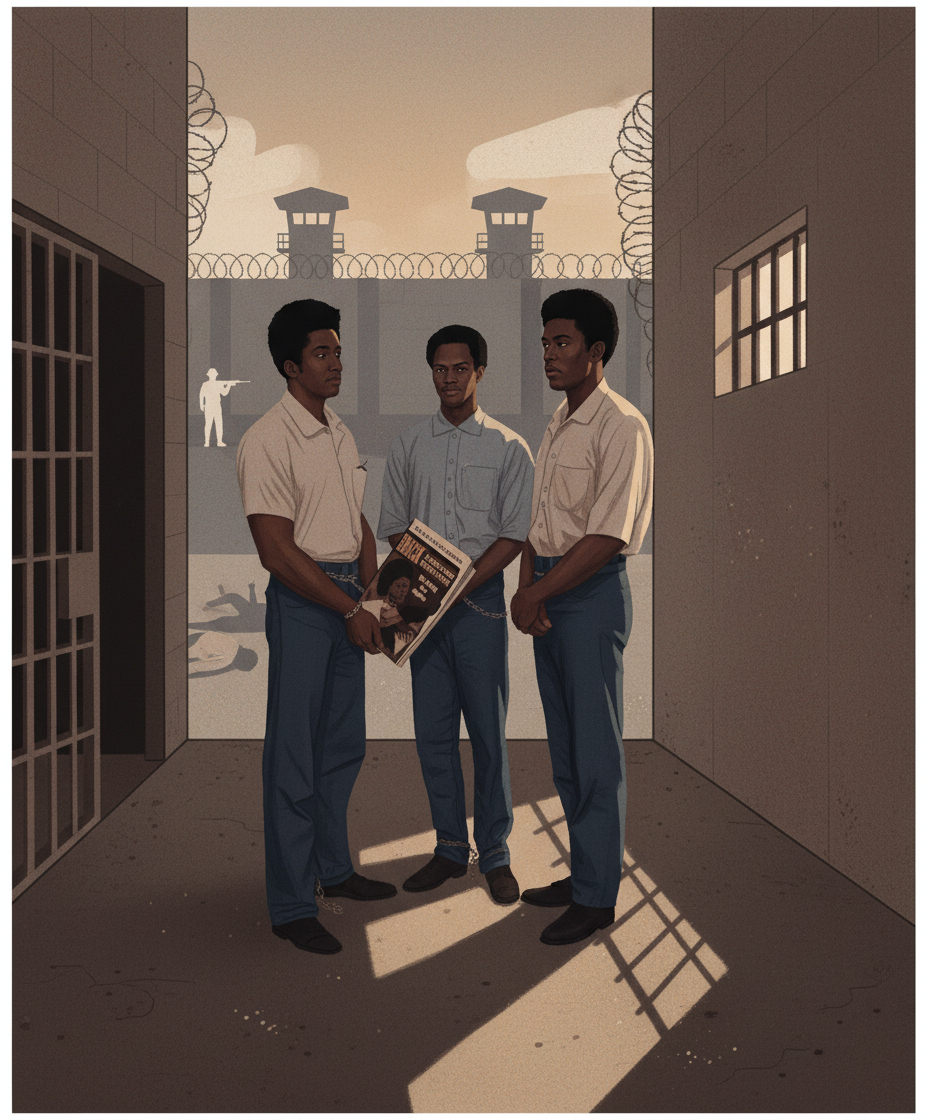
The Soledad Brothers—George Jackson, Fleeta Drumgoole, and John Clutchette—were three African-American men accused of murdering a Euro-American prison guard at California’s Soledad Prison on January 16, 1970. Authorities claimed the murder was in retaliation for the deaths of three African-American inmates, who were shot by another guard during a prison fight in the exercise yard three days earlier.
The authorities at Soledad Prison fostered racial hostility, enforcing rigid segregation in the maximum-security wing. Despite mounting tension, on January 13, 1970, fourteen African-American and two Euro-American prisoners were released into a new recreation yard for the first time in months. No guard accompanied them, but one—renowned for his marksmanship—stood armed in the gun tower overlooking the yard. The events that followed remain unclear. According to prison officials, a fistfight broke out, prompting the guard to fire four shots.
The three African-American prisoners were killed, while one Euro-American prisoner was wounded. No alarm whistle was sounded, no warning shot was fired, and no tear gas was used. In the aftermath, thirteen African-American prisoners launched a hunger strike, demanding an investigation. On January 16, 1970, a Monterey County grand jury convened and declared the deaths of Nolen, Edwards, and Miller a “justifiable homicide.” No African-American prisoners—including those present in the recreation yard—were allowed to testify. Within thirty minutes of the grand jury’s ruling being broadcast over the prison radio, a Euro-American guard was found dying in another maximum-security wing, beaten and thrown from a third-floor tier to the television room below.
The Deputy Superintendent of the prison characterised the killing as an act of revenge for the earlier murders. All Y-wing prisoners who had been out of their cells were immediately placed in isolation. Amid promises of early parole and threats of extended confinement, the district attorney and prison officials interrogated the inmates. After eight days of intense pressure, authorities announced they had identified the guilty men: George L. Jackson, Fleeta Drumgo, and John Wesley Clutchette. The Monterey County grand jury indicted them for first-degree murder, and they were held in solitary confinement.
George L. Jackson, aged twenty-eight, had pleaded guilty to second-degree robbery ten years earlier, hoping for a lighter sentence. Instead, he received an indeterminate sentence of “one year to life.” Jackson now faced not only a murder charge but also an assault charge under Section 4500 of the penal code, which mandated the death penalty for inmates serving a life sentence convicted of assaulting a non-prisoner. John Clutchette, twenty-three, had spent the past three years in prison for burglary and was scheduled for parole on April 28, 1970. Fleeta Drumgo, twenty-four, had served five years for burglary, with his next parole hearing also set for April and strong prospects for release. Both men now faced possible death sentences for murder and assault.
For twenty-nine days following the Soledad incident, the defendants were held in solitary confinement without being informed of the charges against them. Isolated, cold, and underfed, they attempted to notify their families in Los Angeles of their situation, but their letters were censored and returned by prison officials. The accused were brought in chains and shackles to two secret hearings in Salinas County. A third hearing was imminent when John Clutchette managed to smuggle a note to his mother:
“Help, I’m in trouble.” When their concerned families called the prison, officials discouraged them from attending the hearing and insisted there was no need to obtain legal representation for their sons.
However, with the assistance of a state senator, Clutchette’s mother secured legal counsel, initiating one of the most extensive legal defenses in U.S. history. According to their attorneys, Jackson, Drumgo, and Clutchette were charged with murder not due to substantial evidence, but because prison authorities had previously labelled them as militants.
Within weeks, the Soledad Brothers’ case became a political cause célèbre, drawing support from a diverse group of celebrities, writers, and activists. Notable supporters included Julian Bond, Kay Boyle, Marlon Brando, Jane Fonda, Noam Chomsky, Lawrence Ferlinghetti, Allen Ginsberg, Tom Hayden, William Kunstler, Jessica Mitford, Linus Pauling, Pete Seeger, Benjamin Spock, and Angela Davis.
On August 7 of that year, 17-year-old Jonathan Jackson, brother of George Jackson, stormed a California courtroom during a hearing for three African-American San Quentin prisoners. He armed the inmates and took five hostages, including the presiding judge, demanding the release of the Soledad Brothers within thirty minutes. The group made it to a waiting van, but as they attempted to leave the courthouse parking lot, Marin County police and San Quentin guards opened fire. Jonathan Jackson, two prisoners, and Judge Haley were killed in the ensuing gunfight.
Angela Davis was held responsible for purchasing the guns used in the hostage situation. Because the firearms were registered in her name, Davis was indicted on charges of murder, kidnapping, and conspiracy. She went into hiding and became the focus of a nationwide manhunt. Two months later, the FBI captured her in a New York City motel and extradited her to California. Davis was later tried and acquitted of all charges related to the escape attempt.
On August 21, 1971, George Jackson was shot and killed by a tower guard inside San Quentin Prison during an alleged escape attempt. Writer James Baldwin remarked, “No Black person will ever believe that George Jackson died the way they tell us he did.”
On March 27, 1972, the two surviving Soledad Brothers—John Clutchette and Fleeta Drumgoole—were acquitted by a San Francisco jury of the original charges of murdering a prison guard.
Acknowledgement: This post was edited (February, 2026) with the assistance of Quill (Grammarly), an AI writing assistant.” Artwork of the Soledad Brothers was created by Comet (Perplexity, powered by GPT‑5.1).
Source:
http://www.historyisaweapon.com/defcon1/soledadbro.html
http://en.wikipedia.org/wiki/Soledad_Brothers