

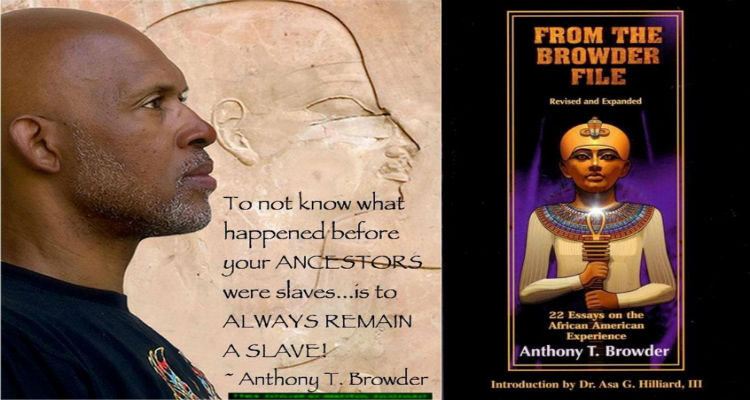
“It is the responsibility of every adult to know their history and culture, to preserve it and then pass it on to the next generation…” ~Anthony T. Browder
From The Browder File by Anthony T. Browder is among my top ten non-fiction books and is the first I would recommend to anyone beginning their journey to learn Black history. In his introduction, Asa Hilliard highlights Browder’s role in inspiring a renewed commitment to African consciousness as a personal and collective task. He also poses a difficult question: why do Black people so often struggle to act in unity? Hilliard suggests that our movement from DISINTEGRATION to REINTEGRATION requires us to examine a series of interrelated losses that have weakened our coherence as a people: we have been alienated from our original names; our ways of life have been displaced; our appetite for our own culture has been dulled; we suffer both from amnesia about our true history and from implanted false memories about both Africans and Europeans; we have been separated from our land and thus our capacity to protect what is ours; we have lost independent productive power and been reshaped as consumers; we lack real control over our institutions, from education to politics; our sensitivity to harms done to us has been blunted; and, lastly, our solidarity and sense of shared destiny have been fractured. Hilliard concludes that information alone cannot heal all of these wounds; a crucial part of our work is to recover our memory, because only then can deeper transformation take place. The points below draw on ideas from From The Browder File as an invitation to begin that work of remembering.
Here are 7 Things You Would Have Learned If You Read From The Browder File by Anthony T. Browder
1. The Creation of the Negro
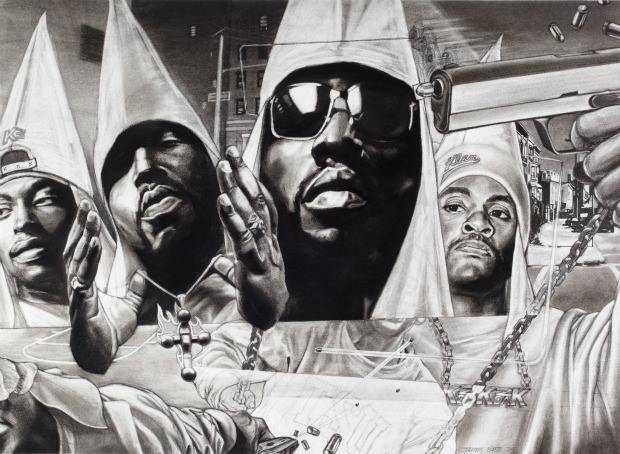
“Pick a name, any name — negro, colored, black or African American. Call a people by any name and they are still the same people, right? Wrong!”
One of Browder’s core arguments is that names are not neutral labels; they shape how people see themselves and how they are seen by others. He challenges the assumption that it makes no difference whether a people are called “Negro,” “colored,” “Black,” or “African American.” The name to which a person or a community responds reflects and reinforces their sense of value and identity, particularly when that name has been imposed rather than chosen.
Browder traces how the term “negro” emerged and how its linguistic roots became attached to African-descended people in ways that implied a people without history, vitality, or future. He describes this as a kind of triple death—an assault on mind, body and spirit—sustained by ignorance of our true past. At the same time, he shows that the historical shift in terminology from “colored” to “Black” to “African American” signals a growing self-awareness and an ongoing effort to reclaim authentic identity.
2. Black is indeed Beautiful
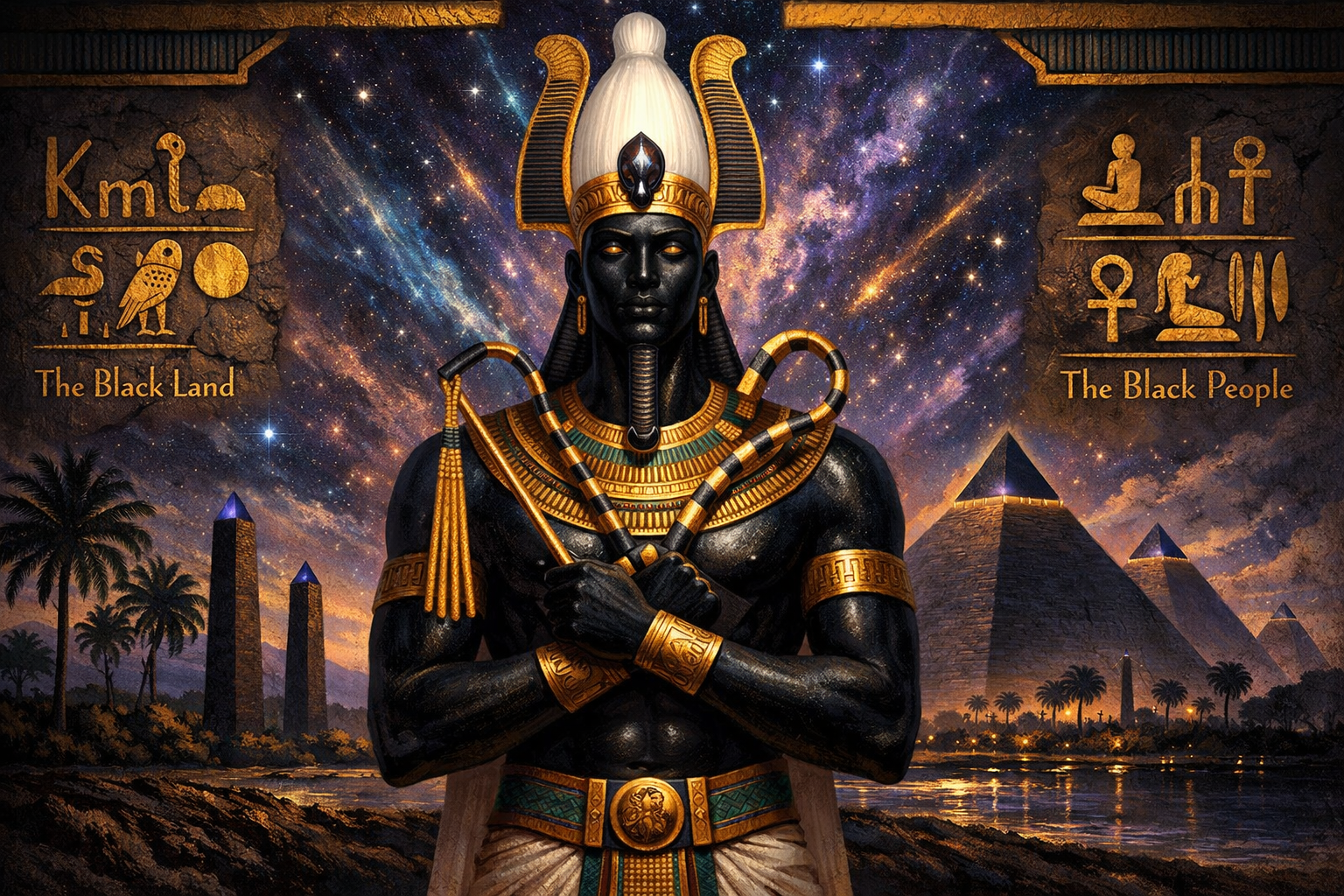
“Black ball. Blackmail. Blacklist. Blackmarket. Have you ever wondered why most references to the color black have a negative and demeaning connotation?”
Browder asks us to notice how often the word “black” carries negative meanings in everyday language, from “blacklist” to “black market,” and even in the foods we name and celebrate. He contrasts this with the way blackness was understood in ancient Kemet, where the Black land and Black people were associated with fertility, richness and sacred power. In that context, black stone, black images of divinities, and black capstones on pyramids and obelisks symbolised receptivity to light and cosmic energy.
He points out that modern technology and ritual life quietly preserve this older understanding: solar cells, batteries, ceremonial robes, sacred stones and revered icons of a Black Madonna all draw on the power and symbolism of blackness. Yet Africans have been conditioned to see black as a marker of shame rather than strength. Browder insists that we must consciously reprogramme ourselves to recognise black as a sign of life, depth and power, and to take pride in Blackness rather than fear or deny it.
3. The First Hero
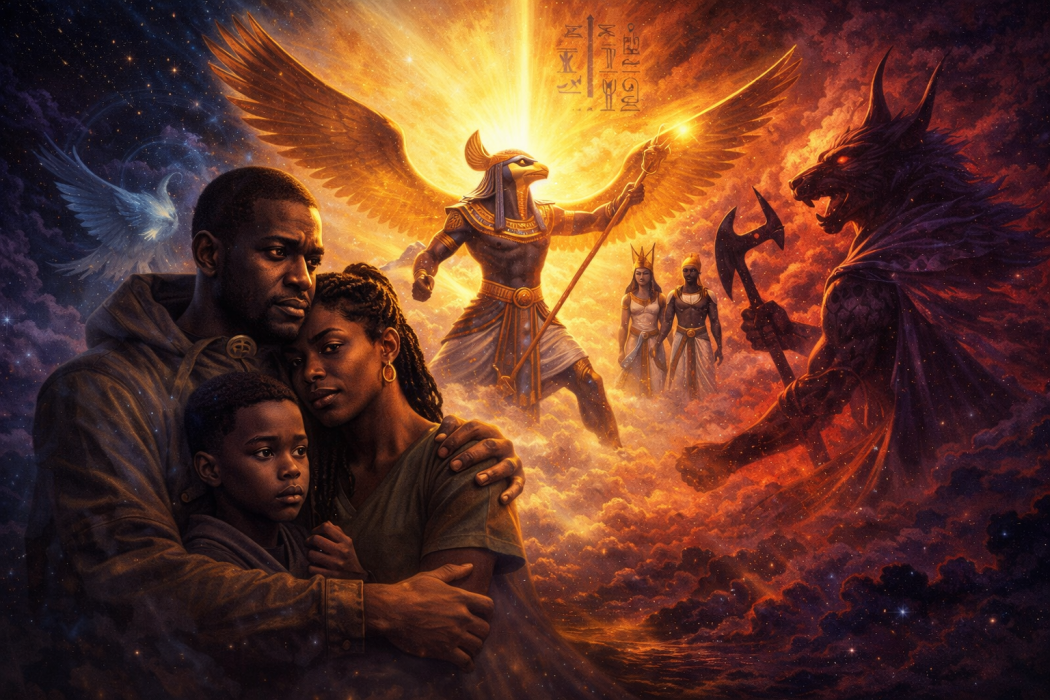
“Everybody’s searching for a hero. Everybody needs someone to look up to. These lyrics to the song The Greatest Love of All, written by the late Linda Creed, express a basic and fundamental human need — the need to be loved, and more specifically, the need to love yourself. The degree of self-love is often determined by role models who instil a sense of self-worth.”
Browder explores the idea of the “hero” by returning to the Kemetic story of Heru (Horus), the child of Auset (Isis) and Ausar (Osiris), who confronts his uncle Set, the embodiment of disorder and evil. In this ancient narrative, Heru avenges his father and restores balance, becoming a model of the victorious principle of good over evil, light over darkness.
He traces how this archetype of Heru underlies later notions of the hero throughout world culture. The familiar struggle between heroic figures and forces of destruction—so common in religion, literature and film—has deep African roots in the mythic conflict between Heru and Set. Browder’s point is that when we seek role models and heroic patterns, we should know that some of the earliest and most enduring examples are African.
4. MLK and Malcolm X
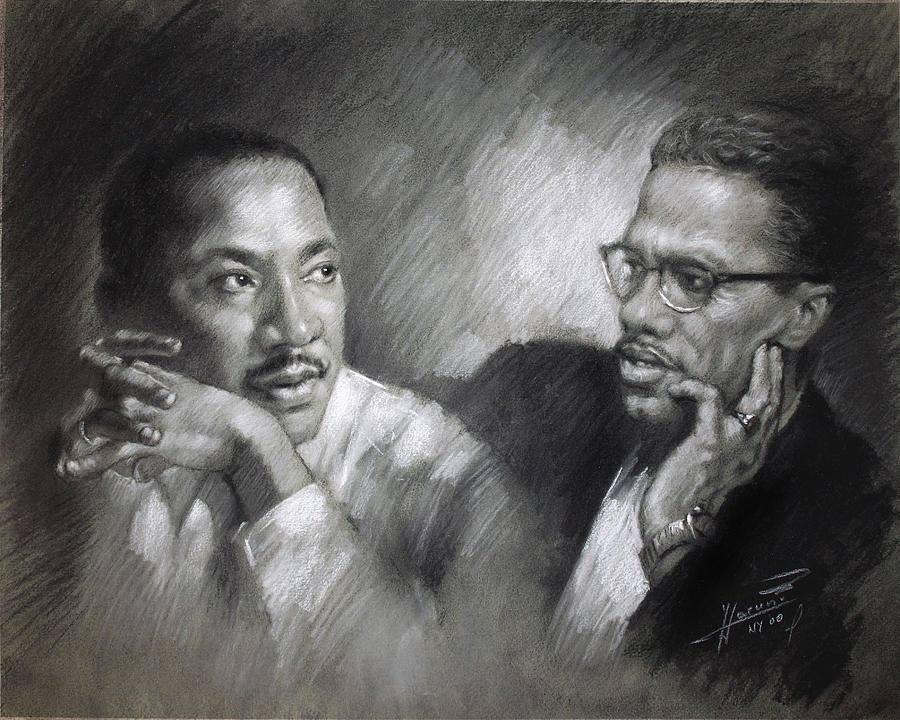
“King was a man of peace — but he was also a fighter.”
Browder is critical of the way Dr. Martin Luther King Jr. is often remembered in mainstream narratives. He notes how dramatizations and commemorations frequently reduce King to a hesitant dreamer who depended on European guidance, flattening his complexity and obscuring his radical shift from a narrow civil rights agenda to a broader human rights and anti-imperialist stance before his death. According to Browder, it would be naïve to expect the same system implicated in King’s assassination to present him as a fully realised, uncompromising Black leader and hero.
He draws a parallel with Malcolm X, whose image is also managed and contained. Although Malcolm is widely recognised, Browder argues that his uncompromising insistence on self-determination and self-respect makes him too challenging a model for institutions that benefit from a passive or compliant Black public. By promoting softened or incomplete images of King, and by marginalising the depth of Malcolm’s message, the dominant culture keeps people attached to safe symbols rather than to transformative heroes who might awaken them.
5. Melanin: “The Giver of Life.”
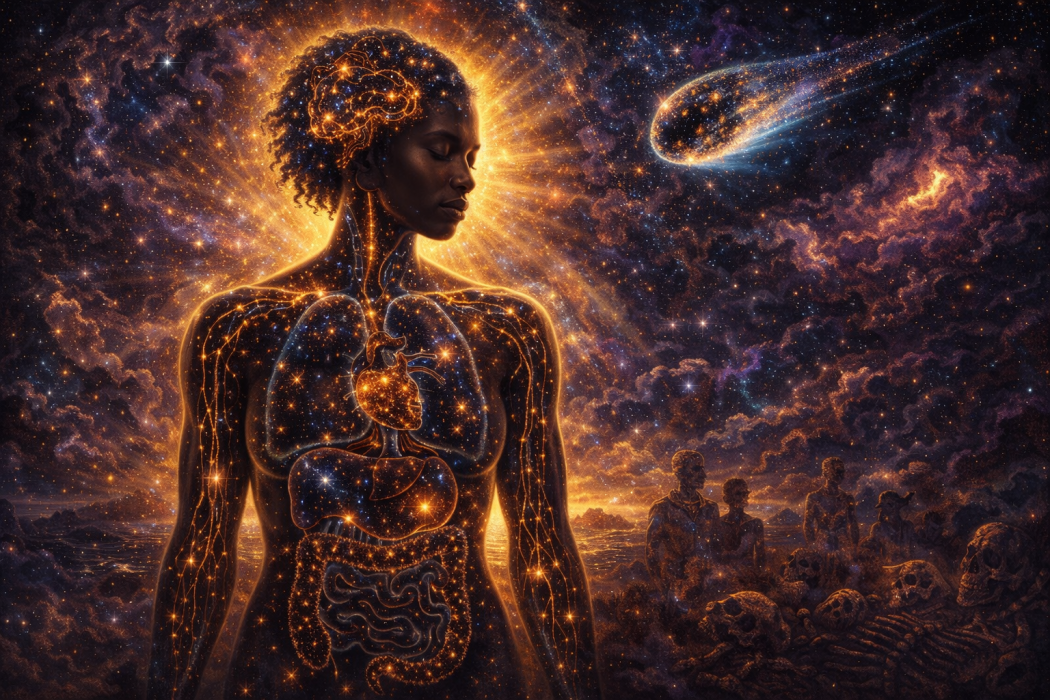
“Without a doubt, melanin is viewed as the ‘giver of life’.”
Browder describes melanin as a fundamental, multifunctional molecule present throughout the human body, not only in the skin, hair and eyes but also in internal organs, the nervous system and the brain. He notes that melanin is found in nature far beyond the human body, from deep within the earth to outer space, underscoring its central role in the universe. In people of African descent, melanin appears in more sites and in higher concentrations, which he connects to darker skin tones and greater natural protection from the ageing effects of the sun.
He suggests a relationship between melanin, spiritual sensibility and the production of melatonin, linking African-descended peoples’ cultural language of “soul” to deeper physiological and energetic realities. Browder cites research indicating that higher melanin levels correspond with higher rates of melatonin production, while pointing to findings that the pineal gland is often calcified in populations with less melanin. Because of melanin’s magnetic and light-absorbing properties, he argues that people with more melanin are inherently more attuned to natural and spiritual forces, and that this attunement is part of our heritage rather than a stereotype.
6. Astrology and the USA
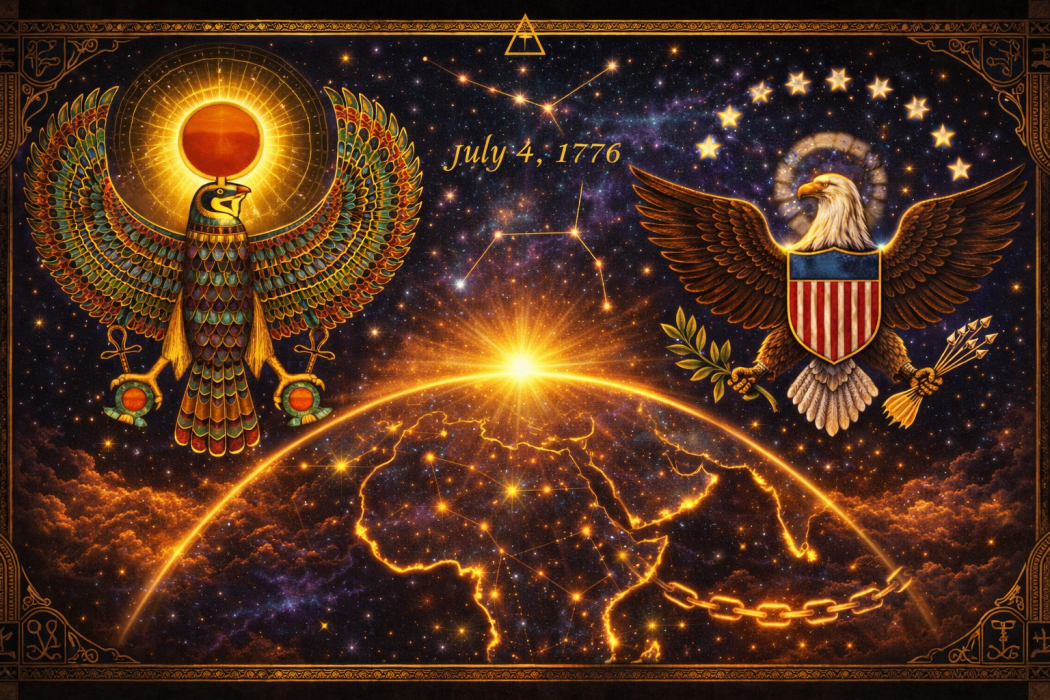
Browder devotes a chapter to the role of astrology and esoteric symbolism in the founding of the United States. He contends that many of the so‑called “Founding Fathers” deliberately timed key events, including the declaration of independence on July 4, 1776, to align with specific astrological configurations—particularly the sign of Cancer, which he associates with Africa and with nurturing, foundational energy. He emphasises that the new nation was structured on principles and labour drawn from Africa, even as African people were enslaved and excluded.
He then offers a close reading of the Great Seal of the United States and the one‑dollar bill, showing how the number thirteen recurs in stars, stripes, arrows, leaves and inscriptions. In his interpretation, this repetition is not accidental but reflects masonic and metaphysical understandings of thirteen as a number of transformation. Browder also draws striking parallels between the American eagle and the ancient African symbol of Heru as a hawk, as well as between the pyramid and all‑seeing eye on the dollar bill and older Kemetic symbols of life, infinity and solar power. For him, the use of these African-derived motifs without acknowledging their origins is another example of how African wisdom undergirds Western institutions while Africans themselves are written out of the story.
7. Free Your Mind
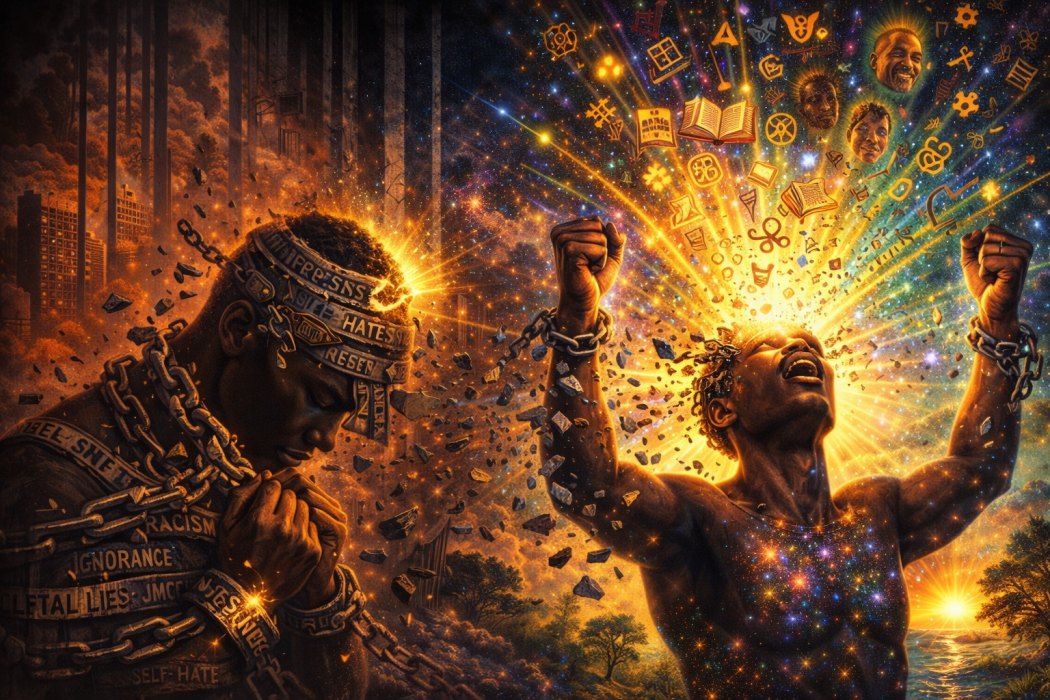
Browder defines consciousness as a state of being fully aware of oneself and one’s surroundings, and he argues that our current condition is shaped by systematic miseducation that has produced various forms of mental slavery. He insists that the history of African people has been deliberately hidden or distorted, and that one of our tasks is to uncover the truth that Africans were pioneers in fields such as timekeeping, architecture, spirituality and transoceanic travel.
He highlights examples that disrupt conventional narratives: the Step Pyramid of Saqqara as the world’s first “skyscraper”; Kemetic masks and royal images bearing clearly African hairstyles; the figure of Maat as an early prototype of the angelic form later seen in European art; the original form of the sphinx as a powerful female symbol later demonised in Greek tradition; and evidence that Africans reached the Americas as traders and teachers long before European conquest, sharing knowledge of pyramid building and monumental stone carving.
For Browder, to “free your mind” means actively stripping away the lies and omissions that limit our sense of possibility and reconnecting with an African-centred view of history and humanity. By doing so, we loosen the chains of mental slavery and expand our capacity for full human development.
Please note: Portions of this article draw on ideas and information presented by Anthony T. Browder in his book and lectures on From The Browder File. To explore these discussions in depth, you can purchase From The Browder File at the IKG at http://ikg-info.com/ikg-store
ACKNOWLEDGEMENT:
- The featured image for the “The Creation of the Negro” quote is a painting by James Pate from the “Kin Killin Kin” Series.
- The featured image for the “Black is indeed Beautiful” quote was co-created by Meserette Kentake in collaboration with Perplexity (Tylis) and ChatGPT, to honor Ausar as Lord of the Perfect Black and re-centers Kemet as “The Black Land” of “The Black People.
- The featured image for the “The First Hero” quote was co-created by Meserette Kentake in collaboration with Perplexity (Tylis) and ChatGPT, connecting the ancient Kemetic story of Heru and Set to the everyday heroism of the Black family.
- The featured image for the “MLK and Malcolm X” quote is by Ylli Haruni, entitled“Martin Luther King Jr. and Malcolm X” http://fineartamerica.com/featured/martin-luther-king-jr-and-malcolm-x-ylli-haruni.html
- The featured image for the “Melanin: The Giver of Life” quote was co-created by Meserette Kentake in collaboration with Perplexity (Tylis) and ChatGPT, envisioning melanin as a sacred, cosmic molecule linking the Black body, ancestral memory, and the stars.
- The feature image for the “Astrology and the USA” quote was co-created by Meserette Kentake in collaboration with Perplexity (Tylis) and ChatGPT, revealing the astrological, African, and numerological foundations beneath the symbols of the United States.
- The featured image for the “Free Your Mind” quote was co-created by Meserette Kentake in collaboration with Perplexity (Tylis) and ChatGPT, using an original prompt that transforms the shackles of mental slavery into a burst of ancestral knowledge, African symbols, and cosmic light, proclaiming: “Free your minds and throw off the shackles of mental slavery and thereby increase your potential for human development.”

7 Responses
Also it’s where I learned about Dr. Frances Cress Welsing Cress theory, even when it wasn’t a book yet
Enlightening!!
Love this site!
Great Website, Good Information. Keep up the Good Work, Again Asante. Wendell.
“What is it that would make a creature as fierce, majestic and powerful as a lion is, subject itself to the intimidation of a man a whip and a chair? The lion has been taught to forget what it is.” ~Iyanla Vanzant!
Until the lion learns how to write, every story will glorify the hunter.” ~African Proverb
This was the first book in my awakening. Found it at an African kiosk in the mall in Augusta, GA (1992). I’ve been on a knowledge journey ever since.
I’m a Black man interested in my Black culture. I’ve read most of your work, very informative and insightful