

“It takes more than a horrifying transatlantic voyage chained in the filthy hold of a slave ship to erase someone’s culture.” – Maya Angelou
Author’s Note (February 2026)
I wrote “Horrors of the Middle Passage” over a decade ago. Since then, I have read hundreds of books and articles, each one widening and deepening my understanding of this history. I was born with a grand trine in water—three planets in water forming a triangular shape. Europeans referred to the forced trafficking of Afrikan people as the “triangular trade.” It is therefore unsurprising to me that, since childhood, I have been following the Maafa’s currents, its energy and direction. I “carry” this historical body of water within me.
This, however, does not make this period of our history any easier to revisit. It is a continual confrontation with horror as well as with insurmountable strength and resilience. To recognise the strength of our ancestors does not diminish, excuse, or soften the depth of the wound.
What is Maafa?
The term Maafa was introduced by Marimba Ani in her 1988 book Let the Circle Be Unbroken to describe the 500-year—and continuing—catastrophe of Atlantic trafficking and Afrikan captivity. In Swahili, Maafa means “great disaster” or “terrible occurrence.” Ani’s use of the word offers an Afrocentric framework for naming our collective historical experience, rather than relying on borrowed terms like “African Holocaust” or dehumanising European descriptors such as “slavery.” The term slavery itself is not unique to Afrikan people—Europeans, including those in Western Europe, were also enslaved by Arabs and Muslims—but through racialisation, this “S-word” has come to evoke primarily Afrikan suffering in the global imagination.
Warning
This article contains detailed descriptions of extreme violence, sexual abuse, death, and psychological terror. You may find it deeply distressing. I did. It took me days to complete the update. I invite you to read with care and intention, holding space for both the horror endured and the brilliance of Afrikan self-defence, collective struggles, and spiritual genius during this long midnight of our history.
Remember that Afrikan history stretches back approximately 90,000 years. The Maafa, which began in 1441, spans approximately 585 years. If we imagine 90,000 years as a single day, these 585 years would amount to approximately nine minutes—yet they have left a profound and devastating mark. Take your time. Listen for the ancestors in the pauses. Remember that those who survived such terror also held dreams of return and liberation, and that those dreams still live within us.
The historical synthesis here draws especially on:
- Eric Robert Taylor, If We Must Die: Shipboard Insurrections in the Era of the Atlantic Slave Trade
- C. L. R. James, The Black Jacobins: Toussaint L’Ouverture and the San Domingo Revolution
- James Walvin, Britain’s Slave Empire
- Anthony Tibbles (ed.), Transatlantic Slavery: Against Human Dignity
Of the four books, the one I found challenging to read was If We Must Die by Eric Robert Taylor. Although Taylor’s book is about shipboard uprisings (he found nearly five hundred cases), he began with a comprehensive introduction to the Maafa to convey the brilliance of African liberation efforts in the face of overwhelming odds. However, time and again while reading this book, I had to put it away; it was just too painful. It was the first book I had to stop reading for weeks before I could go back to it. If We Must Die offers a vivid account of the horror of the Maafa. Most of the traumatic experiences of our ancestors, detailed below, are drawn from Taylor’s book, along with insights from James Walvin, Anthony Tibbles, and C. L. R. James.
The perfect music to accompany this post is Lamentation by Tunde Jegede.
Introduction
In 1441, Antam Goncalvez, a Portuguese sailor, seized ten Africans near Cape Bojador. According to Azurara, the Portuguese chronicler, Goncalvez was to sail along the western shore of Africa, not to try for new discoveries but to prove his worth by shipping a cargo of skins and the oil of “sea wolves” (sea lions). Goncalvez and his crew travelled as far as the southern seaboard of what became Morocco. Once judging that he had travelled far enough to win a reputation, Goncalvez conceived the idea that he could please his ruler, Henry of Portugal, by capturing some of the inhabitants of this unknown southern land.
Goncalvez went ashore with nine of his crew. When they were around three leagues distant from the sea, they found the footmarks of men and youths, the number of whom, according to their estimate, would be from forty to fifty. However, the footprints were going in an opposite direction from where “our men were going”. Goncalvez and his men decided to turn back, but while returning over the sand‑warm dunes to the sea, they saw a Moor following a camel, with two assegais in his hand, and pursued him. Though he was only one, he defended himself as best as he could, showing great courage. “But Affonso Goterres wounded him with a javelin…” The Portuguese took him prisoner, and then, as they were going on their way, they saw a Black Mooress come along, and so they seized her too.
This initial piratical act of violence would eventually spiral into more terrifying forms – warfare and raids – for the captivity of African people.
For over 400 years, African people were exploited by Europeans for the creation and development of a number of their invaded territories across the Americas. Over the long history of the Atlantic system, Africans in their millions were removed from their varied homelands and loaded onto ships. There were two distinct stages on the journey from Africa to the Americas: capture in Africa and the Atlantic crossing, which Europeans call the Middle Passage. At both stages, the captive people suffered unimaginable cruelties, as the Atlantic system was initiated and perpetuated in conditions of extreme violence. Nothing in their life experiences could have prepared African people for the psychological trauma, dehumanisation, and degradation they would experience. An estimated 40 per cent of the captives died before leaving Africa. During the so‑called Middle Passage, between 10 and 20 per cent of the over 15 million who departed Africa died from punishments, hunger, disease, and trauma; large numbers were also thrown overboard when the traffickers considered them sick.
1.
Whatever the method of capture, Afrikans usually made the journey to the coast on foot. They often endured a long trek, fastened one to the other, and were loaded with heavy stones of 40 or 50 pounds to prevent attempts at escape. A European who accompanied one such trafficking reported in 1799 that a typical coffle in the Senegal River area would march some twenty miles in seven or eight hours each day. To control the captives and discourage resistance on these long journeys, not only were they manacled, but they were also whipped and deprived of sleep. Guards would sometimes even keep the entire group awake for days on end, “seating them each night around a large fire, and kicking any who managed to doze off back to wakefulness.” Poor supply of food and water meant that the captives often suffered from severe malnutrition and dehydration. On the long journey to the coast, sometimes hundreds of miles, nearly half of the newly captured Africans died on the way. The trails to the coast were littered with skeletons. As one slave‑merchant noted, slavers in the latter half of the eighteenth century expected to lose approximately 40 percent of their captives to either flight or death before reaching the slave ships.
Some captives were brought to the coast by canoe, forced to lie in the bottom of boats for days on end, with their hands bound, their faces exposed to the tropical sun and the tropical rain, their backs in the water which was never bailed out. The strongest Africans would be additionally tied at the knees. As Alexander Falconbridge (a British surgeon who took part in four voyages in slave ships between 1780 and 1787) noted in 1788, “[The Afrikans’] allowance of food is scanty, that it is barely sufficient to support nature. They are, besides, much exposed to the violent rains which frequently fall here, being covered only with mats that afford but a slight defence; and as there is usually water at the bottom of the canoes, from their leaking, they are scarcely ever dry.”
2.
At the coast, the captives were forced to undergo a humiliating physical inspection. They were carefully examined from head to toe, without regard to sex, to see that they did not have any blemishes or defects. They were poked and prodded, had their limbs and teeth checked, and were inspected for any signs of disease. Some were rejected if defects were identified, as invalides. An eighteenth-century Dutch handbook recommended that traffickers test the captives’ hearing and speaking ability by making them scream. There was a clear preference for fifteen to twenty-five-year-old males, who accounted for about two-thirds of those taken. Therefore, in order to avoid purchasing older Afrikans, the traffickers were advised to check the captives’ teeth, examine their hair, and test the firmness of women’s breasts. The captives could endure as much as four hours of inspection. Armed guards were usually in attendance at these inspections, and the captives had no choice but to endure the humiliation.
Once deemed acceptable, many then had to endure the further indignity of being branded. Some were branded multiple times before leaving Africa and, often, again upon arrival in the Americas. The branding process was especially painful. After the irons were heated red hot on a bed of burning charcoal, several traffickers would hold the captive in place while another would rub the spot intended for branding with tallow and then place a piece of greased or oiled paper over it. The branding iron would then be pressed into the piece of paper. These marks were variously made on the shoulder, breast, thigh, stomach, or even on the buttocks in the case of small children, and took four to five days to heal.
Once purchased, some were sold in small numbers to ships along the coastline and others were imprisoned at forts and factories staffed by Europeans, until the arrival of ships that would take them to the Americas.
3.
Those imprisoned were put in the dark pen of a fort or a makeshift pen constructed on the beach, waiting to be sold. The fort at Cape Coast was “cut out of the rocky ground, arched and divided into several rooms underground in such a way that it easily imprisoned a thousand Africans.” Describing the barracoons, Joseph Miller writes, “Large numbers of [captives] accumulated within these pens, living for days and weeks surrounded by walls too high for a person to scale, squatting helplessly, naked, on the dirt and entirely exposed to the skies except for a few adjoining cells where they could be locked at night. They lived in a ‘wormy morass’…and slept in their own excrement, without even a bonfire for warmth.”
Some pens held 150 to 200 captives, along with pigs and goats, leaving only about two square meters per captive. Africans were sometimes forced to suffer these conditions for months on end. Another observer noted, “[The captives] were confined in prisons or dungeons, resembling dens, where they lie naked on the sand, crowded together and loaded with irons. In consequence of this cruel mode of confinement, they are frequently covered with cutaneous eruptions. Ten or twelve of them feed together out of a trough, precisely like so many hogs.”
To make matters worse, diseases periodically ravaged the dirty and crowded pens, and the captives became progressively weakened by their extended confinement. Death rates were extremely high. When they died, their bodies would be thrown onto the beach to rot, to be picked over by wild animals. In the Dutch fort, some captives were put to work during their detention.
In addition, at these fortresses, women were subjected to the sexual violence of European men stationed there to oversee the gruesome business of enslavement. Imprisoned women were also required to clean and cook for them.
4.
When slave ships anchored offshore, imprisoned men, women and children on shore were usually stripped naked and ferried in small groups to the floating hell. The conditions on the ships were foul. Ottobah Cugoano described the arrival of a ship as the “most horrible scene; there was nothing to be heard but the rattling of chains, smacking of whips, and the groans and cries of our fellow men.” Many refused to get in the boats and flung themselves on the sand in an effort to stay on land. Special appointed “captains of the sand” would beat, drag and otherwise force them into the canoes.
Finally onboard, the men, who were perceived to be more of a threat than the women, were chained right leg to left leg and sometimes by the hands and even the neck as well, and all were loaded securely below. In addition to the slave holds, some slavers built half‑decks along the sides of the ships, extending no farther than the sides of the scuttles, where captives, lying in two rows, one above the other, were crowded together and were fastened by leg irons. Captives were brought on deck at mid-morning, and those who had died during the night were thrown into the ocean. Once a loaded slave ship left the Afrikan coast, the terrifying seven‑ to eight-week journey to the Americas began.
5.
A pervasive fear among the captives was that they were being seized to be eaten. This fear was not unfounded. Fear of Afrikans bred a savage cruelty in the traffickers. One captain, in order to strike terror in the captives, killed one amongst them and divided the heart, liver and entrails into 300 pieces, which he forced the others to eat a piece; threatening those who refused with the same torture. Such incidents were not rare.
Consequently, many Africans believed they were being transported to serve as human sacrifices for the gods of the Europeans, or to be killed so their blood could dye cloth red. Some feared that their body fat would be rendered into oil or lard, or that their brains would be used to make cheese. European black shoe leather was at times mistaken for the skin of Africans, and gunpowder was sometimes thought to be made from the burnt and ground bones of earlier captives.
A tragic event occurred aboard the Prince of Orange in 1737, when one hundred captives leapt overboard in what appeared to be a mass suicide attempt, convinced that the Europeans intended to pluck out their eyes and then consume them. Thirty-three of these men resisted rescue and “sank directly down.”
6.
To control the captives’ food consumption, the process of eating was sometimes directed by signals from a monitor, who indicated when the captives should dip their fingers or wooden spoons into the food and when they should swallow. It was the responsibility of the monitor to report those who refused to eat, and any captive found to be attempting to starve themselves was severely whipped. According to a ship’s surgeon, “Upon the [African] refusing to take sustenance, I have seen coals of fire, glowing hot, put on a shovel, and placed so near their lips as to scorch and burn them. And this has been accompanied with threats of forcing them to swallow the coals, if they any longer persisted in refusing to eat.” At other times, the speculum orum, a mouth‑opener, was used to force-feed the captives.
7.
“The loathsomeness and filth of that horrible place will never be effaced from my memory; nay, as long as memory hold her seat in this distracted brain, will I remember that. My heart even at this day, sickens at the thought of it.” As one survivor remembered.
The suffocating conditions on slave ships meant that captives as well as traffickers were afflicted by fevers, dysentery and smallpox. The biggest killer of all was dysentery or the notorious “bloody flux,” which may have accounted for a third of all deaths. This disease was an infection of the intestines resulting in frequent bowel movements, vomiting, severe abdominal pain, headaches and high fevers. The disease got its name from the fact that those who suffered from it would often lose blood as a result of ulcerated intestines.
8.
Fights among Afrikans in the ship’s holds also occurred, as strangers who were now chained to one another struggled for personal space. One entry in the log of the ship Sandown reveals that the doctor had to amputate the infected finger of a captive bitten by another. Similarly, the log of the Danish ship Fredensborg noted that two captives were whipped for fighting. On the Lady Mary, fights among the captives were responsible for several deaths.
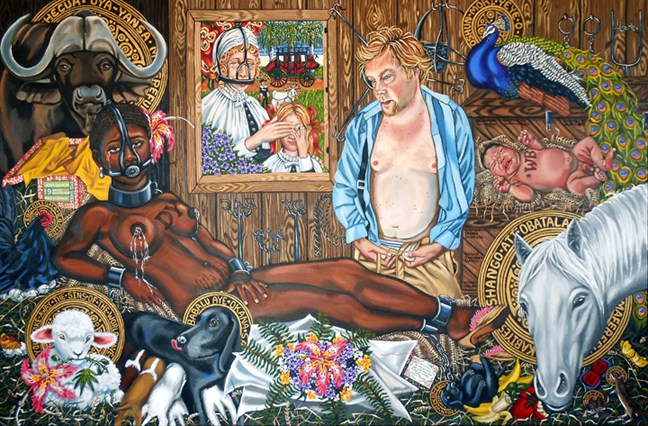
Lili Bernard stated that the painting “is a memoriam to my great-grandmother Caroline who was a very poor dark-skinned Black maidservant for my great-grandfather William Bernard. William was a rich stage coach designer in Kingston, Jamaica, and was married with children. Caroline bore three babies from William: my grandmother Harriet and her brothers William and Nathan Bernard. We assume they were born out of rape.” Visit her website.
.
9.
The true horrors of the Middle Passage would be incomplete without acknowledging the abuse of the female captives by slavers and traffickers. It is possible that a major reason the men’s and women’s quarters were separate on slave ships was so that the traffickers could have easier access to the women without dealing with angry African men. The trafficker John Newton, who composed “Amazing Grace,” wrote: “When the women and girls are taken on board a ship, naked, trembling, terrified, perhaps almost exhausted with cold, fatigue and hunger, they are often exposed to the wanton rudeness of [European] savages.”
It is likely that the rape of AfriKan women and girls occurred on just about every ship that crossed the Atlantic. The comments of a French trafficker anchored at Whydah in 1792 are telling. Fearing an uprising on board after witnessing one nearby, the trafficker lamented: “To avoid a similar incident, we put the largest part of our [Afrikans] in irons, and even among the [women] those who appeared to us the most resolute and the most dangerous…although because of their beauty they were very dear to [us] who had each given their names to chosen ones, there was nothing left to do but put them in chains.”
Another French trafficker wrote in his memoirs that each officer of his ship selected an Afrikan woman to serve him “at the table and in his bed.” Ottobah Cugoano acknowledged the prevalence of sexual exploitation in a much different tone, angrily recalling that “it was common for the dirty, filthy [traffickers] to take the Afrikan women and lie upon their bodies.” As one historian writes: “For the attractive woman, there was the added ignominy of being fought over by lustful [European] men. Quarrels erupted, insults and blows were exchanged to win the right to be the first to rape a good-looking Afrikan woman, or the right to make her one’s exclusive sexual possession for the duration of the voyage.”
A certain trafficker Liot “mistreated a pretty [Afrikan woman], broke two of her teeth and put her in such a state of languish that she could only be sold for a very low price at Saint Domingue where she died two weeks later. Not content, Philippe Liot pushed his brutality to the point of violating an eight to ten-year-old girl, whose mouth he closed to prevent her from screaming. This he did on three nights and put her in a deathly state. On Dutch ships, although sexual contact with African women was officially forbidden, the female quarters were often referred to as the hoeregat, or “whore hole,” clearly referring to the sexual exploitation that obviously occurred there.
10.
Afrikan captives and traffickers alike were killed by catastrophic accidents. The wooden ships would frequently be struck by lightning and burn, get blown off course for months, run aground on shallow coastal rocks, or encounter hurricanes in the mid-Atlantic and sink. The Danish Cron‑Prindzen was lost in a storm in 1705, for example, causing the deaths of some 820 captives. In January 1738, the Dutch Leusden was similarly caught in a storm off the Suriname coast and got caught on the rocks. While the traffickers and a few of the captives escaped, 700 Afrikans below deck drowned. In 1737, some 200–300 Africans drowned when the ship Mary sprang a leak. The Liverpool vessel Pallas was slaving on the African coast in 1761 when she mysteriously blew up, taking some 600 captives with her. 380 captives were reported killed when the London ship Den Keyser blew up on the African coast in 1783. On its way to Havana in 1787, the Sisters capsized in the West Indies, drowning nearly 500 captives.
Furthermore, the traffickers often faced threats from interlopers, privateers, or pirates. Warships were a constant concern as European nations waged seemingly endless wars. When the French Hercule found itself in combat with a Dutch warship in 1701 during the War of Spanish Succession, the captives on board paid a high price. Outfought, the French ship exploded and burned, killing thirty-eight Africans.
In conclusion, when I first wrote this article, I mistakenly attributed the words below to P.J. Patterson. I have since learned that they are inscribed on a memorial plaque in Ghana, which I was fortunate to read in person during a visit in the summer of 2025.
“In everlasting memory of the anguish of our ancestors.
May those who died rest in peace.
May those who return find their roots.
May humanity never again perpetrate such injustice against humanity.
We, the living, vow to uphold this.”
Acknowledgement:
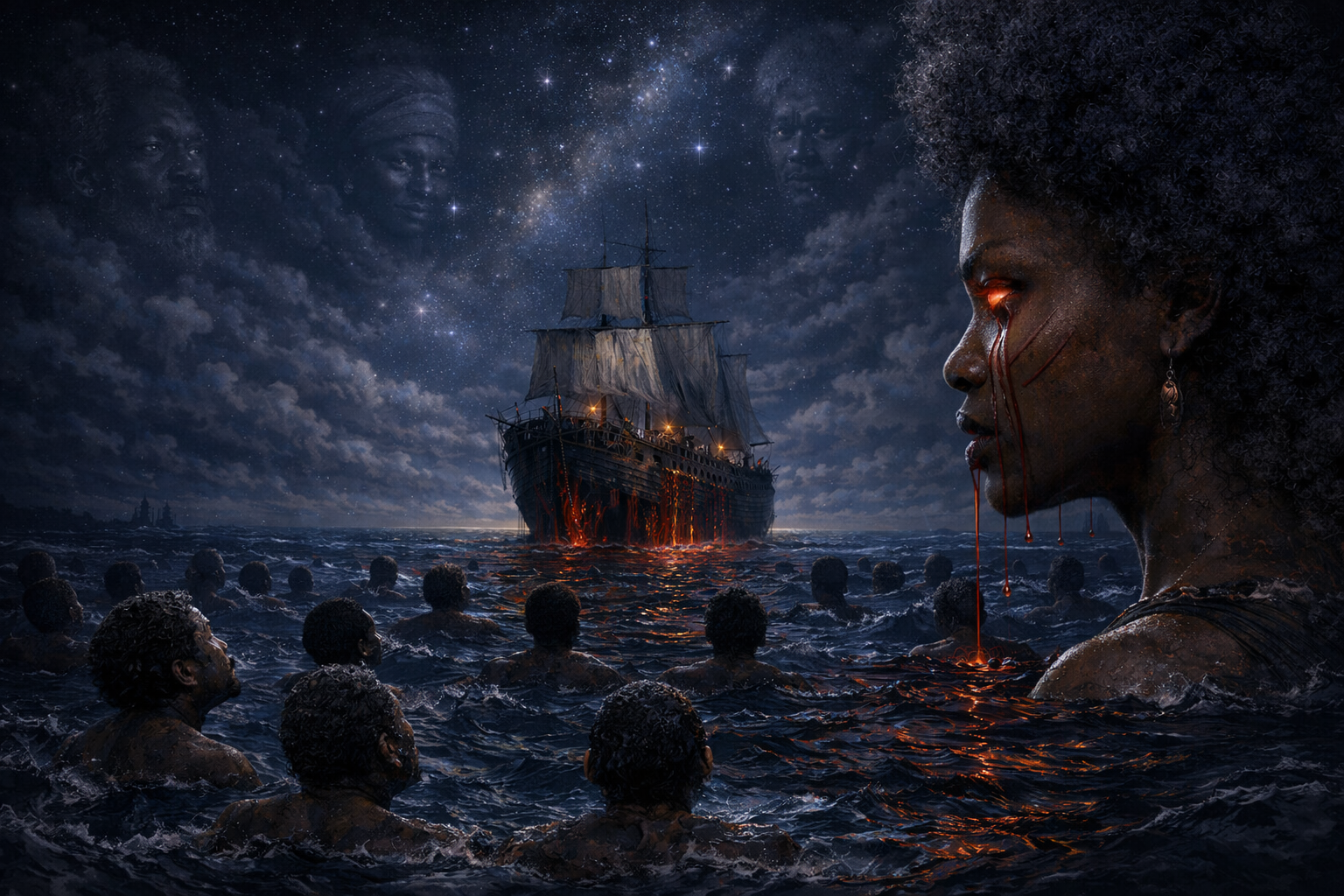
The 2026 revision of this article was supported by Perplexity, an AI research assistant (powered by GPT‑5.1), and Grammarly, which assisted with source verification, historical framing, and the refinement of language to balance truth‑telling with care for readers’ emotional well‑being. The featured image was co‑created in collaboration with ‘ChatGPT’, and ‘Comet’ (Perplexity, powered by GPT‑5.1). The artwork depicts the Haitian Goddess (Lwa) Erzulie Danto. She watches intently as a ship takes away her people from AfriKa, crying tears of blood, which merge with the blood leaking from the ship’s hull. The water around the ship is crowded with the drowned from earlier Atlantic ships. They are watching the ship, their expressions solemn, mournful, and prophetic. Above, in the night sky, ancient Afrikan ancestors appear in the clouds and the Milky Way, also watching the ship.
Nb: In this article, I use the word traffickers for sailors/crew.
For more of the Lili Bernard’s artwork, visit lilibernard.com
To learn more about Tunde Jegede, the world-renowned composer, producer, cellist and kora virtuoso, visit tundejegede.org/
Source:
If We Must Die by Eric Robert Taylor
Trans Atlantic Slavery: Against Human Dignity edited by Anthony Tibbles
The Black Jacobins by C.L.R. James
Britain’s Slave Empire by James Walvin
