
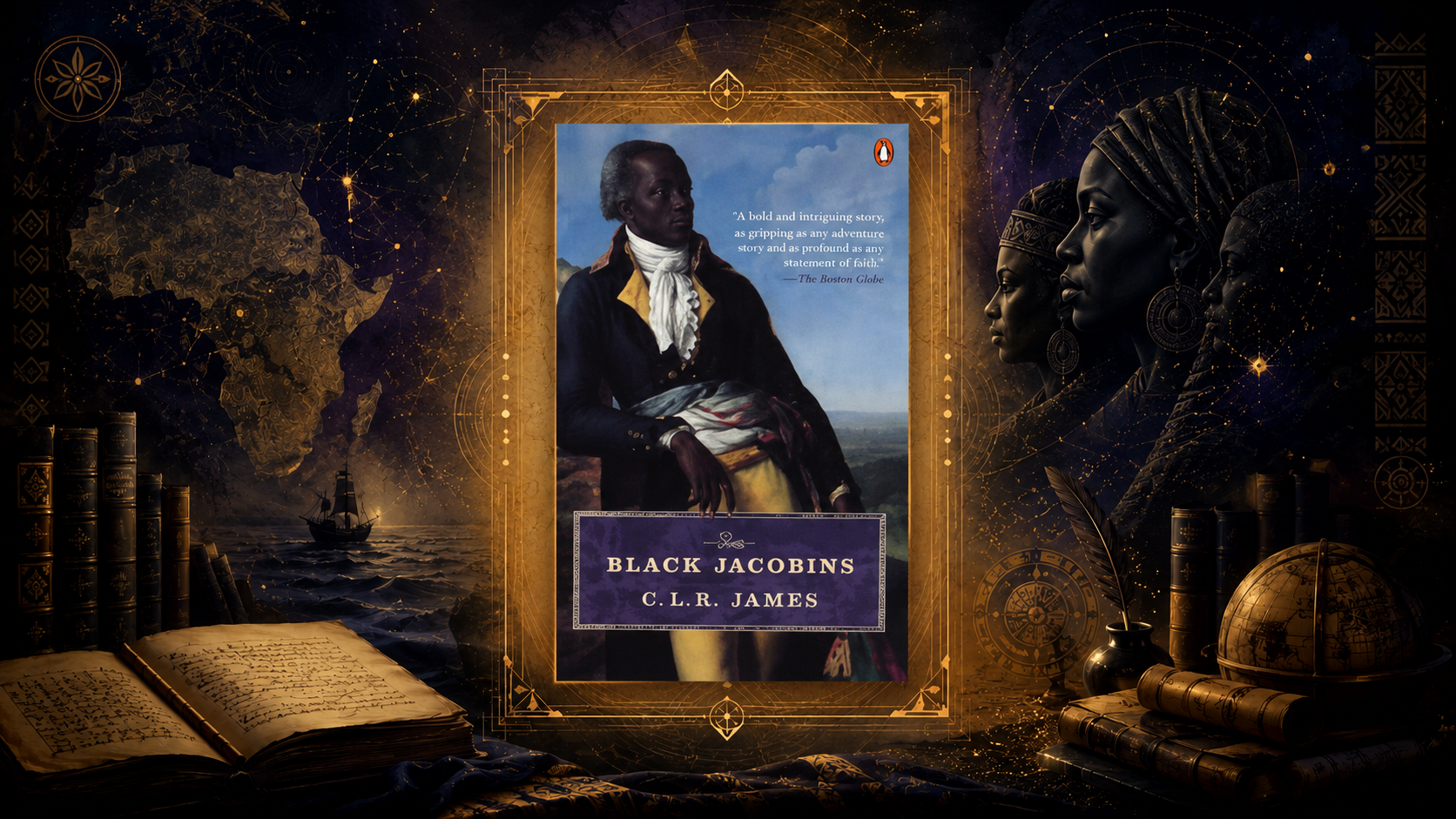
The Black Jacobins: Toussaint L’Ouverture and the San Domingo Revolution is C. L. R. James’s pioneering interpretation of the Haitian Revolution as both the first great Black revolution of the modern world and a decisive event in the global history of capitalism, empire, and emancipation. First published in 1938, it was the first major, sustained analysis of the revolution that began in 1791 and culminated in the creation of Haiti, the first independent Black republic, and the only state born directly from a successful uprising by people held in bondage. James, a Trinidadian Marxist intellectual who was deeply engaged with anticolonial struggles, wrote the book by combining rigorous archival work, political theory, and narrative artistry to present the enslaved of San Domingo as “Black Jacobins”: militants who seized the universal promises of the French Revolution and carried them farther than their European contemporaries dared.
James begins by situating San Domingo (as it was known then) as the richest colony in the 18th‑century Atlantic world, “the greatest single market for the European [trafficking]” and the linchpin of the French economy. He details the brutal plantation regime that produced sugar, coffee, and indigo for European consumption: an economy built on extreme exploitation, staggering mortality, and the constant importation of Africa’s people to replace the dead. Yet even as he catalogs this brutality, he is careful to map the complex social stratification of the colony—grand blancs (wealthy Europeans), petits blancs (poor Europeans), free people of color, and the masses of Ayitians in bondage—arguing that it is the interplay of these class fractions, as much as race, that generates the crisis of the 1790s. The society he describes is unstable, shot through with antagonisms between planters and metropolitan authorities, between European and freed people of African descent, and between all these groups and those held in captivity, whose explosive potential haunts the European imagination.
Against this backdrop, The Black Jacobins interweaves the story of the French Revolution. James insists that the events in Paris and those in San Domingo form a single, dialectically linked process. The abolitionist rhetoric of the French National Assembly, the rise and fall of the Jacobins, and the oscillations of metropolitan policy are not distant dramas but forces that shape, and are shaped by, the struggles in the Caribbean. When the Ayitians of San Domingo rose in 1791, they did so in a world already in motion, seizing upon the language of “rights of man” and liberty to press claims that the French revolutionaries had not fully intended for them. James’s title concept—“Black Jacobins”—names this appropriation: the Ayitians, inspired by but not subordinate to Paris, take the logic of Jacobin radicalism to its most universal conclusion by demanding the end of the Maafa itself.
At the center of the narrative stands Toussaint L’Ouverture, whom James presents as one of the most remarkable political and military leaders of the age. Born in captivity and remaining so until his mid‑forties, Toussaint emerges in the book as a self‑taught strategist who masters not only the arts of guerrilla warfare and conventional battle but also the intricacies of diplomacy, playing French, British, and Spanish powers against one another. James traces Toussaint’s rise from relatively obscure plantation steward to General in the service of the French Republic, emphasizing his ability to read events, grasp the larger dynamics at work, and hold together a fragile coalition of former slaves, free people of color, and sympathetic whites. Yet the biography is never hagiographic. James probes Toussaint’s contradictions: his attachment to French civilization, his belief in disciplined plantation labor under a regime of “free” wage work, and his reluctance—at critical moments—to break definitively with France.
One of James’s most striking interpretive moves is his argument that “Toussaint did not make the revolution; it was the revolution that made Toussaint.” This formulation reflects his Marxist conviction that mass social forces, not great individuals, ultimately drive history. Throughout the book, he centers the “proletarian masses” of the plantations: it is their collective insurrectionary action that forces the hand of the French assembly, compels the proclamation of emancipation, and ensures that attempts at reimposing captivity will be met with armed resistance. Toussaint’s genius lies in his capacity to lead and interpret the movement of those masses, but his limitations—and eventual downfall—are also rooted in his partial identification with French values and erudition. James suggests that Toussaint’s faith in French republicanism and his desire to maintain the plantation economy ultimately led him to underestimate both Napoleon’s ruthlessness and the formerly enslaved’s revolutionary desires.
The narrative builds toward the climactic confrontation with Napoleon’s expeditionary forces in 1802–1803. James dramatizes the arrival of General Leclerc’s army, sent to restore French control and, implicitly, the Maafa, and he records Toussaint’s missteps in initially seeking accommodation. After Toussaint is captured through treachery and deported to France, where he dies in prison, leadership passes to figures like Jean‑Jacques Dessalines and Henri Christophe, whose more uncompromising stance leads to the decisive defeat of the French and the declaration of Haitian independence in 1804. In James’s telling, this outcome is not the work of isolated heroes but the culmination of a twelve‑year struggle in which the Ayitians transform themselves into an army, a polity, and finally a people. The Haitian Revolution thus becomes, in his hands, a model for “Third World” liberation movements: a demonstration that oppressed populations can overthrow their oppressors and refashion their societies.
Stylistically, The Black Jacobins is renowned for its fusion of meticulous research and vivid, almost novelistic narrative. James draws on archival sources, contemporary accounts, and earlier histories, but he refuses the dispassionate tone of conventional historiography; his prose is charged with moral and political urgency. Battle scenes are rendered with cinematic clarity, debates in the French Assembly with sharp irony, and the inner conflicts of leaders like Toussaint with psychological depth. This narrative energy serves a political purpose: by making the revolution come alive, he seeks to inspire contemporary readers, particularly in colonized Africa and the Caribbean, to see themselves as potential actors in similar dramas of liberation.
James’s Marxism shapes not only his emphasis on class but also his reading of slavery itself. He presents Saint‑Domingue as a crucial node in the formation of the modern capitalist world economy, an “appalling economic reality” whose profits fueled European wealth and whose human cost underwrote the rise of bourgeois society. The Haitian Revolution, in this framework, is not merely a colonial disturbance but a fundamental challenge to the economic foundations of the Atlantic system—one reason why Britain, Spain, and France, despite their rivalries, cooperate at times to try to crush it. James underscores how the destruction of the slave system in Haiti reverberates outward: within a few years of Haitian independence, Britain and the United States move to end the transatlantic slave trade, partly out of fear of further revolts and partly because the Haitian example has altered the political calculus.
The book’s afterlife underscores its double existence as history and manifesto. In his 1963 preface to a revised edition, James explicitly states that when he wrote The Black Jacobins in 1938, it was “intended to stimulate the coming emancipation of Africa.” He also adds an appendix, “From Toussaint L’Ouverture to Fidel Castro,” which draws a line from the Haitian Revolution to contemporary struggles in the Caribbean and beyond, suggesting that the lessons of San Domingo remain relevant for understanding anti‑colonial revolutions in the 20th century. Scholars have since produced an extensive secondary literature and even a dedicated Black Jacobins Reader to unpack the book’s historiography, political theory, and reception, revealing how James’s account has shaped thinking on race, revolution, and world history. While some critics question aspects of his Marxist emphasis on class over race, or point to the ways his admiration for Toussaint sometimes coexists with sharp critique, there is broad agreement that The Black Jacobins remains a seminal text in both Haitian studies and the global history of slavery and abolition.
Today, The Black Jacobins is widely recognized as essential reading for understanding not only the Haitian Revolution but also the broader entanglements of Europe, Africa, and the Americas in the making and unmaking of the slave system. By putting enslaved Africans at the center of the story, James reorients the narrative of modernity: the most radical realization of Enlightenment ideals, he suggests, did not occur in Paris or Philadelphia, but in the cane fields and mountain camps of San Domingo. The book’s enduring power lies in this reframing. It asks readers to see Toussaint and his comrades not as peripheral figures in a European drama, but as world‑historical actors whose struggle against slavery opened new possibilities for human freedom—possibilities that, in James’s view, continue to challenge the unfinished business of colonialism, racism, and capitalist exploitation.
Praise for The Black Jacobins: Toussaint L’Ouverture and the San Domingo Revolution
“His detailed, richly documented and dramatically written book holds a deep and lasting interest.” –New York Times
“Contains some of the finest and most deeply felt polemical writing against slavery and racism ever to be published, and it locates the Caribbean and Caribbean society firmly on the world stage.” –Time Out
“He is quite simply, the outstanding West Indian of the century.” -Caryl Phillips, author of Crossing the River
“The Black Plato of our generation…the founding father of African emancipation.” –The Times
“The Black Jacobins dramatically and powerfully recounts the events that led up to the bloody and history-altering Haitian revolution of 1791-1803.” Sacred Fire: The QBR 100 Essential Black Books