
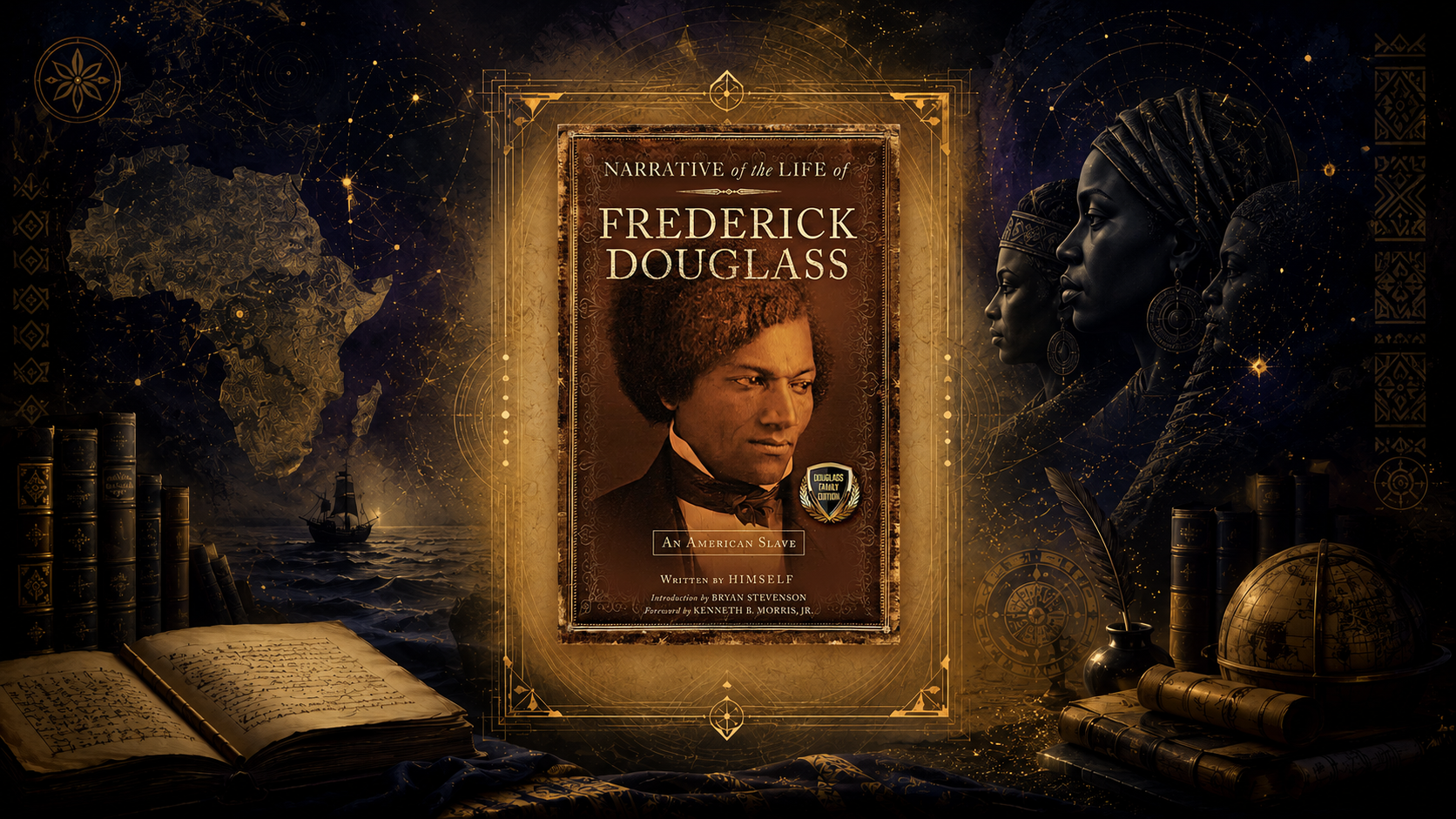
Narrative of the Life of Frederick Douglass, an American Slave, Written by Himself remains one of the most forceful autobiographies in United States literature. First published in 1845, while Douglass was still legally vulnerable as a freedom seeker, the book combines personal testimony, political argument, and a controlled yet devastating literary style. Its very title insists upon authorship and self-representation: a man whom captivity sought to reduce to property speaks in his own name and tells his own history.
Douglass recounts his early life on Maryland’s Eastern Shore, where captivity separates children from their mothers, obscures birth dates and kinship, and normalizes violence as a tool of domination. The narrative’s power lies partly in its refusal to abstract brutality. Through scenes involving hunger, forced labor, the beating of Aunt Hester, and the murder of the captive man Demby, Douglass exposes the Maafa not as a regrettable social institution but as a system sustained by terror, theft, and the deliberate destruction of human relationships.
Literacy sits at the center of the book. When Hugh Auld’s wife begins teaching Douglass the alphabet, her husband objects because education, he understands, could make an captive person unfit to remain in bondage. Douglass turns that prohibition into a path to intellectual and political freedom. His secret pursuit of reading—through newspapers, books, exchanges with poor European boys, and the study of The Columbian Orator—becomes both a personal achievement and an indictment of a society that made knowledge dangerous for Black people.
The memoir also refuses easy consolation. Douglass presents freedom as something pursued amid fear, uncertainty, and repeated peril, rather than as a simple escape plot. His account of resisting the human-breaker Edward Covey marks a profound psychological turning point: it restores his sense of manhood and inner independence before his physical flight north in 1838.
Brief, lucid, and morally uncompromising, Narrative was an immediate publishing success, selling 5,000 copies within months of its May 1845 release and reaching a wide transatlantic readership. Its enduring importance rests on both its historical witness and its exceptional artistry.