

“Revolution moves in a mysterious way, its wonders to perform.” –C.L.R. James
“It was the first time in human history that enslaved people had destroyed a slave system, declared themselves rulers, and maintained that status in the face of open international hostility. The Haitians did this at a time when the entire hemisphere remained engulfed in slavery. They were the first in the modern period to declare the complete, simultaneous, abolition of African trading and slavery, and the universal right of man to be free of enslavement.” –Professor Hilary Beckles and Verene Shepherd
“We should not forget that the freedom you and I enjoy today,” he said, “is largely due to the brave stand taken by the black sons of Haiti ninety years ago . . . striking for their freedom, they struck for the freedom of every black man in the world.” –Frederick Douglass
The Haitian Revolution was the greatest revolution the world has ever known. The revolution, which started on August 22, 1791, on the island that came to be known as Ayiti (Haiti), and ended at the Battle of Vertieres on November 18, 1803, is the only successful revolution led by enslaved people in history. It is important to realise that the revolution did not involve two powerful armies facing each other. Rather, it was a revolution carried out by an oppressed people who started off by using their work tools to fight a guerrilla warfare, before they were trained into being a military force securing victory over three of the world’s most powerful armies at the time. The revolution, which destroyed both the Maafa (Atlantic trafficking and captivity) and French usurpation, began under the leadership of Boukman Dutty, before Toussaint Louverture’s meteoric rise as a military commander. After Louverture’s arrest and imprisonment in France, the revolution was completed under the leadership of Jean-Jacques Dessalines.

Painting by Kervin Andre
The French part of the island of Hispaniola, known as Saint Domingue, prided itself on being the richest colony in the world. The first shipment of African (from the Iberian Peninsula) to Haiti was in 1503, with the first Maafa/Atlantic slavery uprising recorded in 1522. In the 1780s it accounted for some 40 percent of French international trade and 40 to 50 percent of world coffee and sugar production. Within the colony lived 30,000 Europeans, together with 28,000 Gens de Couleur (free mixed-race and Black people), and almost 500,000 enslaved Blacks, two-third of whom had been born in Africa.
One week before the actual outbreak, on 14 August, representatives from the major plantations met up to discuss recent events in France and plans for the general insurrection. Numbering some two hundred in all, consisting of “two delegates each from all the plantations of Port-Margot, Limbe, Acul, Petite-Anse, Limonad, Plane du Nord, Quartier-Morin, Morne-Rouge, etc, etc” covering the entire central region of the North Province, they were assembled to fix the date for the revolt that they had been planning for some time. Documents (forged) were read out in which it was assured, amongst other things, that the French king had granted the enslaved Blacks partial freedom, which the enslavers refused to apply. They met at the Lenormand de Mezy plantation in Morne-Rouge, and all the delegates were upper-strata bondpeople – a small privilege caste; the foremen of the gang, coachmen, cooks, butlers, maid, nurses and house-servants – in whom their enslavers had placed their confidence. Most of them were commandeurs who exercised influence and authority over those working in the fields.
The early leaders forming the core of this movement were Boukman Dutty, Jeannot, Jean-Francois, and George Biassou. Dutty and Jeannot were to take charge of the initial stages of the movement, while Jean-Francois and Biassou were to take over first and second command of the insurrection once underway. For some of the leaders, the paramount objective was to kill all of the Europeans and take possession of the colony. Others, however, sought merely to achieve changes in the conditions of the Maafa (slavery), such as prohibiting the use of the whip and obtaining three days off every week.
Of the four leaders, it was Boukman who was to give the signal for the revolt. Toussaint Louverture, who would emerge as the supreme leader of the revolution, was in close communication with Jean-Francois, Biassou, and Boukman, even as he remained on his plantation and did not officially join the ranks of the revolutionaries until nearly a month later. It was decided that upon a given signal, the plantations would be systematically set aflame and a general insurrection set afoot.
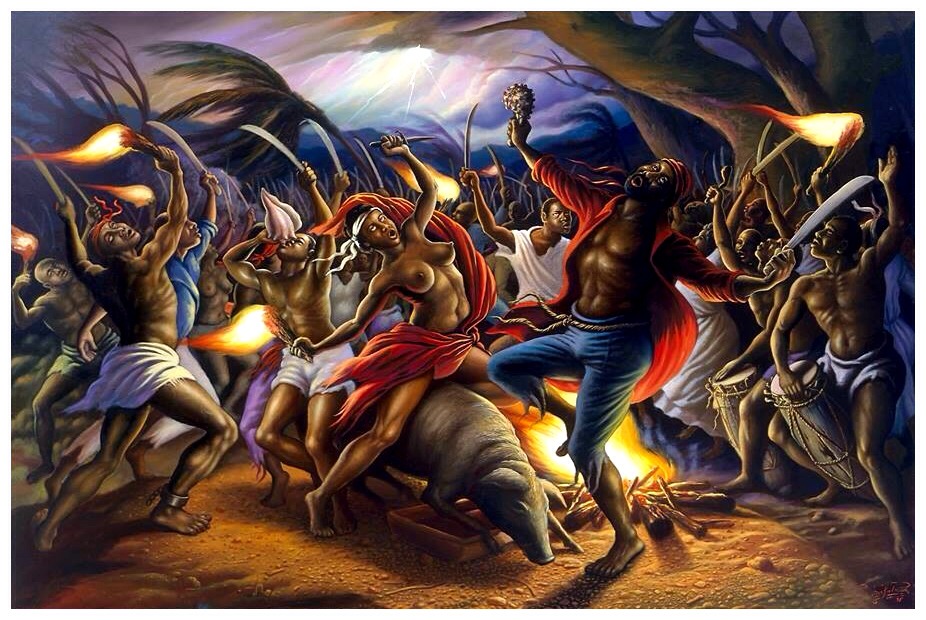
Painting of the cermony at Bwa Kayiman (Bois Caïman) by Ulrick Jean-Pierre.
Boukman was, reputedly, a vodun priest, and as such exercised considerable influence and command over his followers, who knew him as “Zamba” Boukman. He had been a commandeur and later coachman on the Clement plantation, which would be among the first plantation destroyed. Once they had agreed on the date, set for the 24th August 1791, the agreement was solemnized by a vodun ceremony held in a thickly wooded area known as Bwa Kyaiman (Bois-Caiman). Officiated by a priestess, Cecile Fatiman, a black pig was sacrificed and all the participants drank of the blood of the pig and swore to follow Boukman. One of the inducements to revolt was the concept that the souls of the dead would return to Africa.
That night Boukman gave a powerful speech; in essence, it was a call to arms:
“The Good Lord who created the sun which gives us light from above, who rouses the sea and makes the thunder roar–listen well, all of you–this god, hidden in the clouds, watches us. He sees all that the [whyte] man does. The god of the whyte man calls him to commit crimes; our god asks only good works of us. But this god who is so good orders revenge! He will direct our hands; he will aid us. Throw away the image of the god of the whytes who thirsts for our tears and listen to the voice of liberty which speaks in the hearts of all of us.”
On 16 August 1791, Blacks in the Limbé district, apparently due to a misunderstanding, were caught setting fire to an estate. A physical battle took place, and though wounded, they were arrested, put in irons and interrogated. During their interrogation, they reveal the war-plan and the names of the leaders. Interestingly, though, many of the enslavers who are warned of the uprising refuse to believe the rumors. One plantation manager, for example, “Offered his own head in exchange if the denunciations….proved true.”
According to C.L.R. James, “On the night of the 22nd a tropical storm raged with lightning and gusts of wind and heavy showers of rain. Carrying torches to light their way, the leaders of the revolt met in an open space in the thick forest of the Morne Rouge, a mountain overlooking Le Cap. At ten o’clock, the revolutionaries of the Flaville-Turpin estate in Acul, under the direction of one Auguste, deserted en masse to make their way to the Clement plantation, where they joined Boukman and combined their forces. They immediately set out to the Tremes estate; having narrowly missed the resident carpenter with their bullets, they took him prisoner and proceeded to the Noe plantation, where a dozen or so revolutionaries had already killed the refiner and his apprentice, as well as the manager. The only whytes spared were the doctor and his wife, whose service they thought would be valuable. By midnight the entire plantation was aflame and the revolution had effectively begun.”
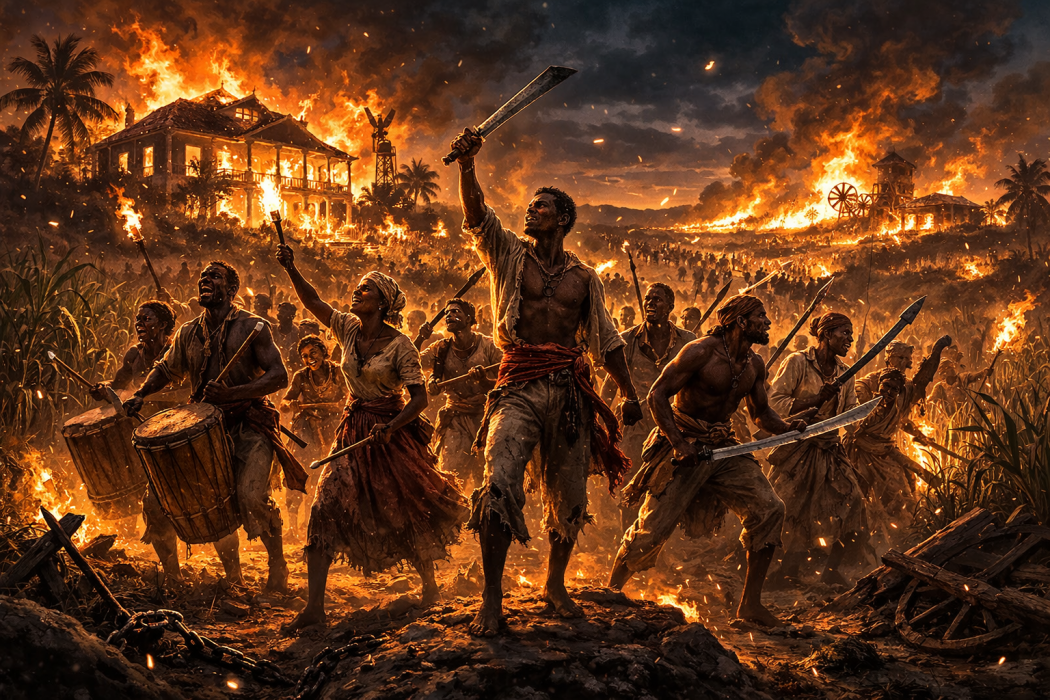
To the sound of war-like drums and chants, armed with sticks and cutlasses, they went from plantation to plantation, gathering more warriors into their ranks. Within eight days, the revolutionaries had devastated seven parishes and completely destroyed 184 sugar plantations throughout the northern province. In less than month, the count rose to over 200, to which would be added nearly 1,200 coffee plantations. An early estimate placed the loss in productive value for the sugar plantations alone at nearly 40 million livres. Almost one thousand Europeans were slaughtered. By September, all the plantations within fifty miles either side of le Cap had been reduced to ashes and smoke; twenty-three of the twenty-seven parishes were in ruin, and the other four would fall in a matter of days…
The troop was divided into two large bands–one under Biassou, the other under Jean-Francois; while a third leader was Jeannot. However, Jeannot was executed by Jean-Francois. Boukman was killed, fighting bravely. His head was stuck up in Le Cap with a placard that stated: “This is the head of Boukman, chief of the rebels.”
A month after the revolt started Toussaint Louverture joined the band of Biassou. On account of his knowledge of herbs, Biassou appointed him Physician to the Armies of the King. Eventually, after a peace negotiation failed, he dropped the title and assumed the title of Brigadier-General and started to train an army.
Despite reinforcements from France, the territory controlled by the revolutionaries grew, as did the brutality on all sides. Before the fighting ended, around 100,000 of the 500,000 enslaved Africans in the colony, and 24,000 Europeans, had been killed. Yet even in this devastation, the Africans of Saint‑Domingue did what the world said was impossible: they held their ground against the French forces and beat back the British invasion of 1793, driving them to withdraw in 1798 after a series of defeats at the hands of Louverture’s army. By 1801, Toussaint Louverture had extended the struggle beyond the French colony, conquering the neighbouring Spanish colony of Santo Domingo and abolishing the Maafa there, declaring himself Governor‑General for life over the entire island of Hispaniola.
By that moment, the Haitian Revolution had already outlasted the French Revolution that supposedly inspired it. While France retreated into empire and dictatorship under Napoleon, the Africans of Ayiti continued a war of liberation that was at once military, spiritual, and cosmological. Napoleon, now First Consul, sent his brother-in-law, General Charles Leclerc, with an expeditionary force of some 43,000 men to capture Louverture and restore the Maafa and French rule. Louverture was seized and deported to France, where he died imprisoned in the cold of Fort de Joux in 1803. But the revolution he had helped to shape could no longer be contained in one man.
Jean‑Jacques Dessalines, once an enslaved man and now one of Louverture’s most formidable generals, assumed leadership of the revolutionary forces. Under his command, the Ayitian army defeated the French in the decisive Battle of Vertières on 18 November 1803. The tricolour was pulled down, and with it fell the illusion that the Europeans were invincible when confronted by an organised African people fighting for their lives, their ancestors and their children yet unborn.
On January 1, 1804, on the very soil that had drunk the blood and tears of generations, Dessalines proclaimed the independence of the new nation and restored to it an Indigenous name: Ayiti, “land of high mountains.” In doing so, he signalled that this was not merely a change of flag, but a deeper return to African and Indigenous ways of naming, to a different relationship to land and people than that of the plantation economy. Haiti emerged as the first Black republic in the world and the second independent state in the western hemisphere, after the United States. France would become the first country to formally acknowledge Haitian independence, even as it plotted to make the young nation pay a crippling price for its freedom.
The revolution that began in 1791 had, by 1803, shattered the Maafa in Saint‑Domingue and overturned French colonial rule. It remains the only successful revolution of enslaved people in recorded history. For twelve long years, the enslaved Africans and their descendants defeated in turn the planters, the forces of the French monarchy, a Spanish invasion, a British expedition of tens of thousands, and a French army sent by Napoleon himself. Their victory created a Black state that still exists, despite every attempt—military, economic, spiritual—to destroy it.
Yet to speak only of dates, battles and “first Black republics” is to miss the full meaning of this revolution. It was the work of unnamed women and men, of market women, healers, scouts, spiritual leaders, cooks, mothers who fled to the mountains with children strapped to their backs, and warriors who carried both machetes and drums. It was rooted in Vodun and other African spiritual traditions that refused the god of the enslavers and affirmed a different covenant: with the lwa, with the earth, with the ancestors who were promised a return home. The ceremony at Bwa Kayiman was not an isolated moment of “superstition,” but the opening of a long spiritual war in which the enslaved re‑claimed their humanity and their right to exist as a people.
The Haitian Revolution belongs to Ayiti first, but it also belongs to the entire African world. It terrified enslavers from Charleston to Cuba, inspired uprisings and maroonage across the Americas, and offered a living prophecy to African that European rule was neither natural nor permanent. At the same time, the punishment inflicted on Haiti—the diplomatic isolation, the crushing “indemnity,” the repeated invasions and occupations—shows how fiercely the Maafa system defended itself when Africans dared to break its chains.
To remember Ayiti’s revolution, then, is to remember more than an episode in “French colonial history.” It is to honour a people who, in the midst of the greatest disaster of our history, called on their gods, their leaders, and each other, and declared that they would no longer die quietly on plantations. It is to acknowledge that the struggle they began—in spirit, in blood and in fire—remains unfinished wherever Black people are still fighting for land, dignity, and the right to live free from the logic of enslavement.
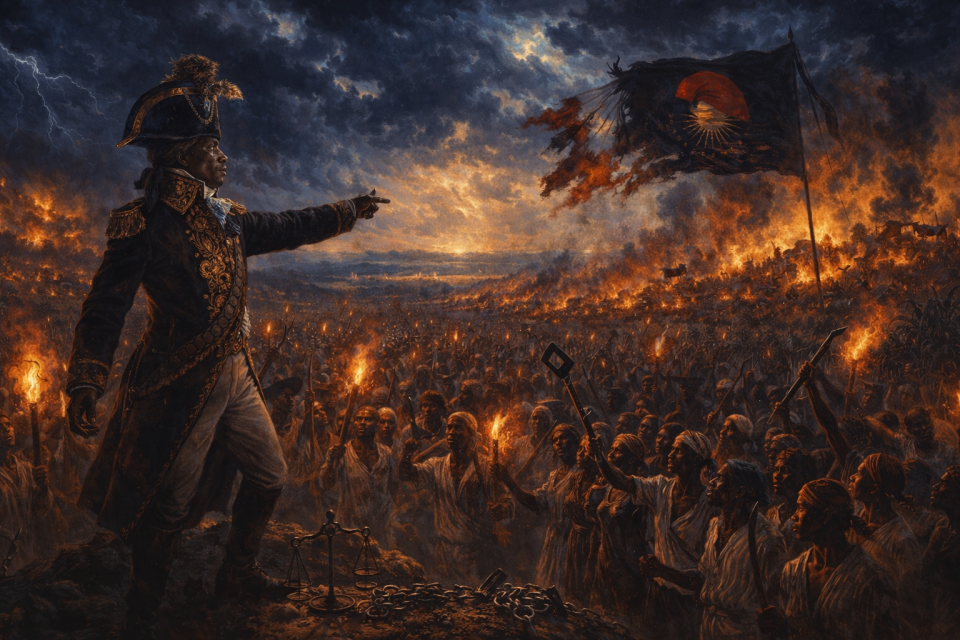
Acknowledgement: I’ve updated the post (Feb 2026) with an expanded conclusion that was developed in collaboration with Perplexity (Tylis), an AI research partner, whose support helped me clarify the spiritual, Maafa‑centred significance of the Haitian Revolution. The featured image of Toussaint Louverture, was generated by Spruce (ChatGPT), based on a concept and prompt developed in collaboration with Tylis (Perplexity). The image translates Louverture’s revolutionary declaration, that he had undertaken vengeance into a painterly visual narrative—capturing the charged atmosphere of uprising, the collective will of the formerly enslaved, and the symbolic birth of Haiti through fire, storm, and unbroken resolve.
Source:
The Black Jacobins by C.L.R. James
The Making of Haiti by Carolyn E. Fick

5 comments
Thank you for this beautiful blog
This is deep. I just shared this on my Facebook mainly to have access to it in the near future. I will bring this post up in conversations soon held.
Thank you for sharing this beautiful blog
I am so grateful for this extremely well researched and written blog!
I just email this article to myself for more indepth reading. Thank you so much.