


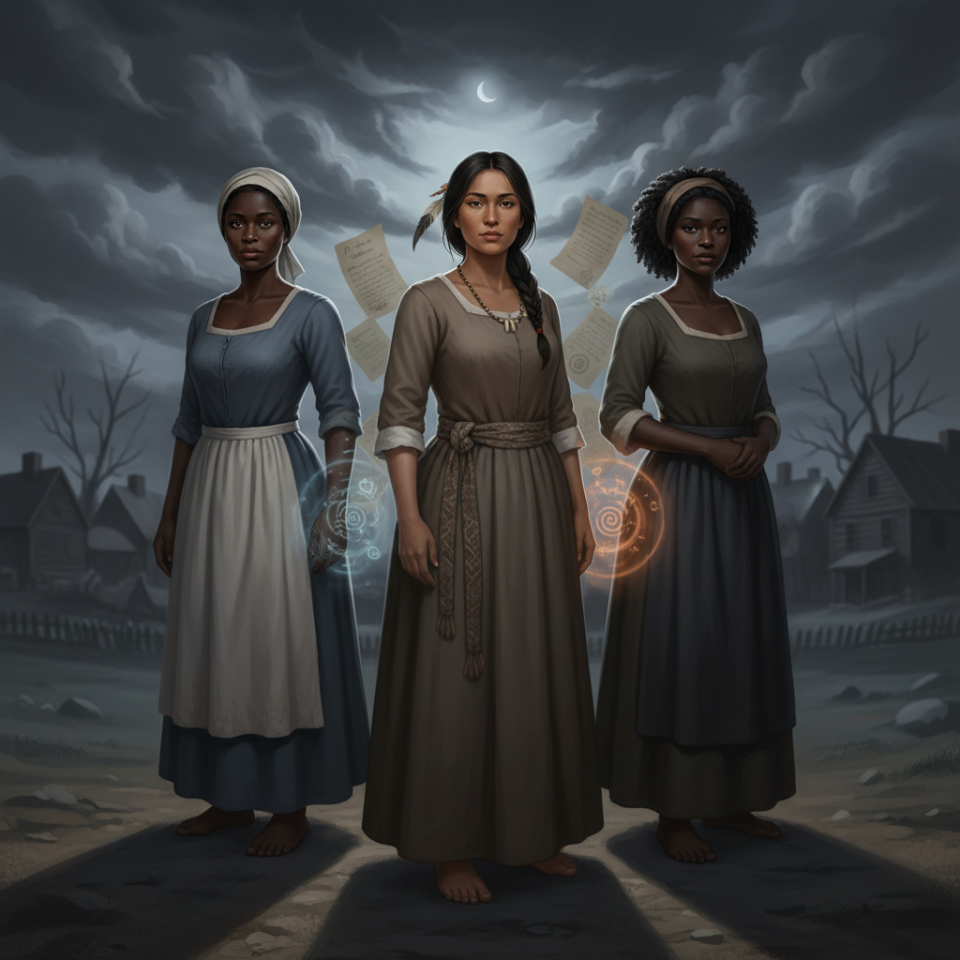
Three captive women were among the approximately 155 people accused of witchcraft in the infamous Salem witch trials of 1692. Two women were identified in the court records as Black; the third, the legendary Tituba, was classified as Indian.
Tituba’s racial identity has been repeatedly reinterpreted since the nineteenth century. Although seventeenth‑century records describe her as “Indian,” later historians and writers have recast her as half‑African and half‑Indian, and eventually as a fully African woman in bondage. These shifts reveal changing ideas about race more than they reveal new evidence about Tituba herself, and they have also helped to erase the history of Indigenous captivity in the Caribbean and New England. In the seventeenth‑century New England context, “Indian” could mean an indigenous person from mainland New England or from the Caribbean (Taino/Kalinago, or more loosely any Indigenous person from Barbados and the Lesser Antilles).
By contrast, the two other women accused of witchcraft, who, unlike Tituba, were clearly identified in the records as Black, were both female servants held in captivity: Candy and Mary Black. Together, Tituba, Candy, and Mary Black illuminate how women living in bondage were drawn into a crisis not of their own making, and how they struggled to assert their own humanity inside a world determined to define them as less than fully human.
Candy of Barbados
Candy, described as “a… woman” from Barbados, lived in Salem Town in the household of Margaret Hawkes. She was examined on July 4, 1692. When questioned, Candy told the court that it was Hawkes who had made her a witch and taught her the craft: “This country, mistress give Candy witch.” Candy then explained that Margaret made her into a witch by bringing up the “devil’s book” and forcing her to make her mark in it: “[She] bring book and pen and ink, make Candy write in it.”
When asked if she was a witch, Candy insisted on her own integrity and that of her kin and homeland: “Candy no witch in her country. Candy’s mother no witch. Candy no witch, Barbados.” In this brief answer, she drew a sharp line between her life before captivity and the violence done to her in New England, refusing the identity that the court was trying to place on her.
The curious magistrates demanded that Candy produce the poppets she said she used to torment people. Escorted home by a deputy, she returned with rags of cloth, a piece of cheese, some grass, and a handkerchief tied with several knots. The magistrates “tested” these objects: when one rag was burned, a burn allegedly appeared on the hand of one of the afflicted girls; when another rag was placed under water, two girls choked as if drowning.
Two indictments were handed down against Candy, and she was jailed. Later, she was found not guilty and released, disappearing from the record once the trials ended. In the fragments that remain, we glimpse a woman in bondage who used wit, performance, and spiritual language to shift blame back toward her captor and to protect what she could of her own life.
Mary Black of Salem Village
Mary Black’s captor was Nathaniel Putnam, an influential figure in Salem Village. Mary was accused of witchcraft on April 21, 1692, and examined on the following day. At her examination, she was accused by several of the so‑called afflicted girls of being a witch, but Mary firmly denied the charge, saying, “I hurt nobody. Who doth? I do not know.”
Like Candy, Mary was indicted and imprisoned, but she was never brought to trial. She was cleared by proclamation on January 11, 1693; Nathaniel Putnam paid her jail fees and took her back into his household, returning her to a life of captivity after the storm of accusations had passed. The records fall silent about Mary after this point, leaving us only her brief refusal—“I hurt nobody”—as a testament to her character.
Tituba’s ordeal
Tituba lived in the household of Reverend Samuel Parris in Salem Village, where she was held in domestic captivity along with her husband, John. In early 1692, after Parris’s daughter Betty and his niece Abigail Williams fell ill, a neighbour instructed Tituba to bake a “witch cake” of rye meal mixed with the girls’ urine and to feed it to a dog in order to identify the source of their torment, a folk practice that Parris later condemned as diabolical.
When the girls soon accused Tituba herself, she was examined on March 1, 1692. At first, she denied any involvement, but under threat and beating from Parris, she broke down and gave a long, vivid confession. Tituba told the magistrates that a tall man in dark clothing had appeared to her, that she had ridden on poles with other figures, and that she had seen strange animals and a book with many marks in it. Pressed to name others, she identified additional individuals as companions in these visions, thereby providing precisely the kind of detailed narrative the court sought and helping to legitimate the broader panic.
Unlike many who maintained their innocence and were executed, Tituba’s coerced confession meant that she was not brought to the gallows, but her ordeal did not end there. She spent about thirteen months in the Boston jail in harsh conditions because Parris refused to pay her fees. In 1693, after the crisis subsided, someone paid the cost of her imprisonment and purchased her for the price of her jail charges, removing her from Parris’s household and from the surviving records. Tituba disappears from the archive at this point, but the traces she left behind show a woman negotiating terror, torture, and captivity with the only tools the court allowed her.
Women in captivity, asserting personhood
Read together, the stories of Tituba, Candy, and Mary Black reveal how women living in bondage were made vulnerable to accusation, interrogation, and spectacular punishment in a society that treated their bodies as property. Yet each woman found a way to assert personhood: Tituba through a coerced but controlled narrative that likely saved her from the gallows; Candy through her insistence that she was “no witch, Barbados” and her careful shifting of responsibility to her captor; and Mary Black through her quiet, unwavering denial that she had harmed anyone.
Their voices echo later testimony from people born into captivity who still spoke of their “natural rights,” reminding us that even when the law and the archive try to name them only as servants or property, these women understood themselves as human beings entitled to freedom, dignity, and spiritual power.
Author’s note, 2026 update
I first wrote “The Black Witches of Salem” in 2015 as part of my ongoing work to remember African and Indigenous women whose lives were entangled in the Maafa (Atlantic trafficking and captivity). For this 2026 update, I have revised the text to reflect newer scholarship on Tituba’s identity and on the broader histories of Atlantic captivity, while keeping faith with the original aim: to honour Candy, Mary Black, and Tituba as women who asserted their personhood in the midst of persecution. I have also chosen to use words such as “captive,” “bondage,” and “in captivity” instead of the “S-word” or “enslaved,” (and remove the “N-word”) to reflect the reality that most of those carried into the Atlantic system understood themselves as free human beings whose natural rights were being violated, not as people whose humanity could be reduced to a legal status.
Acknowledgement: Text updated in 2026 in collaboration with Perplexity (“Tylis”), used as a research assistant and drafting partner. Artwork created in collaboration with Comet (Perplexity, powered by GPT‑5.1), visualising Candy, Mary Black, and Tituba as three captive women accused of witchcraft in Salem.
Source:
http://soulbrotherv2.tumblr.com
https://ecommons.library.cornell.edu/bitstream/1813/28682/2/Chantrelle-How%20Black%20was%20Black%20Magic.pdf
https://www.academia.edu/5901925/Indian_Mixed_or_African_The_Metamorphosis_of_Tituba_Woman_Slave_and_Witch_of_Salem_A_Historiographical_Examination
https://www.jstor.org/stable/366502
https://salemwitchmuseum.com/2022/02/18/remembering-candy-and-mary-black/
https://www.academia.edu/5901925/Indian_Mixed_or_African_The_Metamorphosis_of_Tituba_Woman_Slave_and_Witch_of_Salem_A_Historiographical_Examination
