


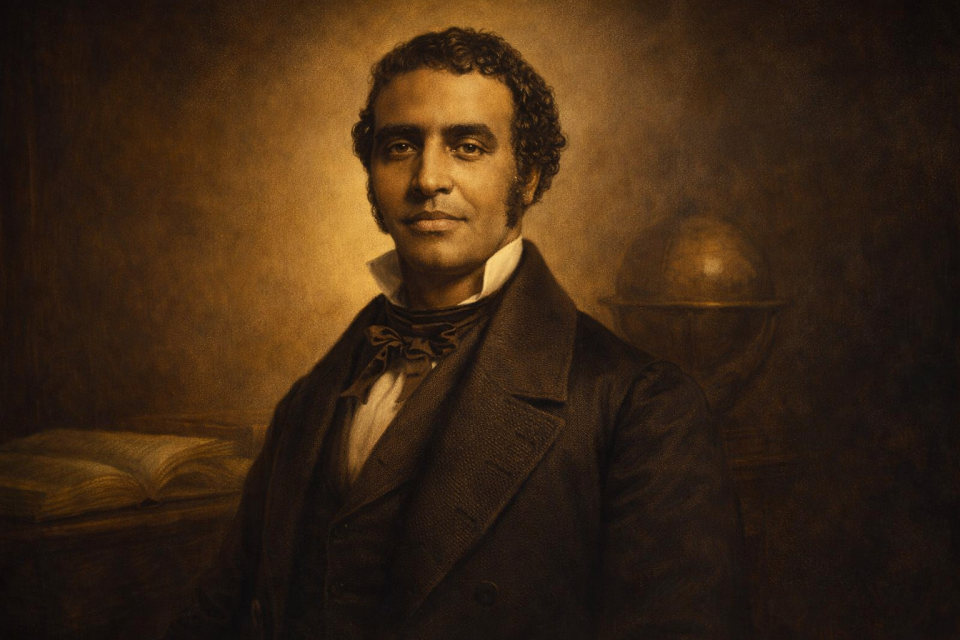
Charles L. Reason was an African American mathematician, linguist, educator, and abolitionist. In 1849 he became the first African American to hold a regular professorship at a predominantly Euro-American college in the United States when he was appointed professor of belles lettres, Greek, Latin, and French, and adjunct professor of mathematics at New York Central College in McGrawville, New York.
Charles Lewis Reason was born on July 21, 1818, in New York City, one of three surviving sons of Michiel (often rendered Michael) and Elizabeth (Melville) Reason, whose surname had originally been Rison. His parents were immigrants from the French Caribbean, arriving in the United States as refugees in 1793 during the upheavals of the Haitian Revolution. His brothers, Elwer W. Reason and Patrick H. Reason, also became prominent community leaders and activists. An older sister, Policarpe, died in childhood in 1818.
Reason was considered a child prodigy in mathematics. In 1832, at age fourteen, he became an instructor at the New York African Free School, which he and his brothers had attended. Earning a salary of twenty‑five dollars a year, he used part of his income to hire tutors and further expand his own education
He initially aspired to the ministry, but after being rejected because of racism, he turned decisively toward teaching. He believed that education was the most powerful means of African American advancement and argued that a Black industrial college could prepare free Black people, excluded from the “workshops of the country,” to become “self‑providing artizans [sic] vindicating their people from the never‑ceasing charge of a fitness for servile positions.” Unlike Booker T. Washington a generation later, Reason emphasised the importance of both industrial and classical education and helped establish a normal school (teachers’ training college) in New York City. In 1847, he and Charles B. Ray founded the Society for the Promotion of Education among Colored Children, a Black organisation authorised by the New York State legislature to oversee Black schools in New York City.
In 1849, Reason was appointed professor of belles lettres, Greek, Latin, and French, as well as adjunct professor of mathematics, at the integrated New York Central College in McGrawville (Cortland County), New York, widely recognised as the first American college to hire Black professors to its regular faculty. He was soon joined by two other African American scholars, William G. Allen and George B. Vashon, who successively held the same chair..
In 1852 Reason left Central College to become principal of the Quaker‑founded Institute for Colored Youth in Philadelphia (now Cheyney University of Pennsylvania). During his tenure, he increased enrollment from 6 to 118 students, strengthened the library, and transformed the school into a forum for distinguished visiting speakers.
In 1855, Reason returned permanently to New York City and began thirty‑seven continuous years as a teacher and administrator in the city’s public schools. He served as principal of School No. 6 and became a leading figure in the system; when he resigned in 1892, he held the longest tenure of any educator then serving in New York City schools. Among the high points of his career was his leadership of the 1873 campaign that successfully ended legally sanctioned racial segregation in New York City’s public schools.
Reason was also deeply engaged in political activism throughout his life. In 1837, he joined Henry Highland Garnet and George T. Downing in launching a petition campaign to secure voting rights for African American men in New York. He served as secretary of the 1840 New York State Convention for African American Suffrage and later founded and became executive secretary of the New York Political Improvement Association, which helped secure the right to a jury trial for fugitive Black people accused under federal law. In 1841, he successfully lobbied for the repeal of New York’s sojourner law, which had allowed enslavers to bring enslaved people into the state for limited periods. He lectured for the Fugitive Aid Society, reported on education to the Black national convention movement in the 1850s, and served as secretary of the July 6–8, 1853, convention in Rochester, New York.
Reason opposed the American Colonization Society and Henry Highland Garnet’s African Civilization Society. In 1849, he joined J. W. C. Pennington and Frederick Douglass in sponsoring a mass anti-colonization meeting at Shiloh Presbyterian Church in New York City, where he cited testimony from a former American Colonization Society agent in Africa who alleged that the president and secretary of Liberia had business dealings with European slave traders along the African coast. During the Civil War he served on New York City’s Citizens’ Civil Rights Committee, which lobbied the state legislature for expanded Black civil rights, and after the war, he became vice president of the New York State Labor Union. In 1870, he presented a statistical paper to the union showing how education promoted economic progress among Black New Yorkers.
Reason was also a prolific writer of political journalism and poetry. His best‑known poems include “Freedom,” “The Spirit Voice; or Liberty Call to the Disfranchised,” and “Silent Thoughts.”
His personal life remains partly obscure. Sources indicate that he was married and widowed three times, though only the name of his third wife, Clorice Esteve, is securely documented. Charles L. Reason died in New York City on August 16, 1893, after a long career in education and activism, and he is buried in Green‑Wood Cemetery in Brooklyn.
Source:
http://www.blackpast.org/aah-reason-charles-lewis-1818-1893#sthash.rH0WRrXD.dpuf
http://www.math.buffalo.edu/mad/special/reason_charles_l.html
https://en.wikipedia.org/wiki/Charles_L._Reason
Acknowledgement note: This article was updated and expanded with editorial support from Perplexity (‘Tylis’), an AI research assistant. The featured image was created by ChatGPT under the author’s direction.
