


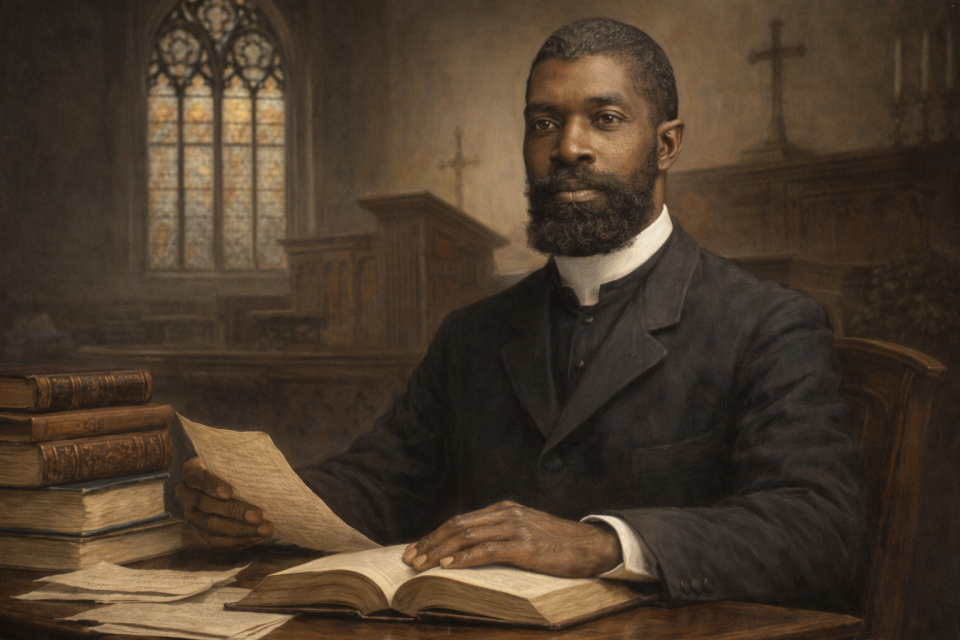
Thomas Nelson Baker Sr. (1860–1941) was the first African American to receive a Ph.D. in philosophy (1903, Yale University). He was a writer, orator, ethicist, and advocate for a positive Black cultural identity, and later served as a Congregational minister in Pittsfield, Massachusetts.
Baker was born in captivity on August 11, 1860, to Thomas Chadwick and Edith Nottingham Baker on Robert Nottingham’s plantation in Northampton County, Virginia, near Eastville. His father later became a Union soldier during the Civil War, and his mother taught him to read the Bible—an act criminalized during the Maafa (Atlantic trafficking and captivity). Baker attended public school from 1868 to 1872, but left at age 12 to help support his family. Even while working as a farmhand, he continued his studies privately and in 1881, at the age of 21, he enrolled in the Hampton Institute High School program, graduating in 1885 as valedictorian of his class.
Determined to prepare for college entrance, in May 1886, Baker enrolled in the Mount Hermon School for Boys in Massachusetts, where, despite being one of only two African-American students, he was entrusted to serve as substitute principal during the summer months. He graduated from Mount Hermon in June 1889. In 1890, Baker entered Boston University’s College of Liberal Arts and graduated with his B.A. in 1893, again as valedictorian. He then enrolled in Yale Divinity School, where he earned his Bachelor of Divinity degree in 1896. The following year, he was ordained as minister at the Dixwell Avenue Congregational Church in New Haven and remained there until 1901 while simultaneously pursuing graduate study in philosophy at Yale.
On September 18, 1901, Baker married Elizabeth “Lizzie” Baytop (1867–1938), and they had four children: Edith, Harry, Ruth, and Thomas Nelson Baker Jr. That autumn, he also became minister of the Second Congregational Church in Pittsfield, Massachusetts, a pastorate he would hold for nearly four decades. In 1903, at the age of 43, he successfully defended his dissertation, “The Ethical Significance of the Connection Between Mind and Body,” at Yale and became the first African American to receive a Ph.D. in philosophy in the United States.
Baker wrote extensively on race and ethics throughout his life. In 1904, he published what is often regarded as his most significant work, “Three Great Needs of the Southland,” in which he argued that both Black people and northern Europeans needed to develop a deeper sympathy for the South, whose people had spiritually and financially degraded themselves through the Maafa (Atlantic trafficking and captivity). At the same time, he insisted that the South must foster a spirit of fair play if free labor was to bring prosperity and moral uplift to both Black and European southerners.
In 1906, Baker wrote a series of essays challenging Jim Crow laws and calling for positive Black self-definition, rather than allowing Europeans to define African people. His ideas about Black social, cultural, and aesthetic self-respect have been read by some scholars as anticipating the Harlem Renaissance and, later, the Black Arts Movement of the 1960s. In July 1907, he published a controversial article on miscegenation (racial intermarriage), in which he opposed legal sanction for racial intermarriage but explored the social and psychological reasons people sought to intermarry.
By the mid-1920s, Baker had become a leading public figure in Pittsfield. On Memorial Day 1926, at age 65, he became the first Black pastor to deliver the city’s traditional annual address at the mound of unknown war dead in Pittsfield Cemetery, speaking to an audience that included veterans of the Civil War, the Spanish-American War, and the First World War. His address, which emphasized both Black military service and a vision of national loyalty grounded in justice, was widely praised in the local press.
In 1938, at age 78, Baker mourned the death of his wife Lizzie. Two years later, he resigned as Minister Emeritus of Second Congregational Church, concluding a ministry in Pittsfield that had spanned nearly four decades and shaped generations of congregants and students. On February 22, 1941, he died at home in Pittsfield from accidental gas poisoning at the age of 80 and was buried in Pittsfield Cemetery beside his wife. Their son, Thomas Nelson Baker Jr., would go on to become the first African American to earn a Ph.D. in chemistry from The Ohio State University in 1941.
Acknowledgement: (Updated Feb 2026) I gratefully acknowledge the assistance of Perplexity (Tylis), powered by GPT-5.1, in refining the biographical narrative of Reverend Dr. Thomas Nelson Baker Sr., and in the co‑creation of the accompanying artwork in collaboration with ChatGPT. Their AI‑supported research, editorial suggestions, and visual development were integrated under my direction and creative control to honor Baker’s legacy with historical care and aesthetic integrity.
Source:
http://www.blackpast.org/aah/baker-thomas-nelson-sr-1860-1940
https://en.wikipedia.org/wiki/Thomas_Nelson_Baker_Sr.
https://www.bloomsbury.com/au/reverend-dr-thomas-nelson-baker-9798881861193/
