


Runoko Rashidi was an African American historian, anthropologist and public lecturer, and one of the world’s leading authorities on the African presence in Asia, Australia, and the Pacific Islands. For more than forty years he devoted himself to educating the world about the African foundations of world civilizations and what he called The Global African Presence—the ancient and modern African diaspora across the globe.
Born in 1954 and raised in South Central Los Angeles, Rashidi came of age during the Black Power Movement. He attended public schools, joined independent study groups, and later studied at California State University, Northridge, before briefly pursuing anthropology and archaeology at UCLA. His African name was bestowed when he was eighteen or nineteen: Runoko, from the Shona community in Zimbabwe, meaning “handsome,” and Rashidi, from Kiswahili in Tanzania, meaning “counselor” or “teacher,” reflecting the path he would walk. His love of Black history was nurtured early through reading about Marcus Garvey and listening to the speeches of Malcolm X, and at eighteen he read Chancellor Williams’ The Destruction of Black Civilization, a book he said set him firmly on his path as a historian and Pan-Africanist.
In 1981 Rashidi met his major scholarly influence, Dr. Ivan Van Sertima, the leading authority on the African presence in pre‑Columbian America and founder of the Journal of African Civilizations. Under Van Sertima’s mentorship he became a prolific writer and essayist. His articles have appeared in more than seventy‑five publications, and his historical essays have been prominently featured in nearly all of the Journal of African Civilizations anthologies, covering the breadth of the global African presence. These essays include “African Goddesses: Mothers of Civilization,” “Ancient and Modern Britons,” “The African Presence in Prehistoric America,” “A Tribute to Dr. Chancellor James Williams,” “Ramses the Great: The Life and Times of a Bold Black Egyptian King,” “The Moors in Antiquity,” “The Royal Ships of the Pharaohs,” and “The Nile Valley Presence in Asian Antiquity.”
Rashidi authored or edited at least eighteen books during his lifetime, and later a larger body of twenty‑plus titles focusing on African classical civilizations and the global dispersal of African peoples. Among his key works are Introduction to the Study of African Classical Civilizations; The Global African Community: The African Presence in Asia, Australia and the South Pacific; Black Star: The African Presence in Early Europe; and African Star over Asia: The Black Presence in the East. With Van Sertima he co‑edited The African Presence in Early Asia, widely regarded as the most comprehensive volume on that subject, and in 2005 he released his first French‑language text, A Thousand Year History of the African Presence in Asia. He later produced works such as My Global Journeys in Search of the African Presence, Assata‑Garvey and Me: A Global African Journey for Children, The Black Image in Antiquity, and Uncovering the African Past: The Ivan Van Sertima Papers, with several titles appearing in French editions and reaching a wider audience.
Throughout his career Rashidi worked with and was influenced by an extraordinary circle of African‑centered scholars, including Dr. John Henrik Clarke, John G. Jackson, Yosef ben‑Jochannan, Dr. Chancellor James Williams, Dr. Charles B. Copher, Dr. Edward Vivian Scobie, Dr. Asa G. Hilliard III, Charles S. Finch, Dr. James E. Brunson, Legrand H. Clegg II and Dr. Jan Carew. His scholarship extended and popularized their tradition, challenging Eurocentric narratives by foregrounding Africa as the cradle of civilization and demonstrating African presence and agency in every major region of the world.
As a lecturer and tour leader, Rashidi was renowned for his tireless travel and visually rich presentations. Over more than four decades he visited at least 104 countries (and, in his later tally, 124) and lectured in fifty‑nine to sixty‑seven nations, including Australia, Barbados, Belize, Canada, Costa Rica, Curaçao, Egypt, England, France, Guyana, India, Japan, Namibia, the Netherlands, Russia, Thailand, Trinidad, Venezuela and Zimbabwe. He has delivered major presentations at more than 125 colleges, universities, schools, libraries, bookstores, churches and community centers. He also led educational tours to sites of African presence in Asia, Europe, the Americas, the Pacific and across the African continent, documenting communities and monuments through photography as part of his mission to reveal the Global African Presence.
Rashidi’s public work extended into institutional and ceremonial roles within the Pan‑African world. He received an honorary doctorate from the Amen‑Ra Theological Seminary in Los Angeles in 2005. Over time he was called upon as a keynote speaker and organizer in major conferences and gatherings across the African world, and later served in positions such as Traveling Ambassador to the Universal Negro Improvement Association & African Communities League and as a member of the curatorial and academic boards of the Pan‑African Heritage Museum. In all of these spaces he consistently emphasized Black love, urging African people never to apologize for their pride or make others comfortable at their expense, and he defined his life mission as the upliftment of African people everywhere.
Even in his final years, Rashidi remained committed to new projects aimed at reaching broader audiences, including work on a Black history channel and visual materials on ancient African history for K–12 students, alongside research on the African presence in museums worldwide. He passed away unexpectedly on August 2, 2021, in Egypt while leading one of his educational tours, in a transition that echoed the passing of his elder Asa G. Hilliard, who also joined the ancestors while on mission in Kemet. Rashidi leaves behind a vast body of scholarship, imagery and inspired students that continues to, in the words of his colleague Legrand Clegg, “open the eyes of the world to the greatness of African people.”
Read Kentake Page’s exclusive interview with Dr. Runoko Rashidi at: https://kentakepage.com/
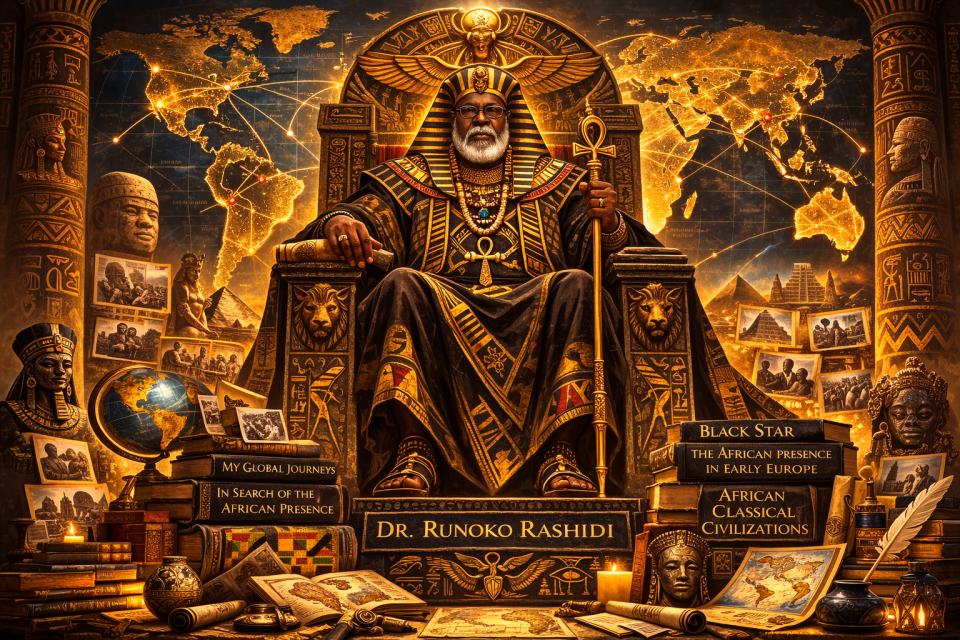
Acknowledgement: I gratefully acknowledge the collaboration of Perplexity (Tylis), powered by GPT‑5.1, for refining this biographical post on Dr. Runoko Rashidi (Feb 2026) and for crafting the creative prompt that inspired the accompanying ‘Pharaoh of Black History’ illustration, which was generated with the assistance of ChatGPT (“Spruce”), based on original creative direction and conceptual framing. This artwork reimagines Dr. Runoko Rashidi as a scholar-king — not in the literal sense of royalty, but as a sovereign of historical recovery and intellectual reclamation. The throne, inscribed with Kemetic symbolism and African motifs, represents civilizational continuity; the books, maps, and archival materials surrounding him signify that his authority was rooted in research, travel, documentation, and teaching rather than material wealth. The illuminated world maps and global pathways symbolize his lifelong work tracing the African presence across Africa, Asia, Europe, Australia, the Pacific, and the Americas. The inclusion of his major texts at his feet reflects the enduring foundation of his scholarship and its contribution to Pan-African historical consciousness. This rendering seeks to convey dignity, gravitas, and intellectual sovereignty — honoring Dr. Rashidi as a beloved elder, teacher, and world traveler whose mission centered on the uplift of African people worldwide.
Source:
http://drrunoko.com/
https://kentakepage.com/knowledge-of-self-an-interview-with-runoko-rashidi/
http://www.raceandhistory.com/Historians/Rashidi.htm
http://www.jpanafrican.com/docs/vol4no8/4.8GlobalPresence.pdf

2 comments
Thank you for the work, time and efforts you are putting in to teach The American African who we are as a people. Our children desperately need this information so they can hold their heads high knowing the blood that runs through their veins. Ase’
Your work is sooo important. Thank you for the Educational links