


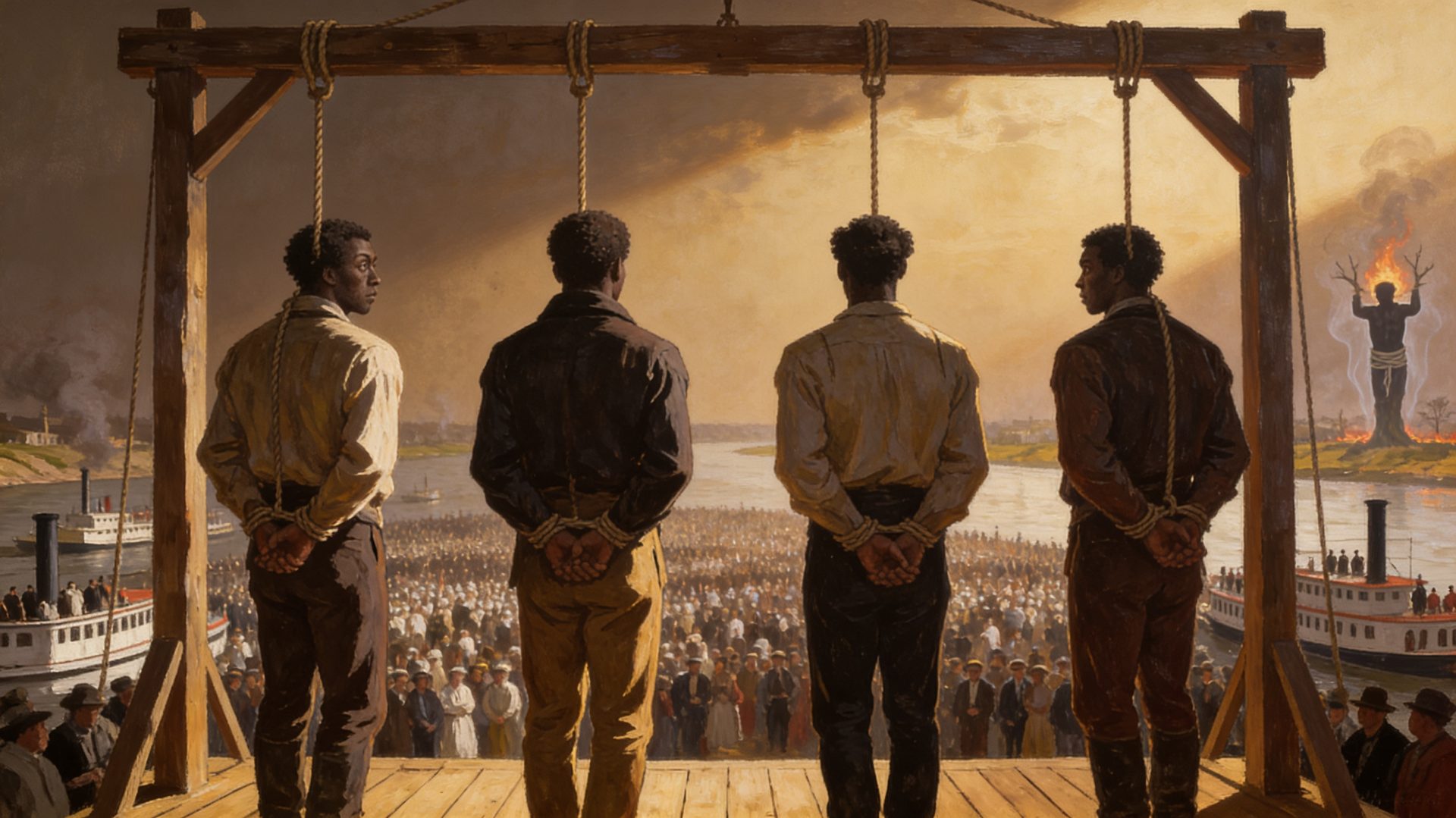
On July 9, 1841, four Black rivermen—Madison Henderson, Alfred Amos Warrick, James W. Seward, and Charles Brown—were executed on Duncan’s Island, just south of St. Louis, for the robbery of a countinghouse and the murders of two bank clerks, Jesse Baker and Jacob Weaver. With what one historian describes as a taste for blood and the destruction of Black bodies, the Euro‑American population turned the execution into a public spectacle: more than 20,000 people, around three‑quarters of the city’s inhabitants, travelled to the island to watch the hanging, and tickets for steamboat excursions to the scene sold for about $1.50.
Five years earlier, in April 1836, a St. Louis mob had lynched Francis McIntosh, a free, mixed‑race steamboat worker from Pittsburgh who allegedly stabbed one policeman to death and seriously wounded another. Dragged from the city jail, he was chained to a tree near the outskirts of town and burned alive while a crowd looked on; no one was punished, and the lynching helped fix St. Louis’s national reputation as a place of racial terror and lawlessness.
By 1841, city and state authorities were anxious to demonstrate a more orderly, “lawful” response to violent crime, even when Black men stood accused. Seeking to redeem the city’s notoriety after the McIntosh lynching, they insisted on a formal trial for the four rivermen—one enchained man, Madison Henderson, and three free Black men, Warrick, Seward, and Brown—and appointed three prominent Euro-American attorneys to defend them. None of the accused testified in their own defence, although at least one had given a written confession that was later printed and circulated, and despite their lawyers’ objections, all four were convicted of first‑degree murder and related charges stemming from the robbery and arson three months before.
At one o’clock in the afternoon on July 9, the four men mounted the scaffold on Duncan’s Island and, moments later, were “launched into eternity together” before the massive crowd. In later accounts, St. Louis residents recalled that, for several days after the hanging, the severed heads of the executed were displayed in the front window of a local drug store as a warning, a macabre exhibition meant to terrorise both enchained people and the free Black community of St. Louis—especially its Black river workers.
To read more about their case: https://docsouth.unc.edu/neh/henderson/henderson.html
Source:
A Firebell In the Night by Lee A Drake
African Americans in Downtown St. Louis by John A. Wright Sr.
https://www.jstor.org/stable/pdf/3789419.pdf
https://www.rjcstl.org/francis-mcintosh-remembrance
Acknowledgement: I gratefully acknowledge the support of Perplexity AI (Tylis) in refining and fact‑checking this post on the July 9, 1841 executions in St. Louis and the 1836 lynching of Francis McIntosh. Featured image created with AI assistance (Perplexity’s ‘Comet’ assistant), under the author’s direction, depicting the 1841 public execution of four Black rivermen—Madison Henderson, Alfred Amos Warrick, James W. Seward, and Charles Brown—on Duncan’s Island near St. Louis. The composition and visual interpretation were collaboratively shaped through descriptive prompting and AI‑generated imagery, with facial details inspired by a surviving 19th‑century lithograph of the four men, to honour their memory and critique the spectacle of racial violence.
