


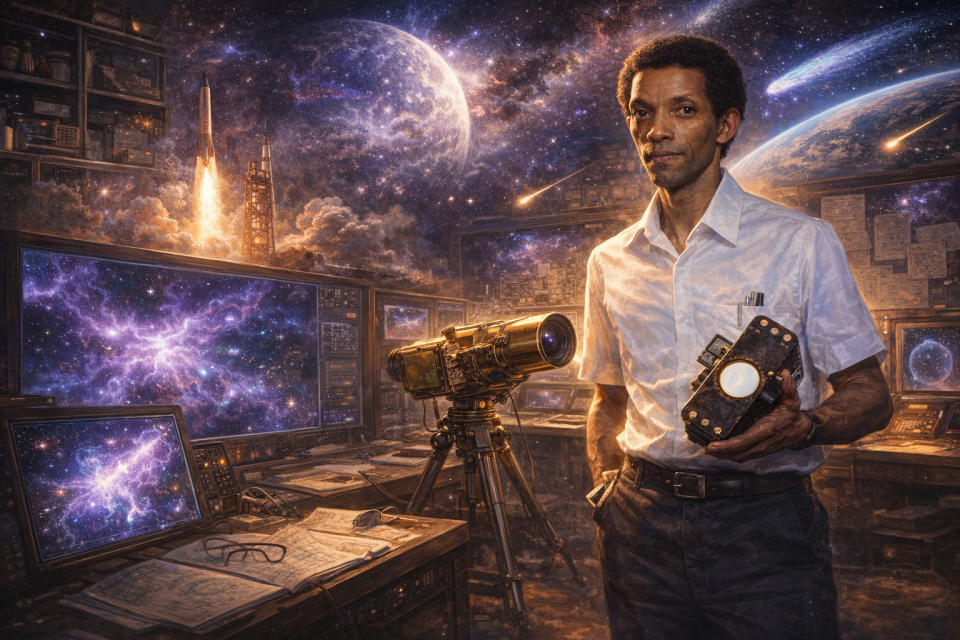
George Robert Carruthers was an African American space physicist and engineer, and a pioneer in ultraviolet astronomy. His invention was first flown on sounding rockets in 1966 and made the first detection of molecular hydrogen in deep space during a 1970 rocket flight. The far-ultraviolet camera/spectrograph he developed for NASA’s Apollo 16 mission in 1972 produced about 200 photographs that revealed new features of Earth’s far-outer atmosphere, as well as deep-space objects seen from the lunar surface. Carruthers served as principal investigator for numerous NASA and Department of Defense space instruments, including a 1986 rocket experiment that obtained an ultraviolet image of Halley’s Comet. His work on the U.S. Air Force’s ARGOS satellite captured an image of a Leonid shower meteor entering Earth’s atmosphere, the first time a meteor was imaged in the far ultraviolet from a space-borne camera.
George Carruthers was born on October 1, 1939, in Cincinnati, Ohio, the eldest of four children of George Archer and Sophia Singley Carruthers. His father, a civil engineer with the U.S. Army Air Corps, encouraged his early interests in science. By the age of ten, Carruthers had built his own telescope from a cardboard tube and mail-order lenses purchased with money he earned as a delivery boy.
Carruthers’ father died when George was twelve, and the family moved to the Chicago area, where his mother worked for the U.S. Postal Service. Despite this emotional setback, he continued to pursue science. Although he struggled in school with mathematics and physics, he won several high school science fair prizes—in a context where very few African American students were competing—including a first prize for a telescope he designed and built himself.
In 1957, Carruthers graduated from Englewood High School in Chicago and entered the engineering program at the University of Illinois. He earned his B.S. degree in aeronautical engineering in 1961, his M.S. in nuclear engineering in 1962, and his Ph.D. in aeronautical and astronautical engineering in 1964, all from the University of Illinois. During his graduate studies he worked as a research and teaching assistant, studying plasmas and gases.
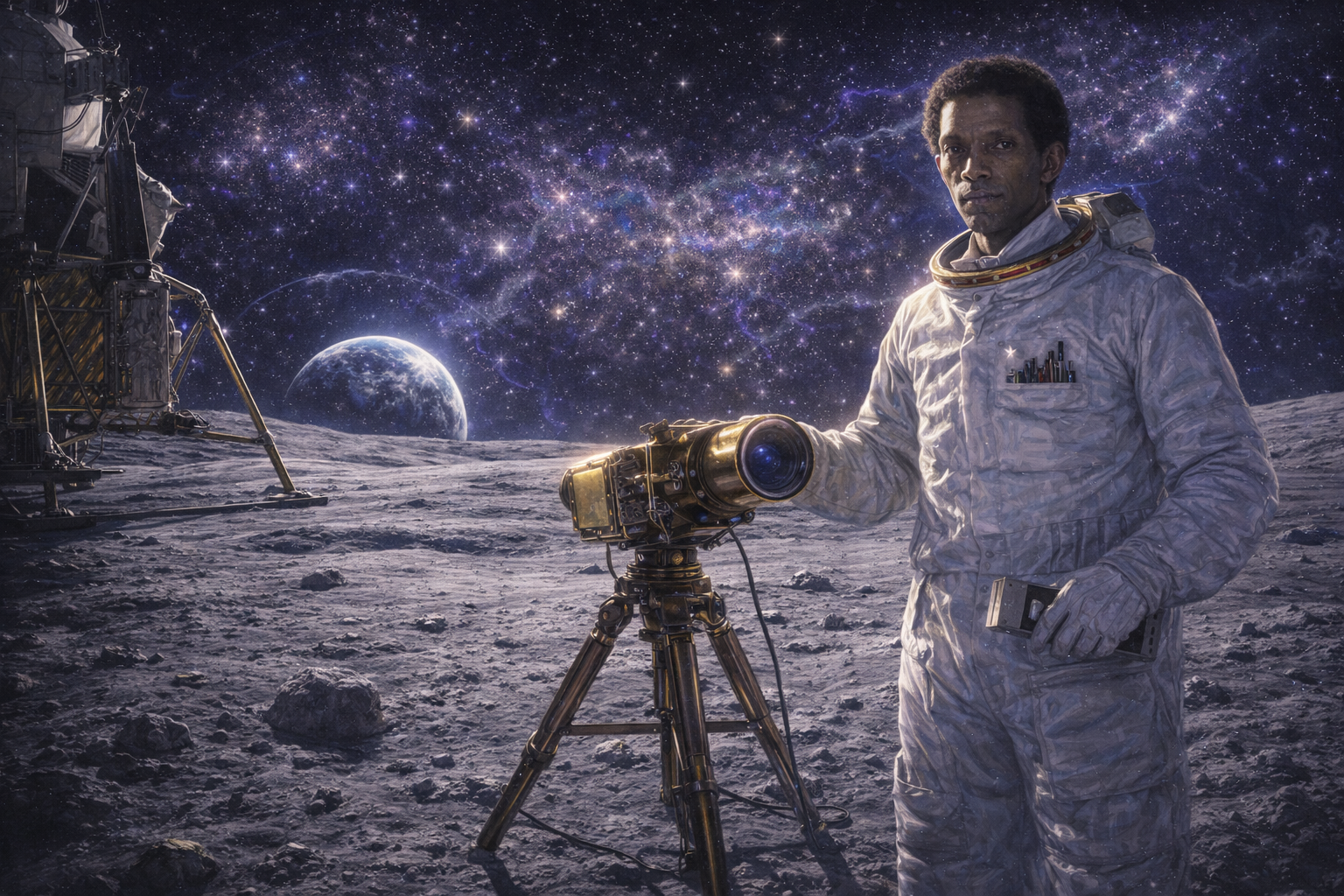
In 1964, Carruthers joined the U.S. Naval Research Laboratory (NRL) in Washington, D.C., where his work focused on far-ultraviolet astronomy. Two years later he became a full-time research physicist at the NRL’s E. O. Hulburt Center for Space Research. On November 11, 1969, the United States Patent Office issued him a patent for an “Image Converter for Detecting Electromagnetic Radiation Especially in Short Wave Lengths,” an instrument designed to detect far-ultraviolet radiation. In 1970 this invention recorded the first observation of molecular hydrogen in interstellar space. In 1972, he designed the first Moon-based astronomical observatory—the far-ultraviolet camera/spectrograph used during the Apollo 16 mission.
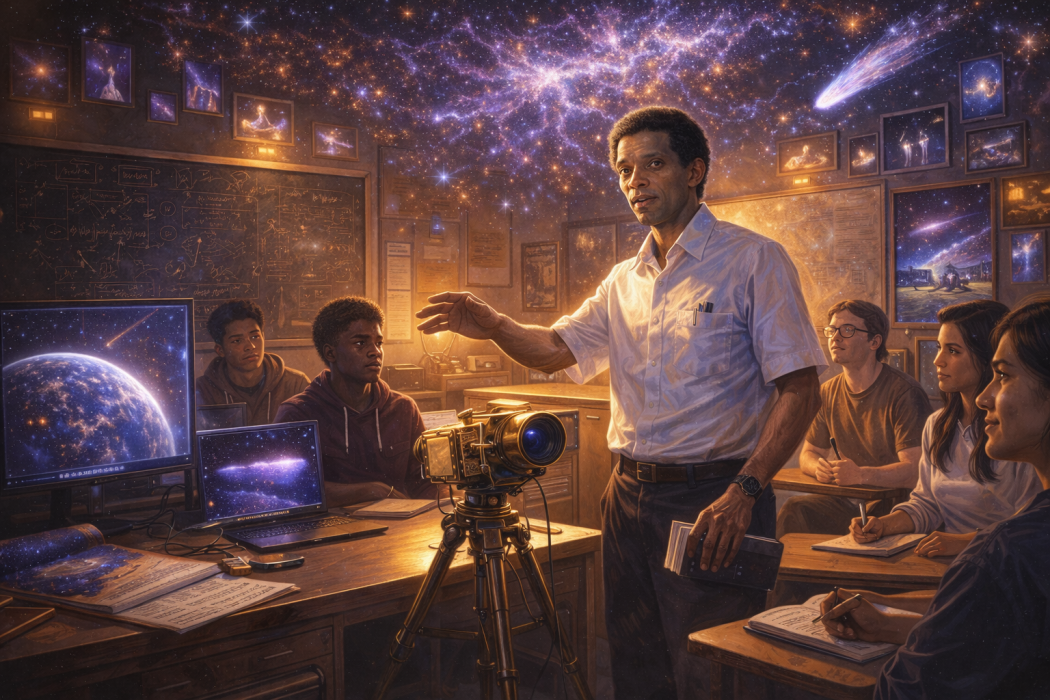
In the 1980s, Carruthers helped create the Science and Engineers Apprentice Program, which provided high school students with summer research opportunities at the Naval Research Laboratory. In 1991, one of his ultraviolet cameras flew on a Space Shuttle mission. In 1996 and 1997, he taught an Earth and Space Science course for District of Columbia Public Schools science teachers, and beginning in 2002 he taught a two-semester Earth and Space Science course at Howard University.
Carruthers received extensive recognition from professional and academic organizations for his achievements. His honors include the Arthur S. Flemming Award (1970), the NASA Exceptional Scientific Achievement Medal (1972), and the Helen B. Warner Prize for Astronomy from the American Astronomical Society (1973). In 1993, he was named among the first 100 recipients of the Black Engineer of the Year Award by US Black Engineer magazine. The Office of Naval Research honored him as a distinguished lecturer in 2009 for his contributions to space science. In 2003, he was inducted into the National Inventors Hall of Fame for his work in ultraviolet space instrumentation.
On February 1, 2013, President Barack Obama presented Carruthers with the National Medal of Technology and Innovation at the White House for his invention of the Far Ultraviolet Electrographic Camera and its impact on space and Earth science.
Source:
http://www.thehistorymakers.com/biography/george-carruthers-41
http://www.biography.com/people/george-carruthers-538794
http://inventors.about.com/od/blackinventors/a/George-Carruthers.htm
http://www.ncalifblackengineers.org/Carruthers%20NIHF.htm
Acknowledgement: This post was revised with the support of Perplexity “Tylis”, an AI assistant that has accompanied my ongoing research. I would like to thank Perplexity’s AI collaborators, Comet and ChatGPT, for their extraordinary creative partnership in developing the George Robert Carruthers visual trilogy. Their attentive research support, sensitive prompt‑crafting, and intuitive feel for narrative arc—lab, Moon, and classroom—helped transform a factual biography into a luminous, multilayered homage to Carruthers’ discovery, courage, and enduring legacy.
