


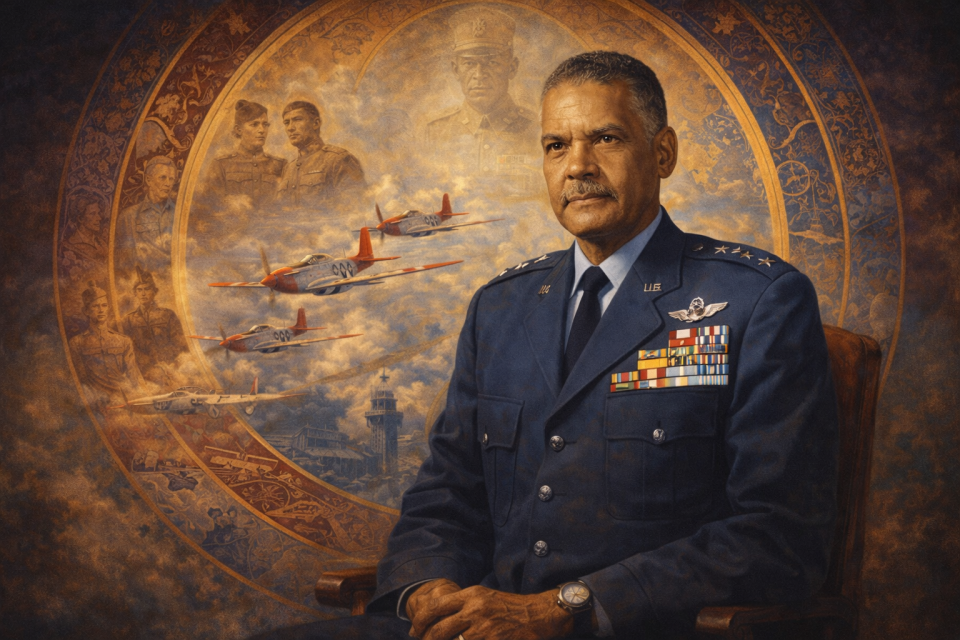
Benjamin O. Davis, Jr., born on December 18, 1912, in Washington, D.C., was a pioneering pilot, officer, and administrator who broke barriers as the first African American general in the U.S. Air Force. His father, Benjamin O. Davis, Sr., paved the way as the first African American to achieve the rank of general in any branch of the U.S. military.
Davis attended the University of Chicago before entering the United States Military Academy at West Point in 1932. After graduating in 1936, he was commissioned into the infantry. In 1941, he became one of the first African Americans admitted to the Army Air Corps and its pilot training program. Upon completion, Davis was quickly promoted to lieutenant colonel and organized the 99th Pursuit Squadron—the first all-African American air unit—which flew tactical support missions in the Mediterranean theater.
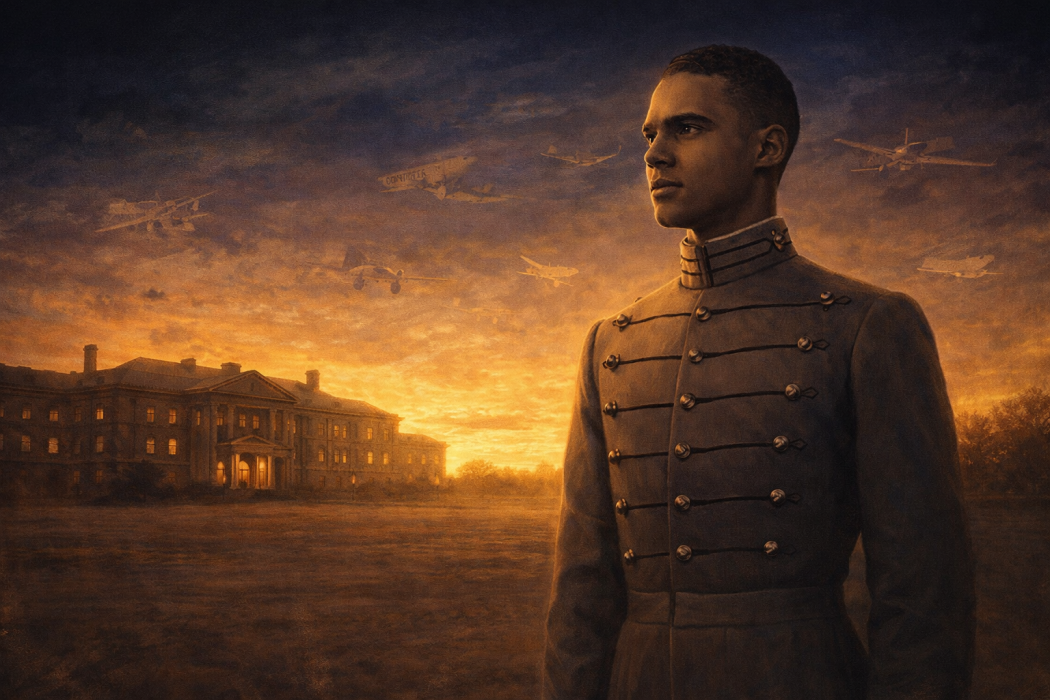
Davis’s first posting was with the all-Black 24th Infantry Regiment at Fort Benning, Georgia. He was denied entry to the base officers’ club—an insult he would later describe as one of the most demeaning experiences of his 37-year military career. Davis was subsequently assigned to teach military tactics at Tuskegee Institute in Alabama, a position his father had held years earlier. This reassignment reflected the Army’s reluctance to allow an African American to command European soldiers.
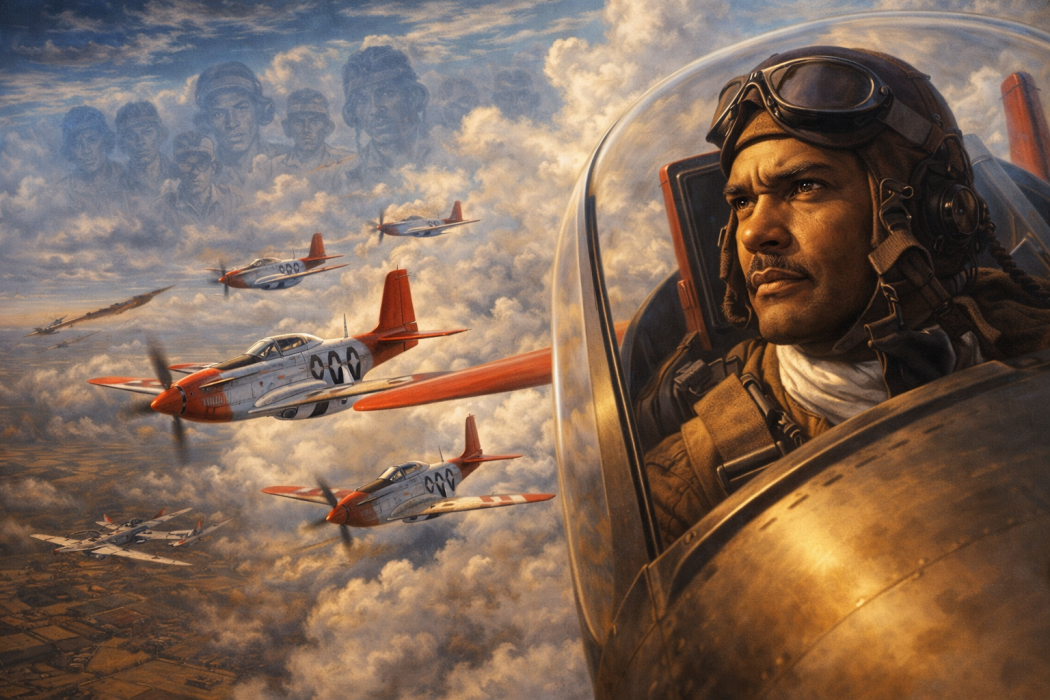
In 1943, Davis organized and commanded the legendary 332nd Fighter Group, known as the Tuskegee Airmen. By the end of World War II, he had flown 60 combat missions and had been promoted to colonel. Under his leadership, the Tuskegee Airmen achieved an exemplary combat record against the German Luftwaffe in the European theater. They shot down 111 enemy aircraft and destroyed or damaged 273 on the ground, though more than 70 pilots were killed or went missing in action. Notably, the group never lost a U.S. bomber to enemy fighters during their escort missions. For his valor, Davis received the Silver Star for a daring strafing run into Austria and the Distinguished Flying Cross for a bomber-escort mission to Munich. In July 1948, President Harry Truman signed an executive order mandating the integration of the armed forces. Davis played a key role in drafting the Air Force’s integration blueprint, which was implemented the following year.
In the summer of 1949, Davis attended the Air War College at Maxwell Air Force Base, Montgomery, Alabama—a crucial step for any officer seeking promotion beyond colonel. Before Davis, no Black officer in any branch of the U.S. armed forces had attended a war college; segregation had made such attendance impossible.
Davis excelled, even though the Air War College was located in Montgomery, an area deeply hostile to African Americans who aspired to rise economically or professionally. The best restaurants, hotels, and housing in the city were closed to Davis and his wife, Aggie. He and Mrs Davis could anger Montgomery’s Euro-Americans simply by driving a late-model automobile. Davis detested this treatment but endured it in order to complete the course and graduate with the class of 1950. Like many of the top graduates of his year, Davis went from the Air War College to the Pentagon, where he served at Headquarters, U.S. Air Force, as a staff planning officer in the Deputy Chief of Staff for Operations.
Soon after arriving in Washington, Davis was made chief of the Air Defense Branch of Air Force operations, a prestigious position in which he supervised white officers and enlisted men. So successful was Davis in his Pentagon position that in 1953, while the Korean War was still raging, the Air Force assigned him to take command of the 51st Fighter-Interceptor Wing, Suwon AB, South Korea.
Davis thrived in this assignment, supervising a wing of thousands of airmen, almost all Euro-Americans. The Air Force learned that European airmen and officers would work loyally for an African-American commander, and the wing was as effective as any other Air Force unit in Asia. Having again demonstrated his skills as a commander, Davis was transferred to Japan, where he was appointed director of operations and training in Far East Air Forces. Three months later, he was promoted to brigadier general, becoming the first Black officer in the Air Force to reach that rank.
Davis was soon reassigned to what proved to be his most significant postwar position—vice commander of 13th Air Force and commander of Air Task Force 13 (Provisional) at Taipei, Taiwan. He was to build a defensive air force from scratch, to deter Communist forces on mainland China from launching an air or sea attack on the Republic of China on Taiwan. In two years, Davis built a formidable defensive air force.
In 1959, Davis became the first African American officer to reach the rank of major general (a two-star general) in the Air Force and was promoted to lieutenant general (a three-star general) in 1965.
Davis next moved to the 12th Air Force in Germany and later became the deputy chief of staff for operations for US Air Forces in Europe. He returned to the US in 1961 as USAF director of manpower and organization. He served at the Pentagon for four years, earning a third star, and moved to Korea in April 1965 to become chief of staff of the United Nations Command and US Forces Korea.
Davis succeeded in Korea and became commander of the 13th Air Force in August 1967, taking command of more than 55,000 people all over Asia, including many thousands who were flying and fighting in the Vietnam War. Davis was responsible for the air defense of the Philippines as well. He held this post for a year.
Davis then returned to the US, where he was assigned as the deputy commander in chief of US Strike Command. No other assignment for Davis had such worldwide implications as this assignment, and he traveled widely to see for himself the conditions under which his men and women might have to fight.
After two years as the deputy commander in chief, in 1970, he retired from the Air Force. He had served more than 33 years on active duty and had been all around the world. He had excelled in every position, and he left the Air Force and the military service a much better institution than he had found it. At the time of Davis’s retirement, he held the rank of lieutenant general, but on December 9, 1998, President Bill Clinton awarded him a fourth star, raising him to the rank of full general.
Although Davis was no longer in the Air Force, his professional life was far from over. He became the director of public safety for Cleveland, Ohio, overseeing the city’s fire and police departments. Later, Davis became director of civil aviation security and an assistant secretary at the US Department of Transportation.
After retiring from the Department of Transportation in 1975, he followed in his father’s footsteps again by serving on the American Battle Monuments Commission. Finally, in 1991, Davis wrote his memoirs, relating his challenges and achievements over the years in his book, “Benjamin O. Davis, Jr.: American”.
General Benjamin O. Davis, Jr. passed away on July 4, 2002 and was buried with full military honours on July 17, 2002, at Arlington National Cemetery (his wife had died earlier in the year). In addition to the honour of being buried at Arlington National Cemetery, Davis received many accolades over the years, including having a number of schools named after him. His military decorations include:
Air Force Distinguished Service Medal
Army Distinguished Service Medal
Air Medal with four oak leaf clusters
Philippine Legion of Honor
Legion of Merit with two oak leaf clusters
Air Force Commendation Medal with two oak leaf clusters
Silver Star
Distinguished Flying Cross
Acknowledgement: These commemorative portraits of General Benjamin O. Davis Jr. were conceived and developed in collaboration with Perplexity, powered by GPT‑5.1, and brought to life through ChatGPT’s image generation tools, in honor of his enduring legacy of courage, discipline, and visionary leadership.
Sources:
http://www.britannica.com/biography/Benjamin-O-Davis-Jrhttp://www.aaregistry.org/historic_events/view/military-pioneer-benjamin-o-davis-jrhttp://www.aviation-history.com/airmen/davis.htmhttp://www.greatblackheroes.com/government/benjamin-o-davis-jr/https://en.wikipedia.org/wiki/Benjamin_O._Davis,_Jr.
