

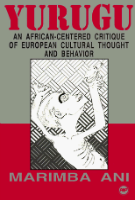
Marimba Ani’s book, “Yurugu: An African-Centered Critique of European Cultural Thought and Behavior,” published in 1994, is widely regarded as her magnum opus. The book is a comprehensive “cultural science” project that unmasks the nature of European culture and the mentality that made the Maafa possible and continues to structure global European oppression. The title is derived from Dogon mythology, in which Yurugu is a being who tore himself away from the process of creation prematurely because he wanted to compete with the creator, Amma; as an incomplete being, forever searching for the twin soul he can never find, Yurugu can only create destruction and disorder—Ani uses this as a metaphor for European intellectualism and its foundational harm.
In Yurugu, Ani develops a unique vocabulary to analyse culture from an African‑centred perspective:
- Asili: From Kiswahili for “seed” or “origin,” the asili is the ideological core or matrix of a culture—the basic pattern that gives rise to all its institutions, values, and behaviours. Ani argues that the European asili is fundamentally defined by a need for power through racial and cultural domination and total control over the universe, whereas an African asili is oriented toward balance, complementarity, and the maintenance of life.
- Utamaroho: This is the “energy source” or “spirit‑life” of a culture—the emotional tone, drive, and collective personality that the asili sets in motion. In European culture, Ani identifies this energy as domination: a deep thrust to control people, land, and meaning through imperialism, missionary work, and the imposition of “civilisation” worldwide; by contrast, African utamaroho is expressed as life‑giving energy, oriented to nurturing community and reciprocity.
- Utamawazo : This means culturally structured thought and is close to what is meant by “worldview”: the patterned way members of a culture must think if the asili is to be fulfilled. Ani argues that the European utamawazo is “structured by ideology and bio‑cultural experience,” producing a dichotomised cognitive style that splits reality into opposites (mind/body, man/nature, European/“other”) and uses abstract “universal” concepts to control, impress, and intimidate, while African utamawazo tends toward relational thinking that holds spirit, matter, and community together.
Ani undertook this study to “turn the microscope” on Europeans, rather than allowing African communities to be the objects of European study. A crucial thesis is that European oppression survives because we accept its definition of reality and of ourselves; once we withdraw that agreement, the system’s psychological grip begins to break. The book is intended to provide African people with tools of analysis to see through political rhetoric (such as the “New World Order”) and to recognise that European definitions of reality are often inconsistent with the African worldview.
Ten key points of “Yurugu” are:
- The Yurugu myth and European incompleteness
In Dogon cosmology, Yurugu is the being who tears himself from his twin and creates a world from an incomplete placenta; Ani uses this as a metaphor for the European cultural seed (asili), permanently restless and unable to achieve wholeness. - Power as compensation for spiritual lack
She argues that because this incomplete asili cannot find fulfillment through spirit, it seeks it through control—power over other peoples and over nature becomes the way Europe tries to fill its inner void. - Turning the world into an object
European thought, in her reading, trains people to treat the universe as an object “out there” to analyze and manipulate, making it easier to dominate land, bodies, and cultures without ethical restraint. - Religion and ideology as formalized control
Ani distinguishes religion (formalized ritual) from ideology (formalized myth), and shows how European Christianity fuses the two into a sacred political system that justifies conquest and genocide. - The Maafa as cultural and psychic assault
Captivity is not just forced labor but sustained cultural violence: the deliberate destruction of African languages, memory, ritual, and self‑definition in order to produce people who consent to their own domination. - Dominance depends on our agreement
A crucial thesis is that European oppression survives because we accept its definition of reality and of ourselves; once we withdraw that agreement, the system’s psychological grip begins to break. - Spiritless matter vs. spirit‑matter unity
She contrasts a European worldview that treats matter as essentially dead with African cosmologies where matter is a living expression of spirit, and where knowledge must honor that unity. - The split self and the whole person
European culture splits mind from body, thought from feeling, producing dismembered selves; African conceptions insist on the human being as an integrated whole in which thinking, emotion, body, and spirit are inseparable. - African power as life‑energy, not domination
Against Yurugu’s drive to control, Ani defines African power as energy: the capacity to create, nurture, and sustain life in community through reciprocity, complementarity, and mutual care. - Ritual as technology of wholeness
For Ani, African ritual is not decorative; it is a practical technology for realigning people with their asili, healing the psychic fragmentation produced by Maafa, and restoring balance between spirit and matter.
Praise for Yurugu
“In this book, [Marimba Ani] has opened up a Pandora’s box called racism that will not be easily closed by the creators of racism or its victims. What she is saying will have to be seriously considered if the reader of her words is ever to know peace. This is a pioneering and ground breaking work dealing with a neglected aspect of European culture. Most books about Europeans deal mainly with what Europeans think of other people. In this book [Marimba Ani] has analyzed the European influence on the world based on what they think of themselves and how this thought affects most of the world. Without saying it, she has emphasized that for the last 500 years the world has been controlled by a form of European nationalism. They have created a concept called the “cultural other” that has influenced their vision of themselves and other people in their contact with Africans, Asians and people of the Pacific Islands… Europeans destroyed more cultures and civilizations than they built. They have studied people without understanding them and interpreted them without knowing them. [Marimba Ani] in Yurugu asks this revealing question:
What is the relationship between the way in which Europeans conceive of the world and the way in which they relate to majority peoples? Put another way: What is the relationship between the dominant modes of European thought and the dominant modes of their behavior towards others?
In order to understand the new information and revelations in this book, the reader might have to approach it as carefully as the Marimba Ani has. This will be an intellectual experience that has its own reward.” –Dr. John Henrik Clarke
Dr. Marimba Ani has written the first bonified text book from an Afrikan-centered framework which focuses on European consciousness, the European worldview, and its global system of race domination. This book is an original, scholarly comprehensive and thorough analysis which lays out, in systematic detail, the historical development and pattern of European world domination, its core structures and key expressive components. She particularly articulates very clearly the nature of the “European Survival Thrust” in terms of its philosophical core, methodology, basic tactics, expression and consequences. Her book represents the final key to the Afrikan world breaking the death grip of European world domination over Afrikans.
This brilliant and courageous effort on the part of our distinguished Sister Warrior is MUST READING for all Afrikan/Black Studies student and faculty, and all serious minded Afrikans everywhere who are dedicated and committed to rebuilding Afrikan World Order. It will definitely become an essential part of the handbook for Afrikan’s surviving the 21st Century.” –Kobi K. K. Kambon, author of The African Personality in America
“Yurugu, Dr. Marimba Ani’s long awaited book, is a defining classic in African-Centered theory. She gives a splendid coverage of indispensable source material in European and African intellectual thought. Marimba Ani is uniquely qualified to explore the nature of the European thought and behavior process from the earliest of European philosophers to the present in an innovative, Afrocentric manner. Definitions, theories, and concept are all reordered under Ani’s thorough eyes. Her juxtaposition of African terms with new insights is clear in discussing African philosophy in an informed manner.” –Dr, Kariamu Welsh Asante, Editor of the Journal of African Dance
Acknowledgement:
This post was updated in February 2026. I would like to acknowledge the collaborative support of Perplexity (Tylis), an AI research and writing partner, for helping to refine this overview of Yurugu and to shape the ten key points presented here as a reader’s guide to Marimba Ani’s work.
Acknowledgement of Artwork
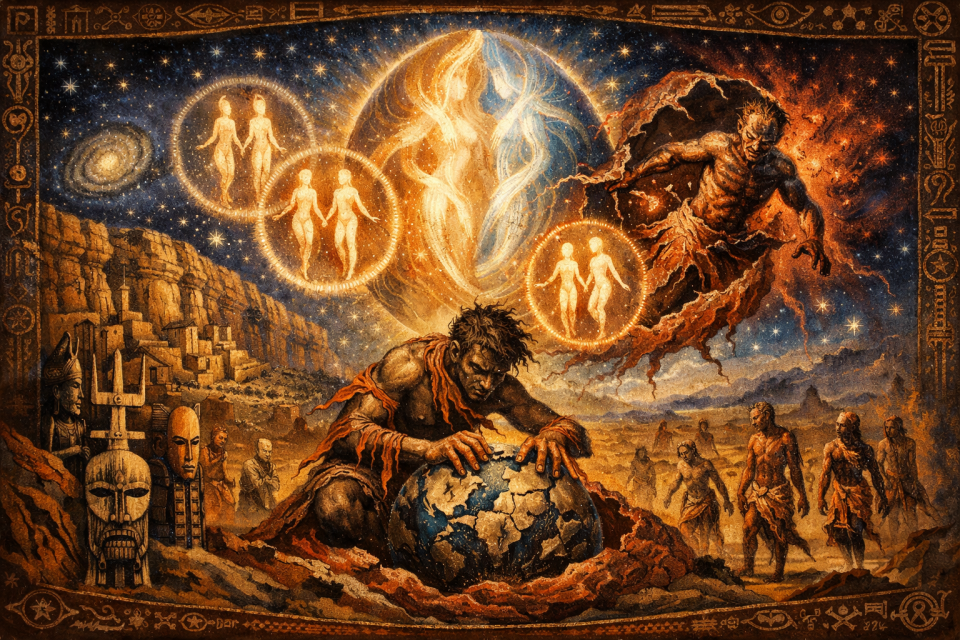
The featured image draws upon the cosmology of the Dogon people of Mali, honoring the profound philosophical depth of their creation narrative concerning Amma and Yurugu. The composition was conceived as a contemplative meditation on twinness, balance, and the consequences of rupture. The radiant, gender-complementary presence of Amma is rendered as abstract, interwoven energies, emanating harmonious twin pairs in luminous equilibrium. In contrast, Yurugu’s premature separation is depicted through distortion, fragmentation, and an altered light, symbolizing tragic incompleteness and spiritual imbalance. Dogon visual traditions—masks, cliff dwellings, cosmological motifs, and Sahelian earth tones—are respectfully integrated to situate the myth within its cultural landscape while maintaining a mythic, universal scale. This work is offered as a visual reflection on complementarity, order, and the enduring tension between harmony and self-willed separation.
