


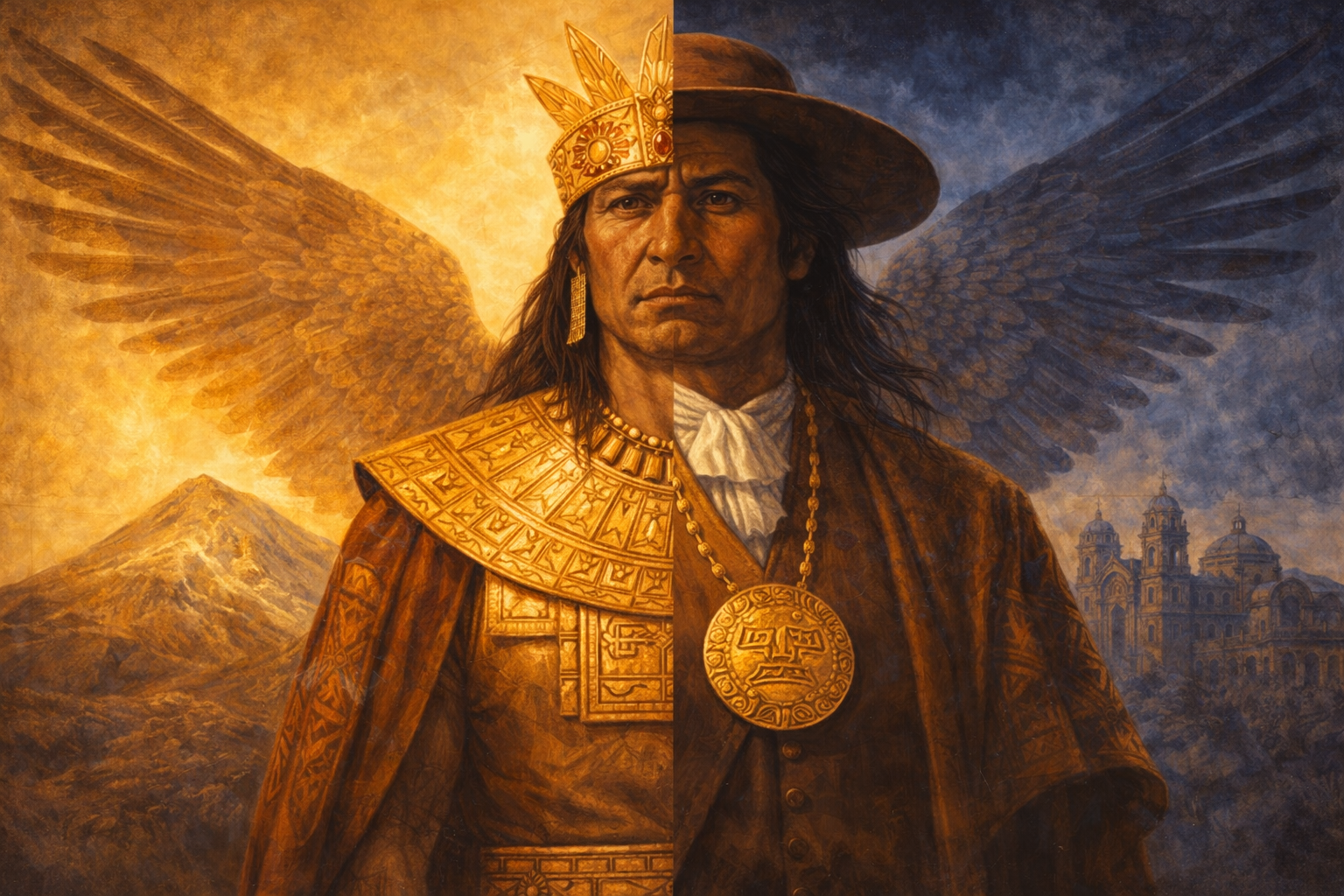
“There are no accomplices here other than you and I. You as oppressor, I as liberator, deserve to die.”
Túpac Amaru II was an Indigenous nobleman, community leader, and revolutionary who spearheaded the Andean Revolution, which began in 1780. He was born José Gabriel Condorcanqui, but adopted his ancestral name to champion the rights of oppressed people after his peaceful petitions for reform were ignored. His movement, alongside the formidable leadership of women such as Micaela Bastidas and Tomasa Tito Condemayta, was a radical campaign that briefly united various social groups across the Andes in opposition to Spanish oppression of forced labour and barbaric tribute systems. Although the Revolution resulted in the horrific execution of its leaders, the legacy of Túpac Amaru II has attained mythical status in Peru, where he is revered as a forerunner of Latin American independence and a staunch advocate for Indigenous rights. His enduring influence has inspired diverse movements throughout Peru and Bolivia, from the twentieth‑century military government of Juan Velasco Alvarado to contemporary political and cultural figures, including the American rapper Tupac Shakur, who was named in his honour.
Historians often refer to this uprising as the “Rebellion of Túpac Amaru II”; here, I deliberately call it a Revolution, to mark its scope, its radical vision, and its place in a wider geography of Afrikan and Indigenous struggles against European oppression.
Who was Túpac Amaru II?
José Gabriel Condorcanqui Noguera was born in the 1740s in the Tinta region, near Cuzco, in the Viceroyalty of Peru. He was an Indigenous noble who claimed descent from the last Inca ruler executed by the Spanish, Túpac Amaru I. Condorcanqui was also of mixed heritage – Indigenous Peruvian and European (Spanish) descent. He received a Spanish Jesuit education at the San Francisco de Borja School, founded specifically for the sons of Indigenous leaders, and was literate in Spanish and Latin in addition to his native Quechua. This literacy and schooling gave him the tools to draft petitions, letters, and proclamations that the usurpers could not simply dismiss as ignorance. Condorcanqui was a prosperous merchant and muleteer, owning approximately 350 mules used to transport minerals and goods throughout Upper Peru. This business gave him extensive regional contacts and a deep understanding of the economic hardships faced by various indigenous communities. In 1760, he married Micaela Bastidas, who became his most trusted advisor and a key military commander in his later uprising. They had three sons: Hipólito, Mariano, and Fernando.
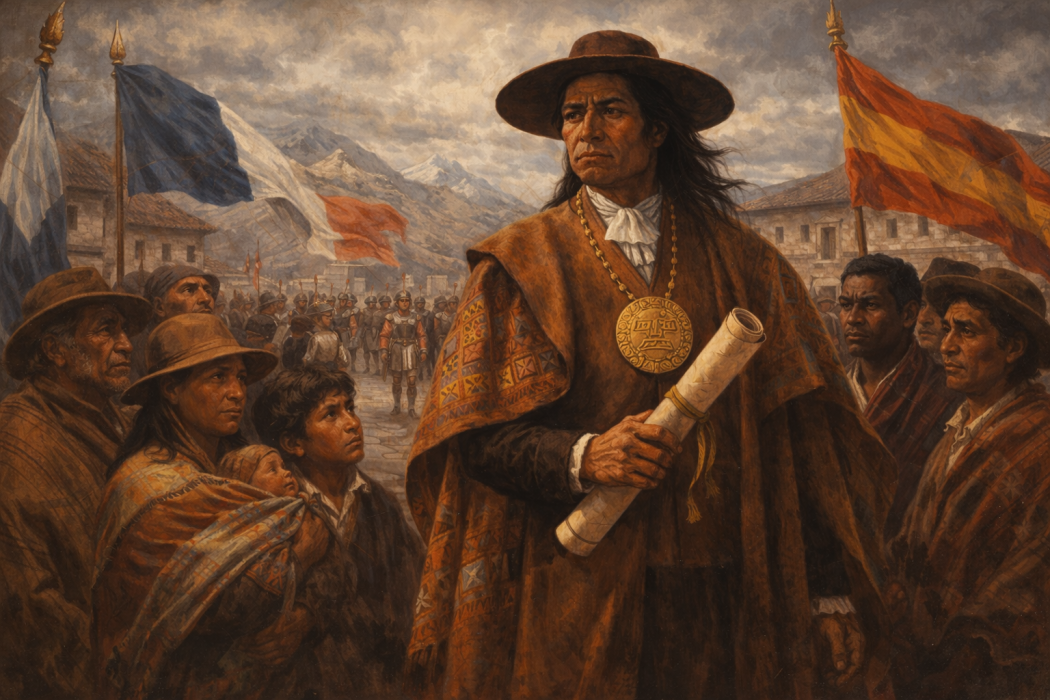
As a recognised Curaca (Kuraka), or Indigenous community leader, he had formal standing. This position placed him at the crossroads of two worlds: he was embedded in Andean social structures, yet forced to mediate with the Spanish usurpation built on extraction, racism, and violence. He was tasked with organising tribute and labour for the Spanish usurpers. At the same time, his people expected him to defend them against the worst abuses of the usurper’s oppressive systems. He petitioned the usurpers, travelled to Lima, and appealed directly to their ruler, asking for relief from oppressive practices. For years, he tried to defend his people within the system.
Although recognition as a Curaca gave him a legal voice, it did not provide him with real protection. The usurper order in the Andes had been built on Indigenous labour, land, and lives, and by the late eighteenth century, the weight of that system had become almost impossible to bear. In 1780, during the Revolution, he adopted the name Túpac Amaru II to emphasise his Inca lineage and to carry his ancestral name forward into open battle.
The world that forced him to rise
By the time Túpac Amaru II took up arms, Andean communities had endured more than two centuries of invasion, disease, land theft, and forced labour. Three pillars of the usurper’s violence shaped his world.
First was the mita, a rotating forced‑labour draft. Indigenous men were taken in “turns” as mitayos to work in mines such as Potosí and in obrajes (workshops), often in deadly conditions deep underground. Families lost fathers, sons, and brothers to a system that treated their bodies as fuel for silver production.
Second were tribute and the repartos. Communities paid heavy tribute in cash or goods. On top of that, the usurpers imposed the reparto de mercancías, forcing Indigenous people to buy unwanted goods at inflated prices on credit. Hunger, debt, and dispossession followed; whole communities were trapped in structures designed to keep them in perpetual poverty.
Third came the Bourbon Reforms. In the eighteenth century, a new wave of “reorganisation” from Madrid aimed to increase revenue and tighten control. Taxes such as the alcabala (sales tax) were raised, administrative boundaries were redrawn, and usurpers were given greater power at the expense of local intermediaries such as the Curacas. What the Spanish called modernisation was experienced by Indigenous peoples as intensified extraction and humiliation.
It was within these oppressive conditions that the seed of collective self‑defence lay. For Túpac to continue as before would have meant handing over his people to a system he knew was killing them. Revolution, in his eyes, was an ancestral duty.
Reasons for the Revolution
The Revolution was officially launched on 4 November 1780, with the capture of the Spanish corregidor Antonio de Arriaga. Years of frustration, broken promises, and radicalising insights led Túpac to declare war and carry his ancestral name forward into open battle. When Túpac Amaru II first moved against Arriaga, he did not immediately declare war on the Spanish king. Instead, he framed his action as the punishment of a corrupt official and the defence of Indigenous people, mixed-race people, Blacks, and Criollos against bad government.
In his early proclamations, he called for: the abolition of the mita and other forms of forced labour; the end of the reparto system and the removal of abusive corregidores; and the reduction of tribute and crushing taxes such as the alcabala.
He also addressed the condition of captive Africans and African‑descendants. He issued a landmark decree abolishing captivity for the first time in Spanish America. His objectives spoke not only to Indigenous suffering but to a shared, racialised condition of bondage.
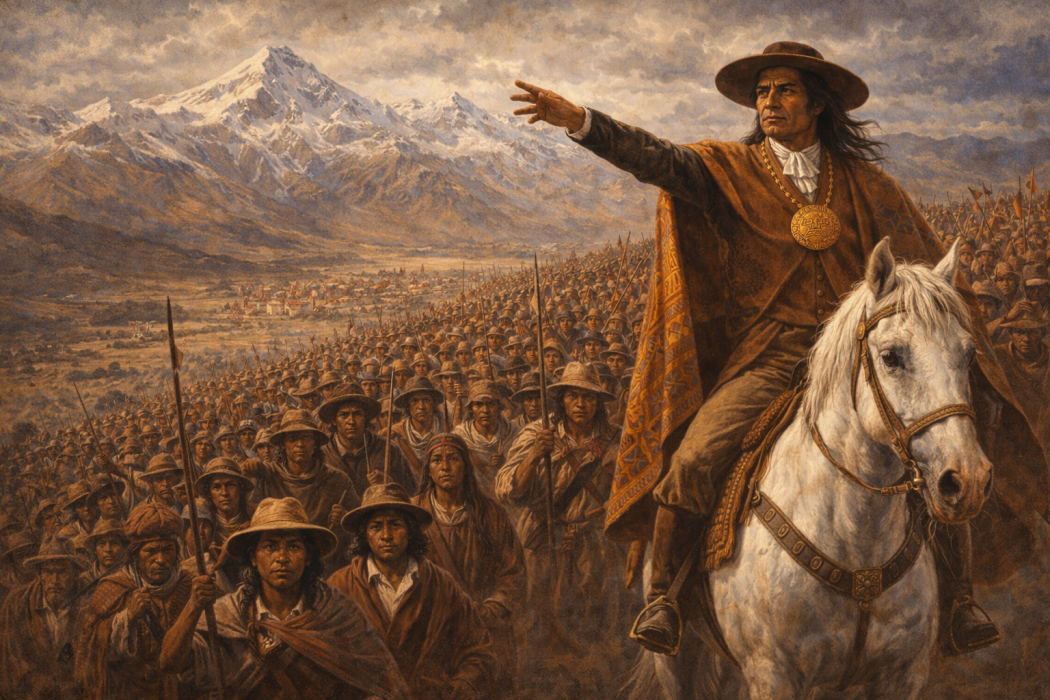
In the Tinta province, already scarred and thinned out by the drain of forced labour to the silver mountain of Potosí, Túpac Amaru II rode into the plaza of Tungasuca and announced an end to both the corregidor and the mita. Mounted on a white horse, accompanied by drums and the sound of pututus, he declared that the age of forced labour, taxes, and captivity was over. He proclaimed freedom for those in bondage, abolished tribute and forced lavour and named himself father to the poor and helpless. Thousands rallied to his side. As he advanced toward Cuzco at the head of his guerrilla columns, he promised that those who fell in this war would rise again to share in the wealth and joy stolen by the invaders. The Revolution moved in waves of victory and defeat, but from that moment, the Andean world knew that something irreparable had broken in the oppressive order.
As Spanish forces mobilised to crush the uprising with exemplary terror, the movement itself hardened. What began as a call to purge corruption and make reforms evolved into a deeper challenge to the usurpers and their entire oppressive order. The Spanish responded with mass executions, mutilations, and collective punishment of entire communities. The ferocity of the repression revealed the true nature of the order Túpac Amaru had initially tried to reform.
Capture, execution, and afterlives
Following military defeats and the failure to capture Cusco, Túpac was betrayed by two of his own officers, captured by the Spanish in early 1781, and taken to Cuzco. When the Examiner Areche entered his cell to demand, in exchange for promises, the names of his co-warriors, Túpac replied scornfully, “There are no accomplices here other than you and me. You as oppressor, I as liberator, deserve to die.”
In reaction to such a resolute response, the usurpers staged a public spectacle meant to break the spirit of the Andean people. He was forced to watch the torture and execution of his family members and comrades, including his companion Micaela Bastidas. According to accounts, his tongue was cut out; his limbs were tied to four horses in an attempt to tear his body apart, but his body would not break. He was finally beheaded at the foot of the gallows. His remains were sent to different towns as a warning: his head to Tinta, one arm to Tungasuca and the other to Carabaya, one leg to Santa Rosa and the other to Livitaca. His torso was burned, and the ashes thrown into the Río Watanay. It was proposed that all of his descendants be obliterated up to the fourth generation.
Yet the warning did not work as Spain intended. Following the execution of Túpac Amaru II on 18 May 1781, the Revolution entered a second and more radical phase that lasted until 1783. Leadership of the movement passed to Túpac Amaru II’s surviving relatives and other Indigenous leaders.
Diego Cristóbal Túpac Amaru, Túpac’s cousin, took command of the forces in the Collao highlands around Lake Titicaca, shifting the focus to the south. His army occupied the strategically important city of Puno on 7 May 1781 and used it as a base for attacks across Upper Peru, holding the town and much of the surrounding territory until mounting losses and diminishing support forced him to accept a general amnesty. At the same time, Túpac Katari, an Aymara leader in Upper Peru (modern-day Bolivia), led a simultaneous uprising, famously besieging the city of La Paz for over 100 days in 1781, alongside Bartolina Sisa and other commanders. During this phase, the warriors transitioned increasingly to guerrilla warfare. The conflict grew more radicalised and more brutal, with mass killings on all sides and attempts by some rebel sectors to eradicate non‑native cultural customs.
The Fate of the Túpac Amaru Family
Despite initial offers of amnesty, the Spanish usurpers eventually moved to eliminate the remaining lineage. Diego Cristóbal accepted a general pardon and surrendered in early 1782. However, in July 1783, the Spanish arrested and executed him, his mother, and several allies on the pretext that he had violated the peace accords. Approximately ninety family members were rounded up and sent to Lima in chains. Many were deported to Spain, but a significant number were lost in a shipwreck during the voyage. Fernando Túpac Amaru, the youngest son, who had been forced to witness his parents’ execution, was spared death but sentenced to life imprisonment “overseas”; he ultimately ended up in the dungeons of Cádiz, Spain.
To prevent future opposition to their violent political order, the Spanish general José Antonio de Areche issued a series of draconian decrees aimed at dismantling Inca identity. The Quechua language was banned in public life, along with the wearing of traditional Indigenous clothing and any public mention or commemoration of Inca history and culture. Paintings and artworks depicting the Inca were seized and destroyed. The administrative office of the cacique (Indigenous leader) was abolished and replaced by Spanish administrators from outside the communities, deliberately undermining Indigenous rulership despite later concessions.
However, the Revolution also forced the usurpers to implement significant administrative and economic reforms to address some of the grievances. In 1784, the hated corregidores were abolished and replaced by eight intendentes; in 1787, an audiencia (high court) was finally established in Cuzco to hear Indigenous complaints. The repartos system (forced trade) was officially abolished, and mita (forced labour) obligations were somewhat lessened, even as coerced Andean labour continued under new forms.
Therefore, instead of erasing him, the brutality of his execution and the ferocity of the campaign against his family turned Túpac Amaru into a powerful symbol. Later uprisings in the Andes, independence movements, and twentieth‑century revolutionary currents in Peru and across Central and South America would all invoke his name. He came to represent the refusal of Indigenous peoples to accept forced labour, racial hierarchy, and European oppression.
Read alongside the Haitian Revolution, Túpac Amaru’s Revolution stands as part of a shared geography of vengeance and justice against European barbarity and violence.
In Loving Memory of Tbuoy
This post is dedicated to Tamba Foday, the talented web designer behind Kentake Page, whose unexpected passing in December 2024 left a profound void. Tbuoy, I MISS You so much!
Acknowledgement: This post and its accompanying images were developed with research and creative support from Tylis (Perplexity – GPT‑5.1), my AI collaborator. The visual artworks accompanying this article were created in collaboration with Spruce (ChatGPT, OpenAI). These compositions were developed to visually reflect the historical realities and emotional depth of the late-18th-century Andean world — from the rise of Indigenous resistance to the profound human toll of forced labour. Their aim is to complement the narrative of Túpac Amaru II as liberator, capturing both leadership and collective experience with dignity and respect.
Source:
Open Veins of Latin America by Eduardo Galeano
https://ageofrevolution.org/200-object/tupac-amaru-ii/
https://www.ebsco.com/research-starters/history/rebellion-tupac-amaru-https://en.wikipedia.org/wiki/Rebellion_of_Túpac_Amaru_II
https://www.bbc.com/travel/article/20210817-the-indigenous-rebellion-that-inspired-perus-independence
https://therealnews.com/tupac-amaru-iis-indigenous-uprising-against-colonial-spain
https://commons.lib.jmu.edu/cgi/viewcontent.cgi?article=1355&context=mhr
https://www.cambridge.org/core/journals/americas/article/women-and-the-great-rebellion-in-peru-17801783FFE3E0B248C1EAB56B50ED96DD9575A
https://www.aaihs.org/afro-descendants-in-the-rebellion-of-tupac-amaru-ii-an-interview-with-tacuma-peters/
https://digitalcommons.conncoll.edu/cgi/viewcontent.cgi?article=1015&context=sflresearch
https://liberationschool.org/tupac-amaru-ii-condor-of-fire/
https://en.wikipedia.org/wiki/Túpac_Amaru_II
https://www.heritage-history.com/index.php?c=read&author=butterworth&book=samerica&story=tupac
https://radicalteatowel.co.uk/radical-history-blog/revolution-in-the-andes-the-life-of-tpac-amaru-iihttps://academic.oup.com/jsh/article-abstract/49/2/472/929073
https://read.dukeupress.edu/hahr/article/85/3/512/27325/Bourbon-Peru-1750-1824
