


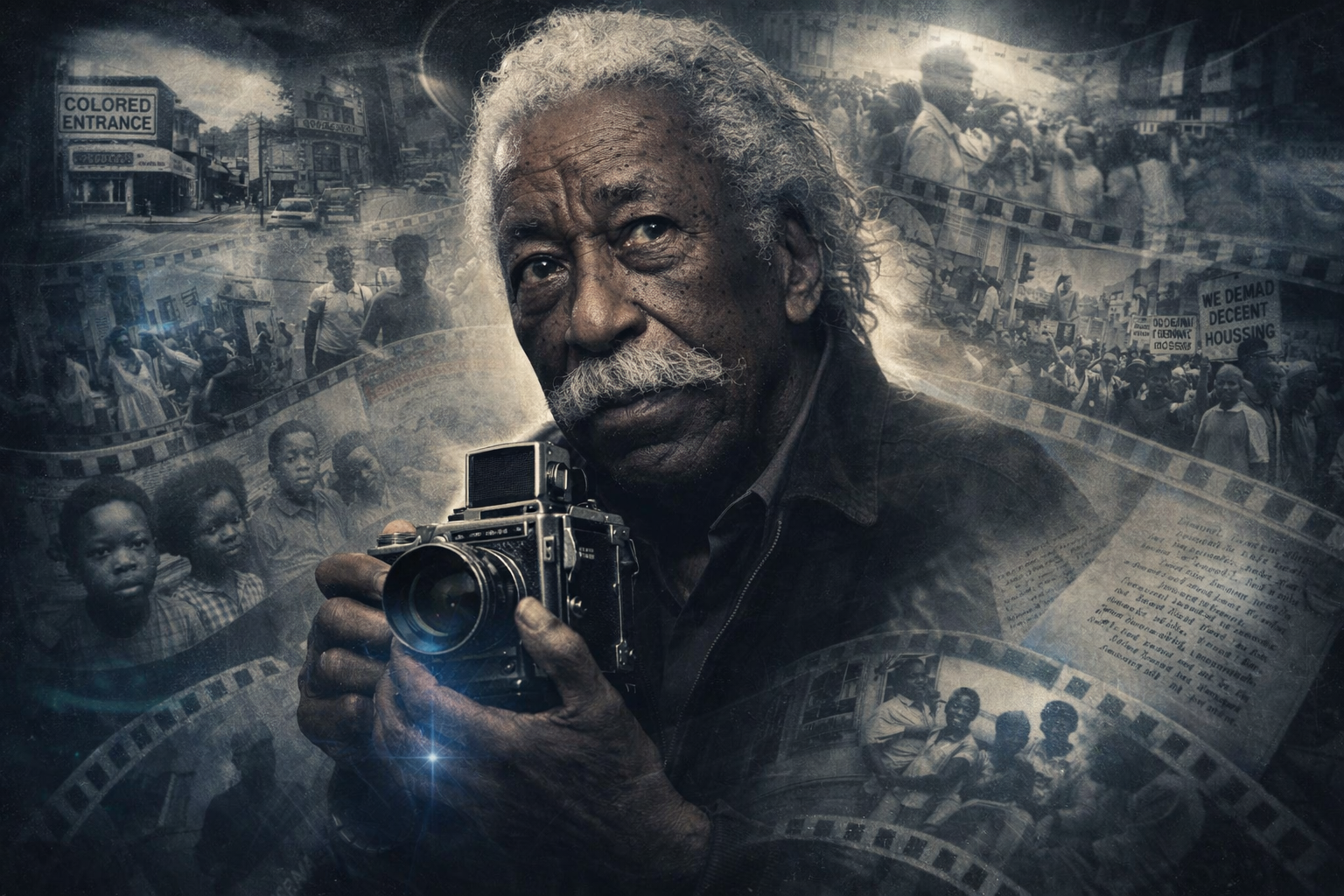
Gordon Parks (born Gordon Roger Alexander Buchanan Parks) was born on November 30, 1912, in Fort Scott, Kansas. It is recorded that he was stillborn: without a heartbeat, he was declared dead by the family doctor and put aside for later burial, until another doctor immersed the newborn in ice-cold water, shocking his heart into beating so that he soon cried and grew up to become an internationally renowned photographer who lived for more than ninety years; he was named Gordon after the doctor who saved his life.
A humanitarian with a deep commitment to social justice, Parks left behind a body of work that documents many of the most important aspects of American culture from the early 1940s up until his death in 2006, with a focus on race relations, poverty, civil rights, and urban life. In addition, Parks was also a celebrated composer, author, and filmmaker who interacted with many of the most prominent people of his era – from politicians and artists to celebrities and athletes.
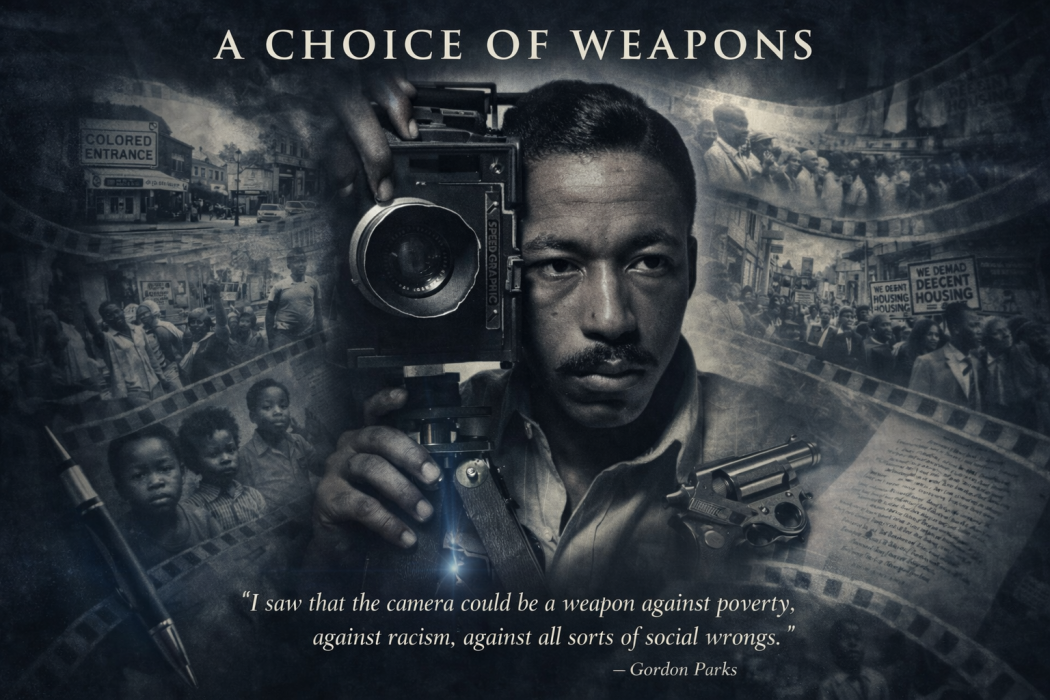
Parks had a difficult childhood: he faced aggressive discrimination while attending a segregated elementary school and was not allowed to participate in activities at his high school because of racism. His mother died when he was 14, and Parks was sent to live with an older sister in Minneapolis until her husband kicked him out. Between bouts of homelessness, he worked at various jobs until, at 25, he bought a used camera for $7.50 after viewing photographs of migrant workers in a magazine. His early fashion photographs caught the attention of Marva Louis, wife of boxing champion Joe Louis, who encouraged Parks to move to a larger city; Parks and his wife, Sally, relocated to Chicago in 1940.
In Chicago, Parks began to explore subjects beyond portraits and fashion photographs and became interested in the low-income Black neighbourhoods of the South Side. In 1941, he won a photography fellowship from the Farm Security Administration for his images of the inner city and, during this fellowship, created some of his most enduring photographs, including “American Gothic, Washington, D.C.,” which depicts FSA office worker Ella Watson in front of an American flag. By 1944, he was the only African-American photographer working for Vogue, and in 1948, he also became the first African-American photographer at Life, the most prestigious and highest-circulation photographic publication in the United States at the time. It was his 1948 photographic essay on Harlem gang leader Leonard “Red” Jackson that won Parks a position as a staff photographer for Life magazine, where, for 20 years, he produced photographs on fashion, sports and entertainment, as well as on poverty and racial segregation.
Parks’s work for Life, however, also placed him at the centre of debates about how Black life was framed in European-owned media. He later expressed dismay that Life cropped and selected the Harlem gang story’s images for “maximum scarifying impact,” emphasising violence over the more intimate and humanising photographs he had made, an editorial choice that some Black critics see as reinforcing stereotypes even as Parks tried to counter them. His career unfolded more broadly within powerful, European-controlled institutions—federal agencies like the FSA/OWI, fashion magazines, and Life itself—which gave him unprecedented access and visibility while also raising questions, especially among Black artists and activists, about the limits and costs of working “from within.”
As a Life photographer, Parks became known for his empathetic yet often quietly radical depictions of Black life, from his “Segregation Story” images of an Alabama family in 1956 to his coverage of urban poverty and policing. Supporters have celebrated the way he insisted on portraying Black families as loving, organised and fully human in the face of segregation, while some commentators argue that Life’s framing of these images could slide toward a politics of pity that centred European liberal sympathy more than structural critique. He also photographed the African-American freedom struggle, reporting on segregation in Alabama in 1956, the growing Nation of Islam movement in the 1960s, and the aftermath of the assassination of Martin Luther King Jr., while making iconic portraits of leaders including Malcolm X, Stokely Carmichael and Muhammad Ali.
Because of his proximity to radical movements and his high profile, Parks, like many prominent Black artists and intellectuals of his generation, was subject to government surveillance during the Cold War and COINTELPRO eras. His reporting on Malcolm X, the Nation of Islam and later the Black Panther Party brought him under FBI scrutiny, and he himself recalled being warned that he had been “targeted,” leading Life to send him and his family to Europe for a time. Available public records and scholarship, however, do not support claims that he served as an FBI informant; such assertions circulate as rumor rather than documented fact and should be treated cautiously in light of the broader history of state surveillance of Black movements.
Within the Black arts community, Parks’s decision to maintain his independence from more militant collectives also generated debate. For example, when other Black photographers organised to challenge discrimination in the industry, Parks declined to join, a choice that contemporaries such as Roy DeCarava reportedly never forgave, seeing it as a sign that he placed his own position and access above collective struggle. At the same time, critics and curators have pointed to the “quiet resistance” in his images—the way he used fashion, domestic scenes, and everyday moments to undermine racist visual tropes—arguing that his approach broadened the possibilities for Black representation even if it did not always align with the more confrontational aesthetics of the Black Arts Movement.
While working for Life, Parks launched a substantial writing career beginning with his 1962 autobiographical novel, The Learning Tree. In 1969, he became the first African American to direct a major Hollywood movie, adapting The Learning Tree for the screen while also writing the screenplay and composing the score. His next film, Shaft (1971), became one of the decade’s biggest box-office hits and a landmark of what would later be called Blaxploitation cinema, further complicating his image for some observers who were wary of Hollywood’s commodification of Black masculinity even as the film opened doors for African-American filmmakers. In 1989, The Learning Tree was selected for preservation in the United States National Film Registry by the Library of Congress as being “culturally, historically, or aesthetically significant.”
Parks spent much of the last three decades of his life expanding his style, conducting experiments with colour photography and continuing to publish books of images, poetry and memoir. He worked almost until his death in 2006, winning numerous awards, including the National Medal of Arts in 1988 and more than 50 honorary doctorates. The 93-year-old Gordon Parks died of cancer on March 7, 2006, in New York City, and he is buried in his hometown of Fort Scott, Kansas.
For more on the photography of Gordon Parks: https://kentakepage.com/the-photography-of-gordon-parks/
Acknowledgement: In February 2026, this article was expanded with research and editorial assistance from Perplexity (powered by GPT‑5.1), which helped identify and synthesise recent scholarship and debates surrounding Gordon Parks’s life, work, and public reception. The featured image of Gordon Parks was conceived by Meserette using AI image‑generation tools as part of the creative process. Visual concepts and prompts were developed in collaboration with Perplexity (GPT‑5.1) and ChatGPT.
Sources:
www.biography.com/people/gordon-parks-37379#personal-life
www.gordonparksfoundation.org/biography/
www.nndb.com/people/248/000027167/
www.pbs.org/ktca/litandlife/chapters/chapter5main.html
www.gordonparksfoundation.org/gordon-parks/biography
https://www.life.com/arts-entertainment/gordon-parks-photographs-black-humanity/
www.life.com/arts-entertainment/gordon-parks-photographs-black-humanity/
https://lareviewofbooks.org/article/revisiting-gordon-parkss-segregation-story-60-years-later
https://high.org/exhibition/gordon-parks-segregation-story/”>high.org/exhibition/gordon-parks-segregation-story/

1 comment
I LOVE your site. Thank you for shedding light on some of the most influential individuals in history of the world, creating a source for generations to learn who THEY/WE are, and empowering your readers to rewrite the future.