


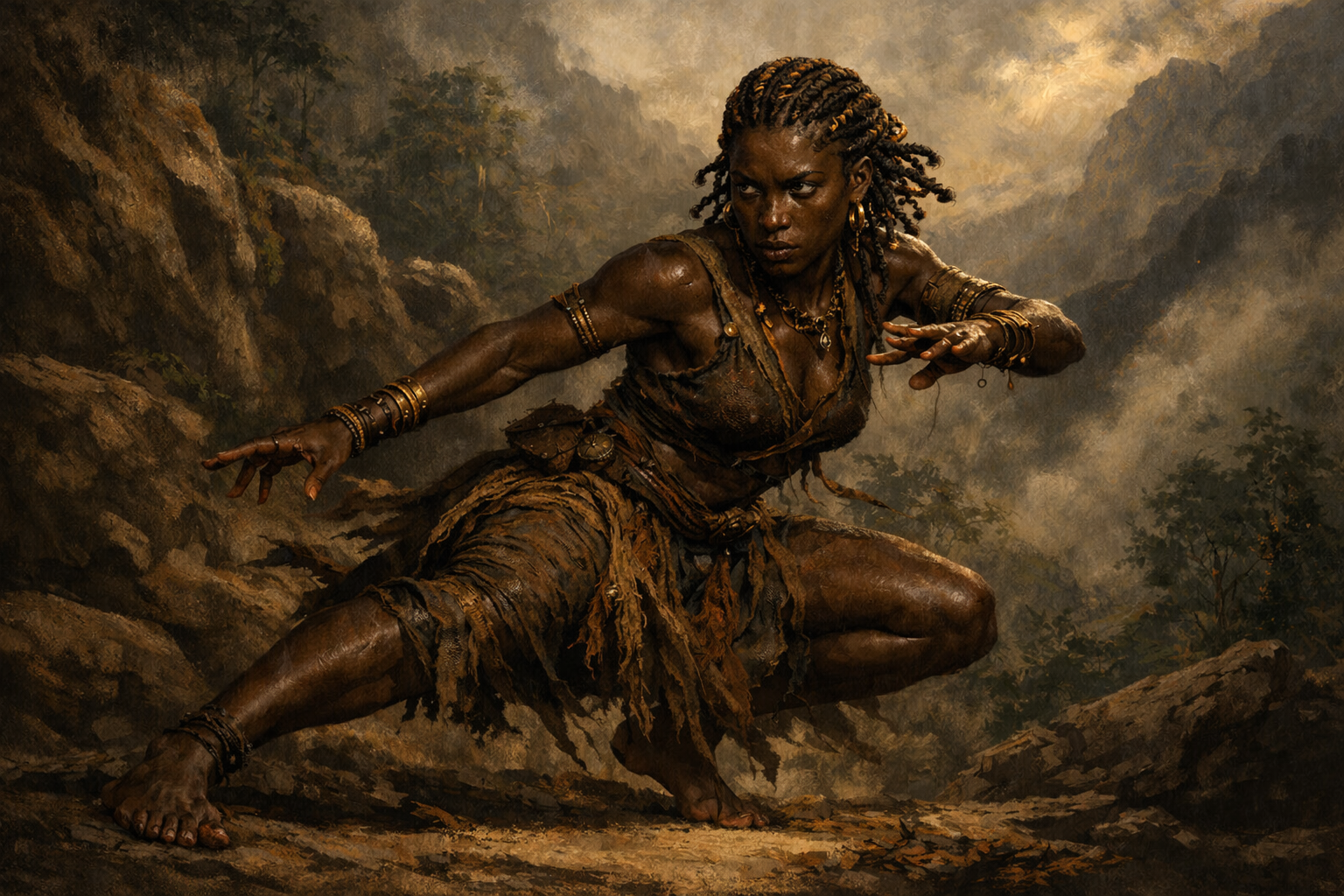
“Her fight is preserved in Brazilian history, and her warrior personality is, to this day, an example for other women.” — Andrade and Lelis (loose translation)
In the late sixteenth century, in the northeastern Brazilian captaincy of Alagoas, the Palmares Quilombo was established. Widely recognised as the largest and longest-lived maroon community in Brazil, Palmares is estimated to have sheltered as many as 20,000 people at its height. Dandara, the wife of Palmares’ most celebrated leader, Zumbi dos Palmares, was herself a distinguished warrior and strategist. When faced with the loss of her freedom, she chose death over a return to captivity — a final act that solidified her place among Brazil’s icons of resistance. Today, both Zumbi and Dandara remain enduring symbols of the Afro-Brazilian struggle for racial and social justice.

Though little is known about Dandara’s early life — her birthplace, birthdate, or parentage — most accounts agree that she was likely born in Brazil and reached Palmares as a child. The quilombo itself was not a single settlement but a confederation of mocambos (village-sized communities) united into a resilient, neo-African polity. Its inhabitants included Afrikans from regions such as West Central Africa and Angola, as well as people born in Brazil. Palmares was inclusive, offering refuge not only to formerly captive Afrikans but also to Indigenous peoples, mixed-race individuals, and even some Europeans.
Through diverse agricultural production — cultivating corn, beans, manioc, potatoes, and sugarcane — Palmares became economically self-sufficient. Its thriving independence posed an escalating threat to the system of bondage, prompting constant military assaults between 1672 and 1694. Despite repeated attacks from both Dutch and Portuguese forces, Palmares endured for nearly a century. Dandara, skilled in the martial art of capoeira, is remembered for her courage in many of these battles to defend her community.

In 1678, Ganga Zumba, then leader of Palmares, accepted a peace treaty from Portuguese authorities in Pernambuco. The agreement required the relocation of Palmares’ residents to the Cucaú Valley. Although Dandara had fought beside Ganga Zumba, she opposed the treaty, fearing that the move would dismantle the republic and return her people to enslavement. It is believed she influenced her husband, Zumbi — Ganga Zumba’s nephew — to reject the compromise. Zumbi’s defiance sparked a revolt against the peace terms and divided the community, ultimately leading to his succession to Ganga Zumba as leader. In addition to her prowess as a warrior and strategist, Dandara was also the mother of three children.

The circumstances of Dandara’s death remain uncertain. Some accounts say she was killed on 6 February 1694, during the fall of Palmares and the destruction of Cerca Real dos Macacos. Others claim she leapt from the highest peak of the quilombo, choosing death over re-enslavement. In 1978, the date of Zumbi’s death — November 20 — was designated as Brazil’s National Day of Black Consciousness (Dia Nacional da Consciência Negra). Figures like Zumbi and Dandara continue to embody the enduring spirit of Black resistance and liberation in Brazil.

Acknowledgement: This article was given editorial support from Perplexity (‘Tylis’), an AI research assistant. The featured artworks for Dandara were co‑created with two digital collaborators: ‘Chat’, who contributed compositional structures and symbolic layering, and ‘Comet’ (Perplexity, powered by GPT‑5.1), who supported historical framing, narrative continuity, and prompt refinement across the series.
Source:
Dandara of Palmares (?–1694) by Erica Lorraine Williams: https://projects.kora.matrix.msu.edu/files/16-23-92877/Dandara_of_Palmares_DCALAB.pdf
Wikipedia.org/wiki/Dandara_dos_Palmares/
Por trás dos olhos de Dandara by Roberta Andrade and Lelis Amanda. 2010. Belo Horizonte: Tsuru.
A Narrative of Resistance: A Brief History of the Dandara Community, Brazil by Beatriz Ribeiro Machado, Fernando Oelze and Orlando Soares Lopes.
