

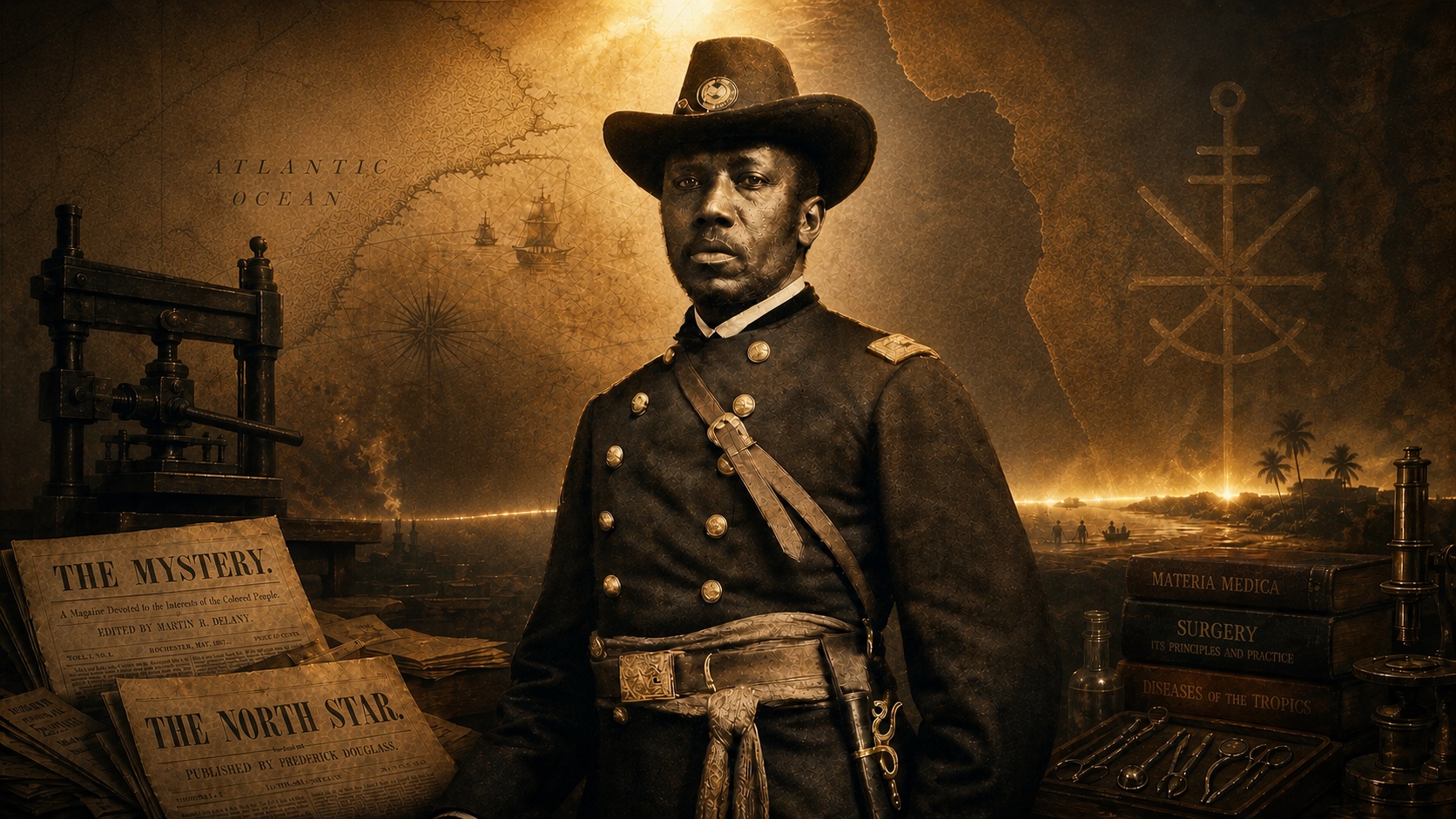
Every people should be originators of their own destiny.
Martin Robinson Delany (May 6, 1812 – January 24, 1885) stands as one of the most formidable and multifaceted intellectuals of the 19th century—abolitionist, physician, journalist, novelist, military officer, explorer, and visionary architect of Black nationalism. His life’s work laid the ideological foundations that would echo through generations, informing the philosophies of Marcus Garvey, W.E.B. Du Bois, Malcolm X, and the entire tradition of Pan-Africanist thought. Frederick Douglass famously said of him, “I thank God for making me a man, but Delany thanks Him for making him a Black man.” That formulation captures something essential about Delany: his unapologetic embrace of Blackness as identity, politics, destiny, and power. In an era when most Black leaders advocated integration and moral suasion, Delany dared to articulate a radical alternative: that African people’s liberation required not simply freedom from bondage, but the full recovery of identity, sovereignty, and pride. Long before Marcus Garvey would popularize the phrase, Delany was already articulating the principle of “Africa for Africans,” insisting that African people’s liberation depended not simply on emancipation, but on the reclamation of sovereignty, homeland, and pride.
Origins: Claiming African Royalty
Delany was born free on May 6, 1812, in Charles Town, Virginia (now West Virginia), to a en father in captivity and a free mother named Pati. Under the legal doctrine of partus sequitur ventrem, his status followed his mother’s, granting him the precious but precarious condition of being free-born in spaces of captivity. From his earliest years, Delany believed he was descended from African royalty — specifically from Mandinka lineage — a conviction that would become the cornerstone of his entire philosophical worldview. This was not mere family mythology; it was a declaration of ontological dignity that he carried like armor against the assaults of white supremacy.
When Pati Delany taught her children to read and write, she was cited for violating Virginia’s laws against Black literacy — a crime for which prosecution loomed. Rather than submit, she gathered her children and fled north to Chambersburg, Pennsylvania, in 1822, ensuring they could continue their education without interference. It was an act of defiance that planted the seed of resistance in young Martin’s consciousness.
Pittsburgh Years: Education, Medicine, and the Underground Railroad
Delany was educated in Chambersburg until 1827, when economic necessity forced him to work. Four years later, at nineteen, he left for Pittsburgh — walking the entire distance — a city that would be his home for the next twenty-five years. Upon arrival, he enrolled in a school operated by the Reverend Lewis Woodson, an African Methodist Episcopal Church leader and formidable educator and advocate of Black economic independence who would later help establish Wilberforce University. Rev. Woodson was also deeply active in the Underground Railroad, the clandestine network that guided Black people to freedom in Canada, and he introduced Delany to both the philosophy of self-reliance and the practice of direct resistance.
In 1833, Delany began an apprenticeship with a Pittsburgh physician and soon opened a successful medical practice in cupping and leeching — practices that did not require formal certification before 1850. He became a respected healer in the Black community, blending empirical medicine with a commitment to service. But Delany was also establishing himself as a leader and organizer. He became actively involved in the Underground Railroad himself, risking his own freedom to guide his people toward liberation.
The Mystery and the Power of the Black Press
Delany understood early that the press was a weapon. In or around 1843, he established The Mystery, an abolitionist newspaper said to be the first Black-owned paper west of the Alleghenies. Published for four years in Pittsburgh, The Mystery was one of the only papers to survive the devastating fire of 1845 that destroyed a third of the city. Through its pages, Delany exposed racial injustice, championed women’s rights, and articulated a vision of Black dignity that was reprinted even in Euro-American newspapers — evidence of the force and clarity of his voice.
A year after the fire, Frederick Douglass came to Pittsburgh to persuade Delany to become co-editor of his new newspaper, The North Star. On December 3, 1847, the two men launched what would become the most influential anti-slavery newspaper of the 19th century. They used its pages to speak out against captivity and oppression, though Delany and Douglass never worked together in an office. Instead, Delany embarked on a “western tour” through Ohio and Michigan to recruit subscribers, sending back travelogue-style letters that documented both the promise and the peril of Black life in the North.
In one harrowing letter, Delany recounted being chased by a mob of Europeans in Marseilles, Ohio, northwest of Columbus. Retreating to their hotel, he and a companion watched as the mob started a bonfire and threatened their lives. “Then came the most horrible howling and yelling, cursing and blasphemy, every disparaging, reproachful, degrading, vile and vulgar epithet that could be conceived by the most vitiated imaginations,” Delany wrote, “which bedlam of shocking disregard was kept up from nine until one o’clock at night…” With the hotel’s proprietor refusing to let the mob enter, Delany waited out the crisis and slipped away the next day — a narrow escape that revealed the fragility of Black safety even in the so-called free states.
The Douglass-Delany Rivalry: “Thank God I Am a Black Man”
By the end of the tour, it was already clear that Delany and Douglass were parting ways on The North Star. Robert Levine, a University of Maryland English professor who wrote a book about the two men, observed that by the late 1840s, Delany was accustomed to being a leader, but “as co-editor of The North Star, he was suddenly cast in Douglass’ shadow.” The decisive break came when Delany began advocating Black emigration, while Douglass was still preaching that free Blacks should continue the anti-Maafa battle in America. Thus, the editorial alliance of the two men lasted only eighteen months. Yet from the time of their first meeting, Douglass and Delany would remain lifelong friends — and often bitter rivals.
Douglass is famously quoted as saying, “I wake up each morning and say, thank God I am a man,” whereas Delany wakes up and says “thank God I am a Black man.” The distinction was not trivial. Delany attempted to use his unmixed African heritage to position himself as a more authentic leader, arguing that his intelligence could not be attributed to European blood — an implicit critique of Douglass, who was of mixed race. It was a complicated strategy, rooted in the racial essentialism of the era, but it also reflected Delany’s unapologetic embrace of Blackness as a source of pride and power.
Harvard Medical School: Expulsion and Defiance
In 1850, Delany entered Harvard Medical School to complete his formal medical education, becoming one of the first three African Americans ever admitted. It was a milestone achievement — and a short-lived one. Within a semester, Euro-American professors and students petitioned for his expulsion, and he was forced out. Undeterred, Delany gave himself the title of “doctor” and continued to practice medicine in Pittsburgh, combining his clinical work with his political activism. He also joined Prince Hall Freemasonry, rising through its ranks and in 1853 publishing the first full-length work on the subject — a text that connected him to an interstate network of Black activists and intellectuals.
The Condition, Elevation, Emigration, and Destiny: The Founding Text of Black Nationalism
The year 1852 marked a turning point in African American intellectual history. Delany published The Condition, Elevation, Emigration, and Destiny of the Colored People of the United States, Politically Considered — widely regarded as the founding document of Black nationalism in print. Written in direct response to the Fugitive Slave Act of 1850, which had turned every free Black person into a potential fugitive, the book argued that American racism was structural and intractable. Even abolitionists, Delany contended, would never accept Blacks as equals. The solution to the Black condition, therefore, lay not in moral suasion or gradual integration, but in emigration — first to Central or South America, later to Africa.
In the text, Delany wrote with brutal clarity:
“Let no visionary nonsense about habeas corpus, or a fair trial, deceive us; there are no such rights granted in this bill, and except where the commissioner is too ignorant to understand, when reading it, or too stupid to enforce it when he does understand, there is no earthly chance, no hope under heaven for the colored person who is brought before one of these officers of the law.
We are slaves in the midst of freedom, waiting patiently and unconcernedly, indifferently, and stupidly, for masters to come and lay claim to us, trusting to their generosity, whether or not they will own us and carry us into endless bondage.”
This was purposeful, incisive rhetoric. It was a clear diagnosis of the condition of Black life in America — a condition that, Delany argued, required the establishment of a sovereign Black nation as its remedy.
The Niger Valley Exploring Party: “Africa for Africans”
Over the next fifteen years, Delany argued relentlessly for emigration. “We are a nation within a nation,” he wrote, “we must go from our oppressors.” But Delany was no armchair theorist. In 1858–1859, he led the Niger Valley Exploring Party — described by one biographer as “the first party of scientific exploration to Africa from the American continent.” Traveling through what is now Nigeria, he negotiated treaties with Egba and Yoruba rulers to establish the legal and territorial conditions for Black American settlement. His 1861 publication, Official Report of the Niger Valley Exploring Party, provided detailed geographical, agricultural, and social data to support potential emigration, combining ethnographic observation with political vision.
Delany coined the phrase “Africa for Africans” as early as 1861 — a slogan that would later become central to Marcus Garvey’s Universal Negro Improvement Association. He stands at the head of a succession of nationalist leaders including Henry McNeal Turner, Garvey, Malcolm X, and Louis Farrakhan.
Blake, or The Huts of America: Revolutionary Fiction
Delany’s novel Blake, or The Huts of America, serialized in the 1850s and early 1860s, stands as one of the most radical works of 19th-century African American literature. It follows a captive man named Blake who travels across the South and into Cuba, building a clandestine revolutionary network to overthrow the Maafa — a “thunderous call for blacks to rise up and resist.” The novel has been described as “at once the most important and the least influential work of fiction published by a black writer in the nineteenth century” — most important for its scope as a blueprint for armed insurrection, least influential because it was largely buried and forgotten until scholars rediscovered it around 1970.
Civil War and the First Black Field Officer
The outbreak of the Civil War in 1861 brought Delany back from Canada, where he had moved in 1856. Despite his separatist convictions, he threw himself into the Union cause, believing that Black men’s participation in the war was essential to their dignity and future political standing. He moved to Wilberforce, Ohio, in 1864 and advanced a bold plan to recruit Black troops commanded by Black officers to fight for the Union Army.
In a historic meeting with President Abraham Lincoln, Delany persuaded the administration to commission him as a Major in the 52nd U.S. Colored Troops Regiment. With that appointment in February 1865, he became the first Black field-grade officer in U.S. Army history — the highest rank achieved by a Black officer during the war. Though the war ended before his full plan could be implemented, Delany’s commission was a powerful symbol of Black martial citizenship.
Reconstruction: Land, Labor, and Betrayal
When Reconstruction began, Delany was assigned to the Freedmen’s Bureau in South Carolina, where he worked to secure land, education, jobs, and economic opportunities for African Americans. He encouraged some to emigrate to Liberia, but he also engaged deeply with the politics of Reconstruction on the ground. He remained with the Bureau until he retired from the army in 1868, then turned his attention to local Republican politics.
Delany ran for Lieutenant Governor of South Carolina in 1874 and lost a close election, though he later served briefly as a trial judge in Charleston. He witnessed firsthand the systematic betrayal of freedpeople — watching as 63,000 acres of land promised to Black families in South Carolina reverted to European planters. As Republicans lost power in the state and the promise of Reconstruction collapsed, Delany renewed his calls for emigration, becoming, in 1878, an official of the Liberian Exodus Joint Stock Steamship Company.
The Principia of Ethnology and Final Years
In 1879, Delany published The Principia of Ethnology, a book that argued for race pride and purity — a text reflective of both the racial science of the era and Delany’s lifelong commitment to the dignity and sovereignty of African people. In 1880, he withdrew from the Liberian Exodus Company and moved first to Boston, Massachusetts, and then to Wilberforce College in Xenia, Ohio.
Martin Robinson Delany, considered by many as the “father of Black nationalism,” died in Xenia, Ohio, on January 24, 1885. He was seventy-two years old.
Legacy: The Long Arc of Black Self-Determination
Delany’s legacy flows through the entire tradition of Black radical thought. W.E.B. Du Bois drew from him. Marcus Garvey built his mass movement on Delany’s ideological foundations. Malcolm X channeled his insistence on self-determination and Black pride. The very phrase “Black is beautiful” has its philosophical roots in Delany’s fierce and unapologetic celebration of African identity.
He remains indispensable to understanding the intellectual history of the African diaspora — a man who, long before others dared say it plainly, declared that Black people’s liberation required not just freedom from bondage, but the full recovery of identity, sovereignty, and pride. In a world that sought to strip African people of their past, Delany insisted on royal lineage. In a nation that demanded gratitude and patience, he demanded land and sovereignty. In an era of accommodation, he chose defiance.
Martin R. Delany was, in his own words, unapologetically a Black man — and in that unapologetic Blackness, he charted a path that generations would follow.
Source:
Black Firsts, edited by Jessie Carney Smith
http://www.blackpast.org/aah/delany-major-martin-robison-1812-1885
http://www.post-gazette.com/life/lifestyle/2011/02/06/Martin-Delany-Father-of-Black-Nationalism/stories/201102060355
https://en.wikipedia.org/wiki/Martin_Delany
https://encyclopediavirginia.org/entries/delany-martin-r-1812-1885/
https://www.britannica.com/biography/Martin-R-Delany
https://schistory.org/february1865-martin-delany-becomes-the-first-black-major-in-the-us-army/
https://picturingblackhistory.org/martin-delany-unapologetic-african/
https://www.studysmarter.co.uk/explanations/politics/political-ideology/martin-delany/https://www.washingtoninformer.com/martin-delany-the-father-of-black-nationalism/
https://www.stlamerican.com/news/columnists/bernie-hayes/the-other-martin-martin-r-delany-architect-of-black-nationalism/
https://shadesofafrika.com/the-condition-elevation-emigration-and-destiny-of-the-colored-people-of-the-united-states-by-martin-r-delany/
https://en.wikipedia.org/wiki/The_North_Star_(anti-slavery_newspaper)
https://newafrikan77.wordpress.com/2018/05/06/martin-delany-may-6-1812-january-24-1885-the-forgotten-giant-of-selfhood/
https://library.schlagergroup.com/chapter/9781961844087-book-part-060
https://www.thenorthstar.com/p/honoring-fredrick-douglass-and-martin-delany-on-the-north-stars-founders-day
https://southernlitreview.com/reviews/blake-or-the-huts-of-america-by-martin-r-delany-and-the-hindered-hand-by-sutton-e-griggs.htm
https://historyofblacktravel.com/timeline/martin-robison-delany-led-an-exploring-party-to-niger-valley-to-find-a-homeland-for-african-americans/
https://africanbloodsiblings.wordpress.com/2012/12/24/part-1-of-martin-delanys-blake-or-the-huts-of-america-with-notes/
https://hoodcommunist.org/2023/03/23/from-martin-delany-to-marcus-garvey/
http://www.gutenberg.org/ebooks/22118


2 Responses
Thank you for making available such important information about our heritage.
Outstanding. Thank you, thank you, thank you. These heroic men and women whose gifts should be shared with ALL people, worldwide, especially throughout the diaspora. I share these yearly at my church’s Black History program – a Kwanzaa celebration of our culture. God’s blessings for your continued efforts.