

Few acts of collective forgetting have been as thorough and as successful as the erasing of slavery from Britain’s “island story”. ~David Olusoga
On August 1, 1838, the British ended the Maafa (Atlantic trafficking and captivity) in the territories they had invaded, occupied and turned into labour camps mainly for the production of sugar. Over 800,000 people were freed but received no compensation. However, Britain’s 46,000 captors received about £20 million in government compensation for the loss of people who had been held in captivity.
In his book The Reaper’s Garden, Vincent Brown related the story of two emancipation “ceremonies” in Jamaica, in which the Maafa was given a funeral. The first was held in Falmouth, Trelawny, and the second at Salter’s Hill in Saint James.
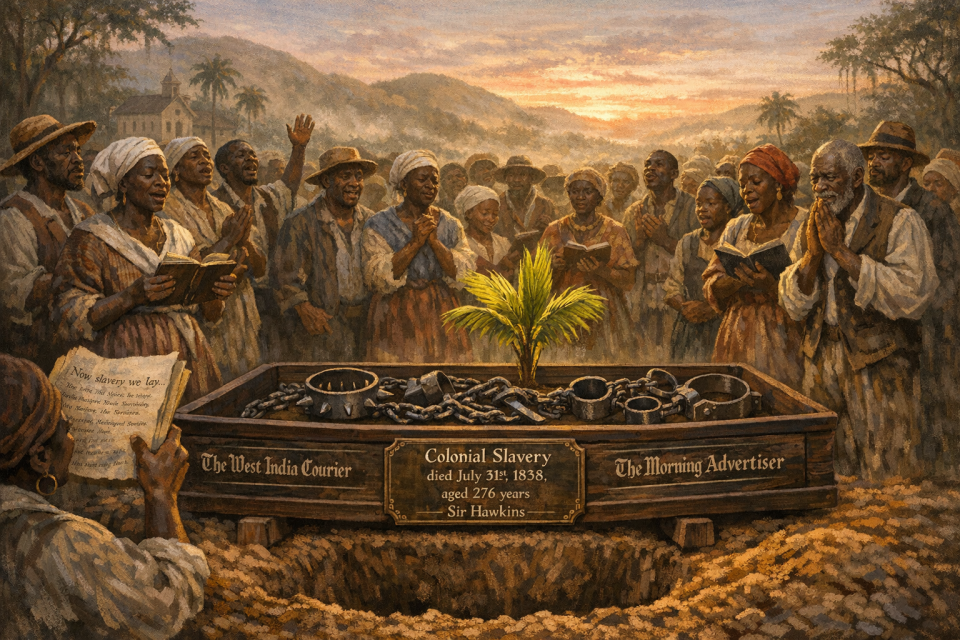
“At dawn [on the morning of August 1, 1838], a multitude assembled around a coffin, containing a chain, handcuffs, an iron collar, and other hateful ensigns of usurped command. The names of two pro-slavery newspapers were painted on the sides, while the coffin’s memorial plate bore the inscription ‘Slavery died July 31st, 1838, aged 276 years,’ and also ‘Sir Hawkins,’ the sixteenth-century British [trafficker]. The crowd sang:
Now slavery we lay thy vile form in the dusts;
And buried forever, there let it remain;
And rotted, and covered with infamy’s rust,
Be every man-whip, and fetter and chain!
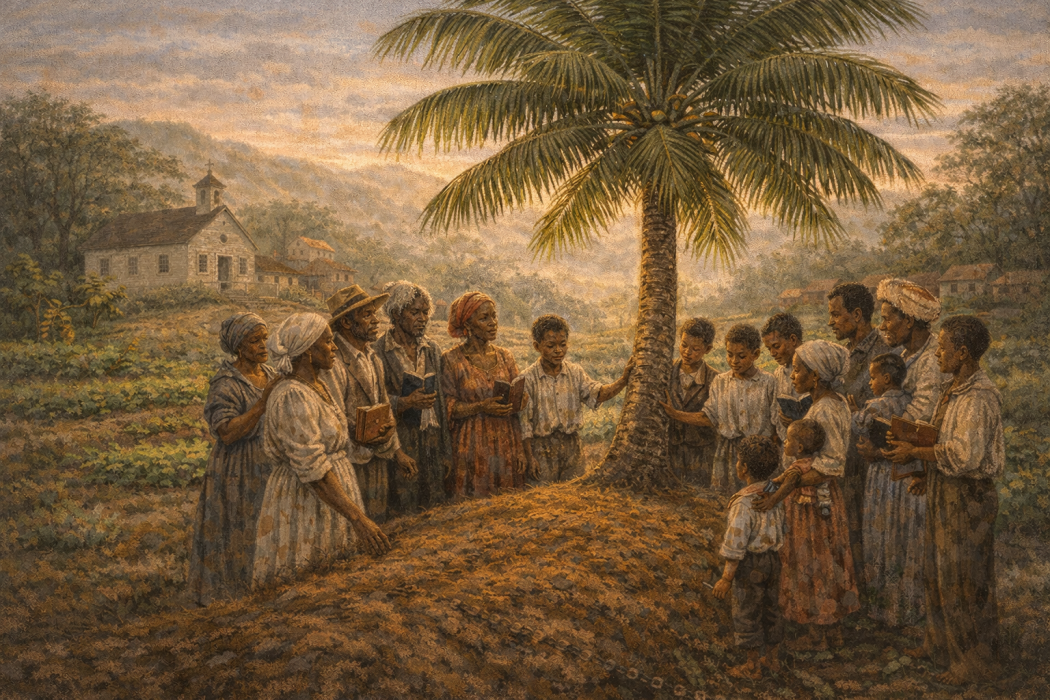
The people buried the coffin and planted a young coconut tree at its head, which acted simultaneously as a symbolic tree of liberty and a prison for captivity’s spirit.
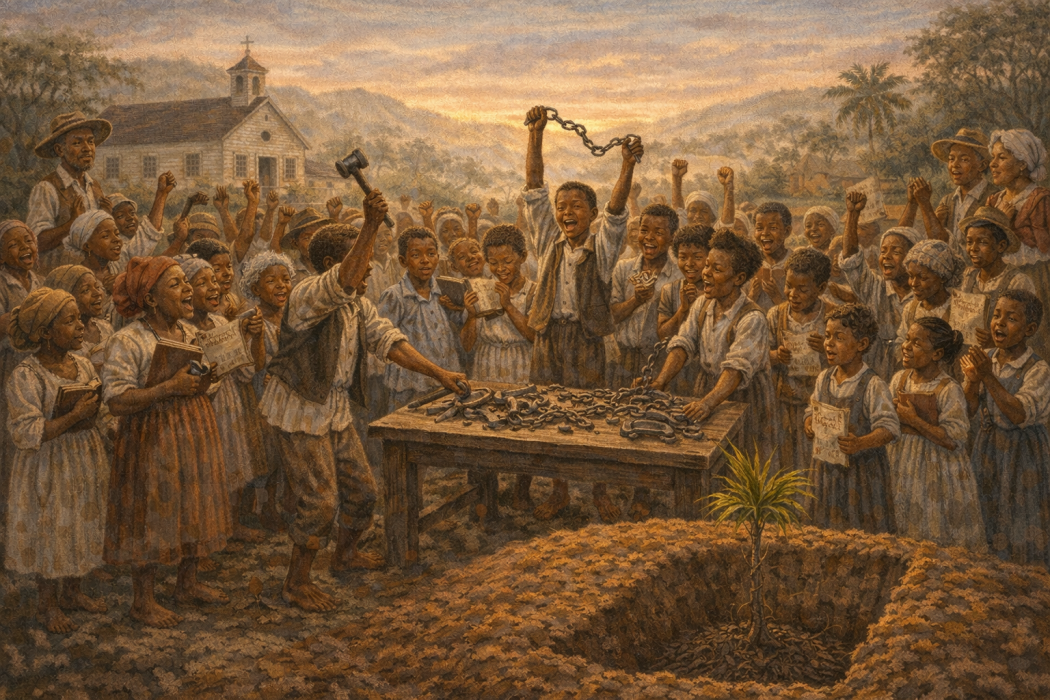
Two days later, a group of more than five hundred children held a similar rite at the chapel on Salter’s Hill. As they prepared for the ‘burial of slavery,’ they produced and then condemned its symbols—the whip, the chain, and the shackles—by demanding that the whip be cut up, the chain broken, and the shackles destroyed. When this was done, the children let out a cheer. Then the question arose, What was to be done with the remains of [captivity]? They answered in unison, Bury them, bury them.…”
Perhaps the children’s voices echoed across the ocean to the British Isles, where the memory of the Maafa has also been buried. When the clock struck midnight on July 31, 1838, it may have signalled not only emancipation but also an erasure of Britain’s involvement in trafficking and captivity. Since then, Britain has largely buried its collective guilt, recasting itself as the great anti-slavery champion. As historian David Olusoga observed, “Few acts of collective forgetting have been as thorough and as successful as the erasing of [captivity] from Britain’s island story.” The British used the abolition campaign, emancipation, and the Royal Navy’s policing of the seas to halt the trafficking as a way to symbolically cleanse their collective conscience.
Here are a few facts about British Maafa history:
The British
Although the British were not the initiators of the Maafa, they more than any other European nation perfected the oppressive system and raised it to new, terrifying heights of oppression. The trafficking of Afrika’s peoples was seen as “in perfect harmony with the principles of the Word of God.” The British held people in captivity in two regions of the Americas—the Caribbean and North America. At the height of British Maafa history, between 1660 and the abolition of the trafficking in 1807, British ships carried away 3.5 million of Afrika’s people from their homeland. More than 10 per cent of the Afrikans died before reaching the European New World destinations.
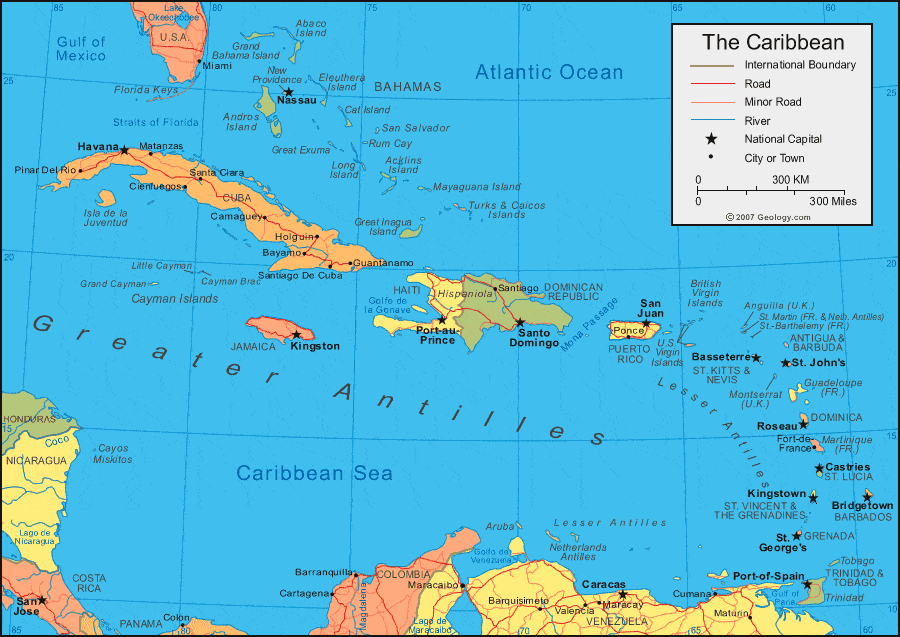
British involvement in the Maafa began as a piratical act. In 1562, John Hawkins captured 300 Afrikans and sold them illegally to the Spanish, bringing Elizabethan England into the Maafa. However, there is evidence that British merchants had been buying and selling Afrikan people in Andalucia (Spain) for decades before that. British participation grew with the seizure of territories in the Caribbean and North America. The British first occupied Virginia in 1607. Then places such as St Kitts (1624), Barbados (1627), Nevis (1628), Antigua and Montserrat (1632), Jamaica (1655), the Cayman Islands (1655), the Virgin Islands (1666) and the Bahamas (1670) were usurped.
When sugar planting began on the islands, trafficking was initiated by freebooters, then by a succession of monopolistic companies with royal charters—the Guinea Company in 1651, the Company of Royal Adventurers Trading in Africa in 1663, and the Royal African Company in 1672. For the next twenty years, the London-based Royal African Company (with the Duke of York, later James II, as a major shareholder) was charged with developing and maintaining a number of forts along the Afrikan coast in order to traffic in Afrikans. The company was responsible for transporting over 150,000 Afrikans.
The company’s monopoly ended in 1698, after another European war destroyed Fort James in Gambia. Private businessmen were allowed to participate in trafficking Afrika’s people, and they expanded to eclipse the Portuguese, Dutch and French. This was given impetus with the ending of the War of the Spanish Succession and the signing of the Treaty of Utrecht in 1713, which gave the British control over the Spanish asiento, a contract to supply the Spanish-occupied lands with 144,000 Afrikans over thirty years—4,800 a year. Throughout the 1700s, the British were the world’s preeminent traffickers, during their peak in the 1760s, embarking more than 42,000 Afrikans yearly.
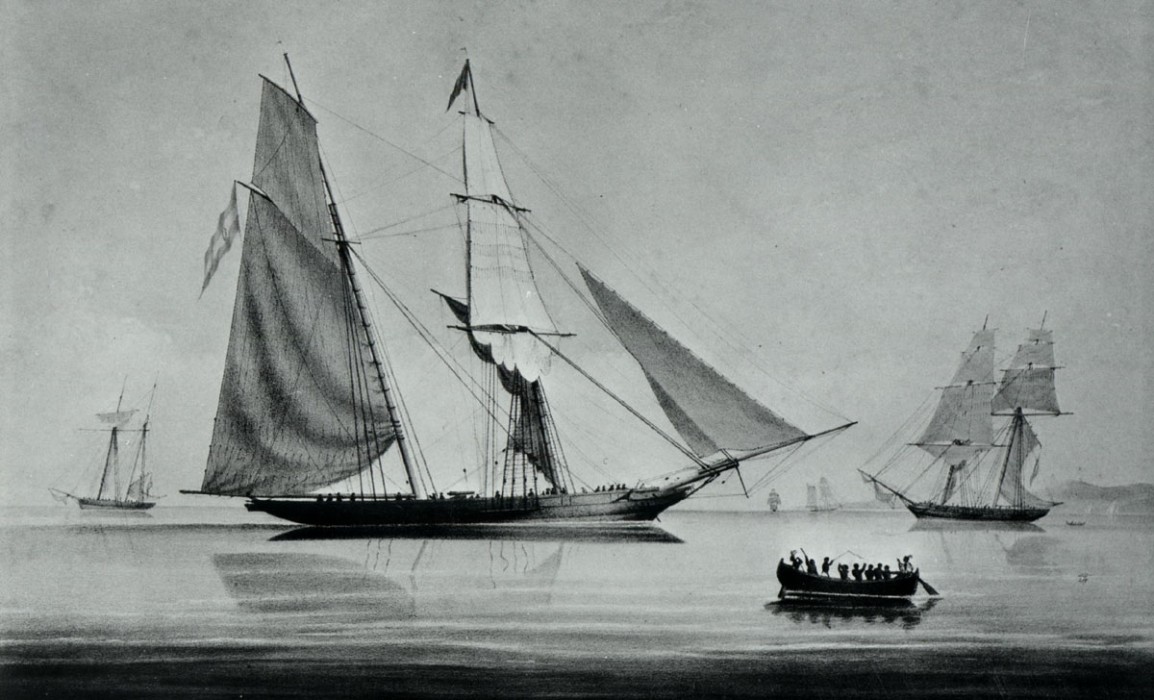
British ships from London, Bristol and Liverpool followed winds and currents that Portuguese navigators had charted in the fifteenth century, south past the Canary Islands, then along the Afrikan littoral, where they took men, women and children, situated between the Senegal and Zaire rivers. Each ship concentrated its efforts, usually gathering captives from only one or two regions along the coastline. Closest to Britain was the area encompassed by the Senegal and Gambia rivers, yet by the mid-eighteenth century, the British were more active to the south and east, in Sierra Leone, the Gold Coast, the Bight of Benin, and especially the Bight of Biafra. They also bartered for people further south along the Loango Coast of West-Central Afrika.
Having loaded the people, the traffickers sailed west, first reaching Barbados or the Lesser Antilles, where they replenished supplies and gauged regional markets, before proceeding downwind to their biggest market, Jamaica, where they knew they could “sell” the most Afrikans at the highest prices. Between 1713 and 1739, when the British held the asiento contract, 33 to 50 per cent of the Afrikans who landed in Jamaica embarked again for the mines and plantations of South America, but from 1740 onward, only about 17 per cent of the captives were sent elsewhere. In total, Jamaica absorbed more than any other single British stranglehold did—more than 500,000 Afrikans.
Bunce Island: ‘The place where history sleeps’
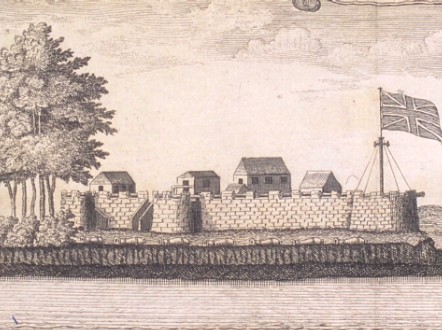


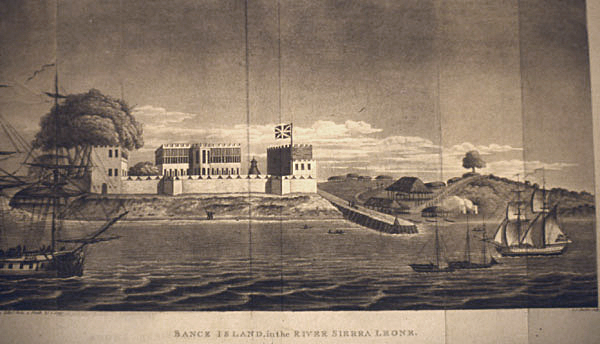
According to David Olusoga in his book, Black and British: A Forgotten History, Bunce Island, located some 30 kilometres from Freetown, was established as a fortress by the British (English) in the seventeenth century. It was attacked and destroyed on six different occasions—four times by the French (1695, 1704, 1779, and 1794), and twice by pirates (1719 and 1720). Afrikan captives arrived on a beach on the island’s eastern side. They were landed there by “war-men” who had brought them on river canoes. Some traffickers were Afrikans, while others were of mixed Afro-Portuguese or Afro-English descent—descendants of Europeans and local women.
From the beach, they were taken to the Sorting Yard, where buying and selling were done, and once purchased, the captives were branded with hot irons. They were then taken into the fortress itself. The men were separated from the women and children, and all were taken to special holding yards. These yards were large open spaces behind walls more than three metres high. It is believed that there was a “rape house” at Bunce Island where Afrikan women and girls were routinely sexually assaulted. In the final hours of their captivity, the captives were marched out of the holding yards, through the main gates and down a stone pathway towards the jetty. On their way to the water’s edge, shackles were fitted to their legs. They were loaded into small boats and ferried out to the ocean-going trafficking ships. The whole operation was carried out under the gaze of a huge cannon. Between 30,000 and 50,000 Afrikans took their last steps on Bunce Island.
The Brookes
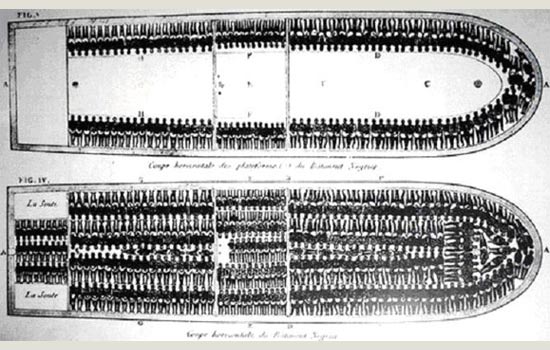
“The Brookes was a tomb, a mass grave that yielded handsome rents to its owner… If the story of the Zong symbolized the Atlantic slave trade as a moral dystopia, the plan of the Brookes refined the abstraction.” –Vincent Brown
The British referred to the harrowing oceanic trafficking route across the Atlantic as the Middle Passage. Their involvement in this route led to the infamous plan of a trafficking ship—The Brookes. This 18th-century British ship became notorious after images depicting its on-board conditions were published in 1788 by the Plymouth Chapter of the Society for Effecting the Abolition of the Trafficking. The plans, first designed and released that same year, became the most widely recognised image of the Middle Passage, reproduced countless times to further the abolitionist cause. The illustration detailed how trafficked captives were arranged on the lower and poop decks in accordance with the Regulated Trafficking Act of 1788. The Brookes was officially permitted to carry 454 Afrikans, allocating just 6 feet in length and 16 inches in width for each man, with only about 2 feet 7 inches of headroom between the shelf platforms. Each woman received 5 feet 10 inches by 16 inches, each boy 5 feet by 14 inches, and each girl 4 feet 6 inches by 12 inches. However, text on the Brookes poster alleged that a trafficker confessed the ship had once carried as many as 609 captives before the Act was enforced.
The Zong Massacre
After leaving São Tomé on 6 September 1781, bound for Jamaica, with approximately 470 captured Afrikans on board—more than the ship could hold—navigational error and bad weather extended the length of the Atlantic journey of the Zong to eleven weeks. By the time the Zong was in sight of Jamaica, more than sixty captives and seven members of the crew of seventeen traffickers had died. The epidemic promised to kill more. Therefore, the head-trafficker (captain), Luke Collingwood, steered the ship away from the island (and would later claim that he had mistaken it for Hispaniola), back into the sea and called a meeting with his officers. As dead captives represented a financial loss, it occurred to Collingwood that the Afrikans with an insurance tag of £30 each could be “thrown alive into the sea,” whereby he could claim on the insurance for his losses. He ordered them to throw overboard the sickest captives, informing them that if they were asked later about the reason, to say that the act had been necessary to safeguard the limited water supplies.
On 29th November, the traffickers went into the dark and suffocating hold and selected 54 ailing men, women and children, bound their hands and cast them overboard. The next day, they came for 43 more and repeated the evil act, but one man had the strength to grab hold of a rope that hung overboard and drag himself back onto the ship. The next day it rained, and the traffickers collected enough fresh drinking water to add a three-week supply to the ship’s store. Then again, on Collingwood’s order, the traffickers went below and took 36 more captives. They managed to bind 26 of them before the last 10 leapt unfettered into the sea. In just three days, Collingwood and his traffickers had murdered 132 Afrikans, with a further 10 who chose to leap to their deaths rather than be bound—bringing the total to 142. Whether from disease, dehydration, or sheer fright, 30 more died before the Zong made landfall. On 28 December, the firm Coppells & Aguilar offered two hundred survivors of the massacre for sale, advertising them as “choice young Cormantee, Fantee and Ashantee.”
When the Zong landed in Jamaica, it still had 420 gallons of water on board. Having learned of the presence of the water and that Collingwood had an opportunity to augment his stock from rainfall, the insurers refused to pay out, and the case went to court twice in 1783, not over the murder of the Afrikans but to settle the insurance dispute. None of the traffickers was charged with or prosecuted for murder. The case received a lot of attention in the press and was used by abolitionists to highlight the horrendous treatment of Afrikans.
1807
The rising tide of uprisings among bondpeople and the growing abolitionist campaigns led to the abolition of British trafficking in 1807. Although Britain banned the trafficking, imposing stiff fines for any Afrikan person found aboard a British ship, other nations, most notably the Spanish and the Portuguese, trafficked a further 3–4 million Afrikans into the Americas. However, the Royal Navy moved to stop other European nations from continuing the trafficking by declaring that it was equal to piracy and was punishable by death. (The United States Congress passed the Act of 1794, which prohibited the building or outfitting of ships in the U.S. for use in trafficking. In 1807, Congress outlawed the importation of captives, beginning on 1 January 1808, the earliest date permitted by the United States Constitution for such a ban.)
Between 1808 and 1860, the Royal Navy’s West Africa Squadron seized approximately 1,600 ships and freed 150,000 Afrikans who were aboard these ships. Several hundred captives a year were transported by the navy to Sierra Leone, where they were made to serve as “apprentices” until the Abolition Act 1833.
Emancipation
August 1st is Emancipation Day in Canada and other countries that were once under the British stranglehold. Afrikans who had been held in captivity in Antigua, Barbuda, Canada and South Africa were freed on August 1, 1834. Afrikans on islands, including Barbados, Dominica, Trinidad, Jamaica, Guiana, and Honduras, were subjected to a system of “apprenticeship.” Only children below the age of six were freed. Captive people older than six years of age were turned into “apprentices” and forced to work 40 hours per week without pay as compensation to their former captors. Full freedom was finally achieved at midnight on 31 July 1838.
Trinidad and Tobago became the first independent country in the world to recognise Emancipation Day as a national holiday in 1985. This observance replaced Columbus Discovery Day, which had marked the European explorer’s arrival at Moruga on July 31, 1498.
Acknowledgement: This post was refined with the editorial assistance of Quill (Grammarly) and Tylis (Perplexity AI). Quill assisted with earlier grammar and style refinements, while Tylis provided factual verification, terminological consistency, and structural editing. The writing, research, and historical analysis remain entirely my own. Acknowledgement of the Emancipation Triptych: “The Burial of Slavery” Series — Jamaica, 1838 and After. The three companion illustrations—depicting (1) the communal Burial of Colonial Slavery on August 1, 1838, (2) the children’s ceremony at Salter’s Hill, and (3) the later gathering beneath the mature Tree of Liberty—were conceptually developed by Meserette and visually generated by Spruce (ChatGPT), 2026. Together, these works form a narrative triptych honoring the spiritual and communal dimensions of Emancipation in Jamaica. They draw upon documented emancipation rites in which formerly captive communities publicly condemned, destroyed, and symbolically buried the instruments of bondage—transforming legal abolition into lived ritual. The Burial of Colonial Slavery renders the formal interment of oppression itself, marking July 31, 1838, as the declared death of an institution sustained for centuries. The Salter’s Hill Children’s Ceremony centers the moral authority of youth, depicting their collective act of breaking and demanding the burial of the whip, chain, and shackles. The Tree of Liberty Gathering portrays generational continuity, with descendants returning to the living monument rooted in the grave of slavery, embodying remembrance, vigilance, and inherited freedom.T hese illustrations were created to honor the ancestors who endured the Maafa, the children who demanded its burial, and the generations who continue to guard its grave.
Sources:
The Reaper’s Garden: Death and Power in the Atlantic World by Vincent Brown
Three Continents, One History edited by Clive Harris
Black and British: A Forgotten History by David Olusoga
Britain’s Slave Empire by James Walvin
https://www.theguardian.com/world/2015-jul/12/british-history-slavery-buried-scale-revealed/
https://en.wikipedia.org/wiki-Atlantic_slave_trade/
https://murphybrowne.blogspot.com/2017-08/on-august-1-1834-slavery-was-abolished/
https://aoxoa.co-the-middle-passage-atlantic-slave-trade/
https://geology.com-world/caribbean-satellite-image/
https://www.loopjamaica.com/content-emancipation-day-jamaica/
