


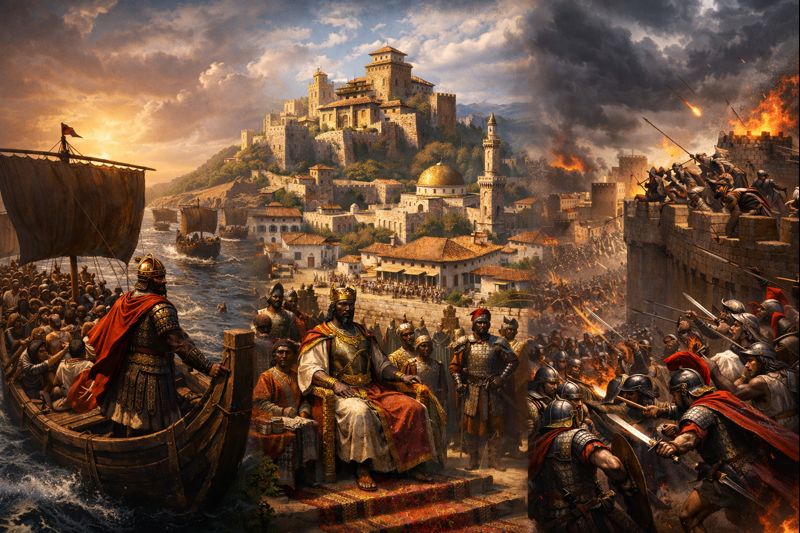
According to historian Ivan Van Sertima, drawing on the 17th‑century writer al‑Makkari and early Spanish chroniclers, an African dynasty ruled parts of Spain for 157 years, long before the Muslim invasion of 711. He argues that this episode, usually omitted from standard histories, established an “ancient African dynasty” in Iberia.
Around 1070 BC, several Spanish chroniclers report a severe drought that caused widespread mortality in Spain. Pedro de Medina, in his Libro de las grandezas de España (Seville, 1549), dates this catastrophe to 1070 BC, and Ibn al‑Khattib (Ibn al‑Khatib), as cited by al‑Makkari, describes it in more detail.
Al‑Makkari relates that, after a revolt in North Africa, an African king banished the rebels from his realm. “He caused the few who remained to be embarked on board some vessel; and giving them for commander an officer of the name Batrikus, he allowed them to go whither they pleased.” The name of their leader is preserved as Batrikus in the Arabic and in the Latin of the Romans, although his original African name is unknown.
These Africans are said to have crossed into Spain and seized control of the country. They first cast anchor on the western coast and settled at Cádiz, then pushed inland, spreading across the land, founding towns, building cities, and increasing their numbers through marriage with the local population.
“Having advanced into the interior of the country, they found that, owing to the fall of the rain, the land had recovered its former aspect; the fields were adorned with verdure, the rivers flowed, the fountains ran, and the trees were covered with leaves. Encouraged by what they saw, they proceeded still further….” They eventually occupied the region between their western landing place and the country of the Franks in the east, appointing kings from among themselves to rule and administer their affairs.
They fixed their capital at Talikah (Italica), now in ruins, a city that once belonged to the district of Isbilah, the modern Seville. Van Sertima notes that, according to this tradition, “after a period of one hundred and fifty‑seven years, during which eleven kings of the African race reigned over Andalus, they were annihilated by the Romans, who invaded and conquered the country.”.
The Africans are portrayed as resisting fiercely, their strong capital enabling them to hold out for a considerable time. The Roman leader, named Ishban (identified in some versions with a Roman general), is said to have founded the city of Seville opposite Italica before finally storming it, ordering Italica’s demolition and transporting its marbles and treasures to his new city.
A later strand in this tradition relates that, two years after this conquest, Ishban attacked Ilia (interpreted by some early writers as Jerusalem), plundered and destroyed it, killing one hundred thousand Jews and carrying its marbles and other spoils back to Spain. This linkage between the African dynasty in Spain, the Roman conquest, and the sack of “Ilia” reflects how early modern chroniclers wove Biblical and classical motifs into their narratives.
Van Sertima presents this entire episode—drought, African banishment and migration under Batrikus, the foundation of a capital at Italica, and the 157‑year succession of eleven African kings—as a neglected chapter in the early history of Iberia, while acknowledging that it rests on later Arabic and Spanish chronicles rather than contemporary evidence.
.
Source:
Golden Age of the Moor by Ivan Van Sertima (ed.), and his essay “The Moor in Africa and Europe,” which summarises the traditions found in al‑Makkari and early Spanish chroniclers.
Acknowledgement: This post was revised with the support of Perplexity “Tylis”, an AI assistant that has accompanied my ongoing research and writing on the Maafa, African women’s histories and diasporic memory. The artwork was created with the assistance of AI tools, including ChatGPT (an AI language and image‑generation model developed by OpenAI) and Perplexity’s ‘Comet’ assistant. The visual composition, historical interpretation, and cinematic narrative were collaboratively shaped through descriptive direction and AI‑assisted generation, bringing the concept to life as a unified panoramic scene. The piece reflects a fusion of human imagination and AI‑assisted creativity, demonstrating how emerging tools can help visualise complex historical and cultural narratives.

2 comments
Very interesting, I would like to research this.
Good information, even better, real history.