

“Afrikans are in bondage today because they approach spirituality through religion provided by foreign invaders and conquerors.” ~Haile Selassie I
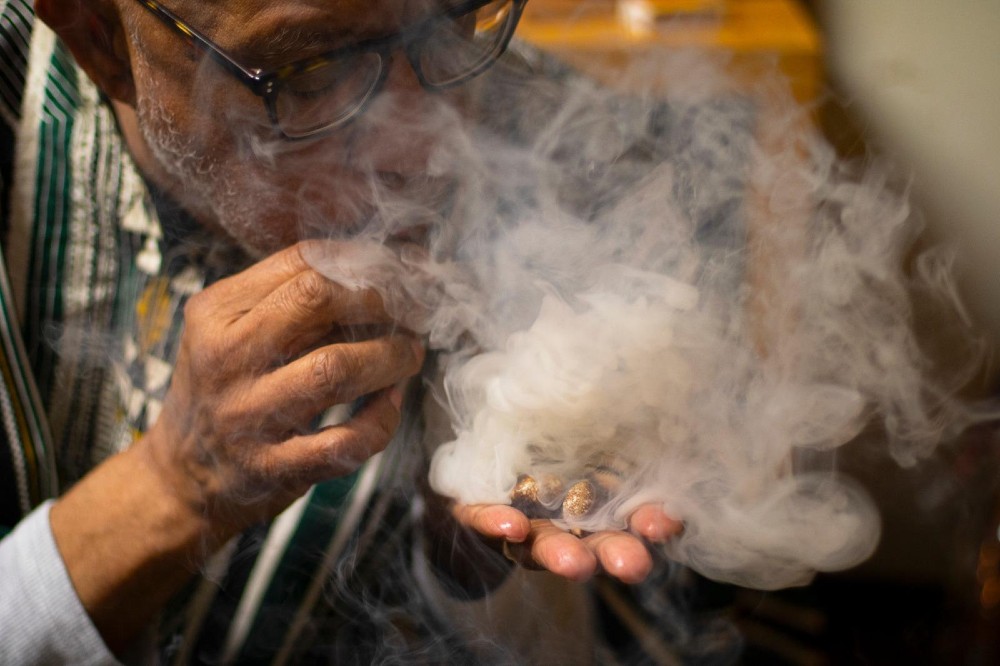
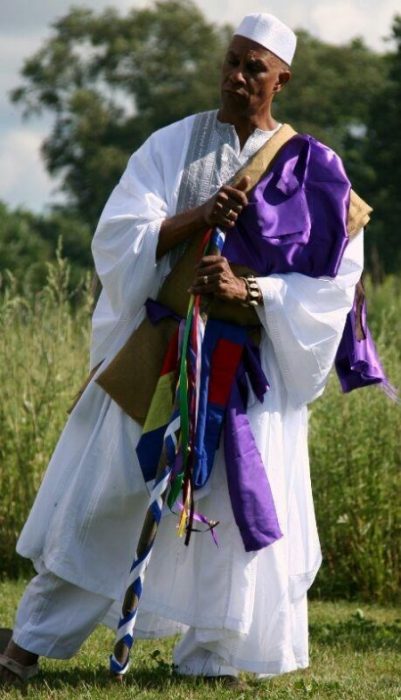
Elliot Rivera, known as the Urban Shaman, has over 40 years of experience working as a Palero and Santero, guiding others on their personal and spiritual path. The word Shaman means “the one who knows.” What the shaman knows is that there is an unseen world of ancestral spiritual forces that pervades us, and that these ancestors have a cosmic and moral responsibility to look after their descendants. The priests and priestesses of a people are gifts of spirit, born to guide us on our earthly journey, because of their connection to this unseen world. During the Maafa (Atlantic trafficking and captivity), the Yoruba people in Cuba (and also Brazil and Trinidad)held on to their spirituality by synchronising it with Catholicism. The Kongolese people also held on to their spirit pot. Rivera is a priest of both spiritual worlds: Lucumi/Santeria and Palo Mayombe. He is also a spiritualist, spiritual teacher, counselor and coach.
I first met Rivera around three years ago when I was called to the mat. I heard the laughter of the boy (Eleggua) in my dream (a sure sign you need to see a Santero/Santera), and so I went to see a Priestess for a Diloggun reading. The reading opened in Osogbo (the negative). I had issues with my ancestors. They desired a stronger connection with me and demanded that I attended Misas. However, the priestess also felt that I needed to see a much more skilled priest to understand the messages my ancestors wanted to give me. Rivera was “summoned” from the Netherlands to London. Before, our one-to-one meeting, I first attended a Misa he facilitated, which was quite frankly the most intense spiritual experience I have ever had. In our one-to-one reading (the priestess was also present), what he told me was simply astonishing. There was no way for him to have known the things he said. In an effort, it seems, for my ancestors to reveal to me that Rivera was in touch with them, they gave him a word that they knew was very, very significant to me. My two older sons also saw Rivera for a Diloggun reading. After sitting with Rivera, my sons walked out of their meeting with him as if they had gone through a rites of passage and were now, men. After connecting again with Rivera for a Diloggun reading, I asked him to honor me with an interview for Kentake Page.
My hope in interviewing Rivera was to offer insights into diasporic Afrikan spirituality and “guidance” for those who feel called to this path but lack a spiritual community to answer burning questions. A man of profound wisdom and unconditional love, I wanted Rivera to share his knowledge with those of us who are searching. For those of us who are thirsty and can only be quenched by the waters of the first people. There is no word in any Afrikan language for religion; only for the word, spirit. Hence, Rivera calls Lucumi/Santeria a tradition rather than a religion. What became clear from our interview is that the path to becoming a Priest/Shaman within Afrikan spiritual traditions is a challenging journey that requires full commitment. The cost is high, financially and emotionally, but also rewarding.
Elliott Rivera was born in New York City in May 1951 to Florence Peraza (mother) and Angel Rivera (father). Both his parents were from Puerto Rico. He told me he was meant to be born in Puerto Rico but was born premature (a month early), because, as he said, he had a mission to accomplish. He lived in Puerto Rico from the age of nine months to five years before his mother and grandmother returned to New York, after his parents separated. After returning to New York, Rivera began sleepwalking and having a recurring “dark” dream of walking around a catacomb alone. Within the catacomb were graves, and the corpses would speak with him. As a child, he lived with his maternal grandmother, Petra. A spiritualist herself, she became Rivera’s first teacher as he spoke to his grandmother about the dreams. Describing the people he saw in his dreams, Petra discovered that Rivera was dreaming of his ancestors from his mother’s side. At the age of 7 or 8 years, Petra took him to see a Santero in Spanish Harlem. The Santero told him that he was the “son of Shango.” Therefore, from an early age, Rivera was called to the unseen world of the ancestors.
As he grew older, Rivera began to see the “living” in his catacomb. These were people whom he knew would eventually die. For example, Rivera shared an experience of dreaming of the death of a close friend, whom he had seen in his catacomb dream. “I had a friend with whom we used to party together. I saw him in my dream. I waited a day before speaking to him about the dream. I meditated in front of my boveda to see if this dream about my friend dying was real. I spoke to him about the dream, telling him what I had seen and what could happen. I told him to be careful. He kind of laughed it off, but he was a little concerned. However, I felt that I had given him the message so he could take responsibility. A couple of weeks later, I got a call that he had been hit by a car and was killed.”
Rivera described the dreams as his initiation into understanding and communicating with the ancestors. He said, “As I got older, the dream would become longer, as the teaching was taking place in my sleep. My dreams would take me to Africa. I was transported across the great Kalunga to the roots of who I am. Sixty-five years later, I still receive the same dream from time to time. Each time it is more like a movie; the difference now is that I know when a family member dies before anyone else.”
Rivera also started reading the tarot, but after predicting the “danger” around a client’s nephew, which came to pass, he put away his tarot cards because he did not want to be “the bearer of bad news.” He did not read the tarot again until he was living in the Netherlands.
After leaving the Navy (he was drafted during the Vietnam war), Rivera started attending university, in the hope of becoming a sociologist. During a course in Puerto Rican sociology, he experienced a spirit possession. This led him to become initiated into Palo Mayombe and Lucumi/Santeria. Rivera is a Priest of Yemaya. He has been living in the Netherlands for over twenty years.
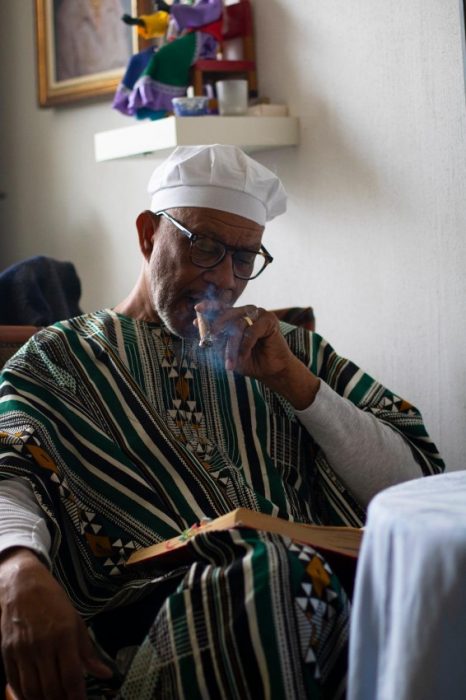
“Our ancestors are an ever widening circle of hope.”
What is Shamanism; particularly within the Yoruba tradition?
In the Yoruba tradition, the “shaman” is the people’s healer or, in some cases, a high priest. Most shamans in Afrikan spirituality work with the Egun (Ancestors). An ancestor simply means those who have gone before you, who are of your bloodline, because their DNA is your DNA. The Ancestors are the key to knowledge. There is a saying, “Egun lube Ocha,” meaning the ancestors carry you to the Orisha. Therefore, the Ancestors are always honoured first before any ceremony or ritual. If we forget the Egun, they will disrupt any ritual if we do not give them their just honour.
Why do you define yourself as an Urban Shaman?
I grew up with both my grandmothers in New York City. My maternal grandmother was a Spiritualist, while my paternal grandmother was a Palera. My maternal grandmother taught me about the light. I also learned by observing my paternal grandmother before she died at the age of 105 years old. After her death, she began teaching me through my dreams. From her, I learned the dark side of Shamanism. She is the reason I was open to becoming a Palero. Both my grandmothers guided me in learning about the importance of our ancestors, and the use of herbs for both spiritual healing and physical ailments.
Also, I have always worked in the urban environment, doing my spiritual work in the inner city. I was also initiated by the river in New York City. So, I felt the name was well suited for me.
What seminal experience brought on your commitment to become an urban shaman?
A little difficult to answer, as there were many.
However, I would say that my commitment began when I was a young man in university. I was taking a course in Puerto Rican sociology, and as the professor was talking about the indigenous people of Puerto Rico, I lapsed into a daydream and experienced a spirit possession at 11am! I spoke with the professor afterwards, and he said, “You should check with your ancestors.” However, by that time, my maternal grandmother was dead. But I was now in touch with my paternal grandmother, and I asked her about our history. I knew about my mother’s side of the family, but knew nothing about my father’s side. My paternal grandmother had very dark skin, but European facial features, hair that reached down to her hips, and deep, penetrating eyes. So, I asked her, and she gave me the information about the indigenous people of Puerto Rico, from which her grandmother came. My mother’s side is more of the Afrikan descent. However, on my father’s side, it is more of a Spanish descent mixed with indigenous peoples.
So, after the incident at the University, I decided to see someone. I started reading a book on the Santeria experience and visited a Santero for a reading. He told me that I had been on the path all my life. A year or so later, a friend of mine who was into Egyptology and Vodun, introduced me to his Godmother in Santeria. She became my first godmother, and I received my elekes and warriors (Eleggua, Ogun, Ochosi, and Osun) from her, and that is how I started this path. The warriors are the first Orishas many people encounter. I worked with her and studied with her for a while. However, I started getting dreams about her spiritual house and began to feel uncomfortable. I also began having my catacomb dreams again, and she advised me to see a Palero, she knew.
The Palero did a reading and told me a lot of things that no one would know, and said that I needed to be scratched. We made arrangements for me to be initiated into Palero. However, after being scratched, I started to feel unwell and was experiencing anxiety attacks. I called him up, and he told me not to worry as it was spirit settling. I believed it, but I still wasn’t feeling well. Long story short. Everything he had to do cost me a lot of money. It cost me about $1300 in those days. So, I got very angry and went to my godmother. I was also angry with her because she had introduced me to this man, and I felt she had not protected me. Other people in her house were also breaking away. I contacted one of my godsisters, and she introduced me to another Palero, because I could not function, even at work.
I went to see a spiritualist in the Bronx. We went into her reading room, and as soon as we sat down, she fell into a trance and started talking. I could see that she was angry with spirit. She came out of the trance, called her godfather, and told him to come over right away and bring his tools. He came and did a reading for me. He told me that I needed to be scratched. I told them both that I had been scratched. They asked me when and how you were scratched, and I had to describe the ritual. The Palero who scratched me the first time did not do it correctly. In Palo, everything is done at night. I was scratched at noon with a white chicken. I learned this was wrong because in Palo we use black or brown chicken. And when I told him how much I had paid, he almost had a heart attack. He told me that I had to do the ritual again and that it would cost me $421. He wanted me to do this in 21 days, but I could not afford it within that time. I told him that I needed more than 21 days. I saved the money and did the ritual. I was not the only one being scratched the second time. There were five of us. In New York and Cuba, they do that. Scratch as many people as they can at one ceremony. The ritual was on August 19th, starting at sundown and lasting until sunrise. It was heavy and strong. And this time, I felt it. The first time I did not feel it.
After that, the woman and the man who scratched me became my teachers. I learned more from the woman, as the man/Palero was not much of a teacher.
After being initiated as a Palero, I wanted to do Ocha (become a Santero). I went to watch the crowning of an initiate, and while at the ceremony, Shango came down yelling. It sounded like a battle cry. And he comes right in front of me, and “spoke” to me. “He” said that you are coming to my house. This is where I met my godfather. I went to see him a week later and he threw the Diloggun. The reading said, that I did not have to make Ocha, because I was a Spiritualist and Palero. However, I wanted to. He asked who gave me the Elekes. And he told me that my first godmother was not supposed to give me the elekes and warriors. She had been crowned Obatala, but in her crowning, she was told that she could not crown anyone.
When you are crowned you receive a reading call an ITA. It’s your spiritual life manual, but it goes over into everyday life. For myself, I cannot crown anyone with Shango. Remember, as a child, I was told that I was a child of Shango. But before you are initiated, you get a reading to see who your Orisha is. In my case, it became a cosmic battle between Shango and Yemaya for my head. Yemaya won. Again, before they took me to the river, another reading confirmed Yemaya. In my ITA, Shango said he does not want to share me. Yemaya and Shango are mother and son. She raised him. So whenever we do rituals for Shango, you have to feed Yemaya, and vice versa. So, in my case, my mother won. I have friends who are crowned Shango, and I do not get on with them. I can’t initiate a Shango person. Although I was told I was the “son of Shango” when I was younger, it was not an official reading. For an official reading to determine your Orisha, there are two ways to do so. You have to do a ritual with a minimum of three Babalowos or have an ITA before initiation.
I choose to be initiated. However, everything is confirmed through official reading. It is not simple to be initiated. 31 years ago, I paid $6500, and three months later, I paid another $1500. The initiation process is not just the day you are initiated; it lasts a whole year. Santeria is dubbed the religion of the poor, but only the rich can get into it, especially in the USA. All the male Orishas are expensive, to crown when you are being initiated. Yemaya is one of the least expensive to be crowned.
You are both a Palero and a Santero. What is the difference?
Yes, I am both. I was initiated into Palo 44 years ago this August 19th, 2020. Palo is known as “Las Regla de Congo” or the Rules of the Congo. Both Palo and Lucumi work with elements of nature. The difference between Palo and Lucumi/Santeria is that in Lucumi, we focus on the Orishas (deities). Palo revolves around the ancestors (not only our own) and the earthly/natural powers, in particular the power of the trees, branches, and vegetation.
Santeros does not have to be initiated into Palo; it is a calling. A Palero does not have to be initiated into Santeria. Many Santeros dislike Palo and fear it, which they pass on to their godchildren. Palo is used for certain types of healing, in particular, black magic. The Palero works with deep energies. We are working with the spirits of the dead. The word Palo means stick. Every tree in nature has a healing property. As a Palero, we work with those trees, with the plant, with the earth to create healing. In Lucumi, we are working with the elevated spirits, who were here when the earth was created, the Orishas. We also work with the plants. We work with Osain, who is the spirit of the plant. There’s a saying: there is no Santero without the plants and herbs.
LET ME BE CLEAR! PALO IS NOT THE DARKSIDE OF SANTERIA. They are two different spirit traditions. The only thing they have in common is that they both come from (different parts of) Afrika.
(The whole film is available on KweliTV)
What is the difference between Santeria, Candomble, Lucumi, and Ifa?
Santeria is the religion that developed through Christianity in Cuba. It was the only way the Yoruba people could continue to practice their tradition. They synchronise their deities with the saints of Catholicism. For example, Saint Barbara was imprisoned in a tower for refusing to marry. She wanted to dedicate her life to God; she probably wanted to be a nun. She was praying, and her tower was struck by lightning, and she was killed. In the Yoruba tradition, the spirit of thunder and lightning is Shango. So, when our ancestors learned of the story of Saint Barbara, they realized they could honor Shango by honoring Saint Barbara, and then this way they would not suffer any repercussions from the church.
However, in Brazil, Santeria is known as Candomble. The spellings and pronunciations of the names differ. In Brazil, Saint Barbara is not Shango; she is Oya. Again, what did Oya do? She gave Shango the gift of fire. So it makes sense that in Brazil, she is Oya. I was confused for the longest time myself, between the differences between Candomble and Lucumi/Santeria. However, the rituals are basically the same, with slight variations.
Lucumi is the name of the pure Afro-Cuban spirituality before our ancestors synchronised it with Catholicism. What has been going on over the last 40 years, especially in the USA and Cuba, is that they are going back to this tradition, and clearing out the Christian saints and focusing only on the Afrikan deities (Orishas). So, Lucumi is the correct name of the tradition. There is a strong argument in Cuba that only there is the pure Lucumi.
Ifa is the base of the Yoruba tradition. It is also the base of other spirit traditions of West Africa. You can safely say that Ifa is the birth of West African Religions. It is the overall spiritual tradition. It’s the home of the Yoruba. There are other Afrika traditions that come from Yoruba. Palo does not.
Are there any memorable/profound experiences you’ve had while being a Shaman?
Yes, I have had many. The very first profound experience was before I even knew anything about the spirit world or Shamanism. I didn’t even know the word at the time. I was in school (Catholic school). I had gotten into a scuffle with a boy at school and pushed him into an old-fashioned phone booth, and his head hit a corner of the booth, cutting his upper earlobe. There was blood all over the place, which frightened me. I can’t say for sure what happened to me, but it was as if I went into a trance. I fell on my knees and placed my hand over his bleeding ear, and almost immediately the ear stopped bleeding. I think I was praying; not sure. I opened my eyes, and there was a crowd of fellow students, quiet and in shock. I guess they had seen what happened. Of course, I got into big trouble: a) for fighting and b) doing the devil’s work. LOL. When my grandmother heard of this, you guessed it, she took me once again to a Santero.
Later in the late 1980s, I began receiving visitors in my sleep from friends that were in the hospital and were dying. They would come just at the hour of their passing. There was always a message from them. When I would call the hospital in the morning, they would inform me that the person died at the same time of their visitation. This happened many times before I went to my teacher to investigate why this was happening. After this, I had a calling to help people make the journey home. The hospital would call me when they had a patent struggling with letting go. I was entrusted by the spirit and the person’s ancestor or spirit guide to show them the way. I did this for almost ten years. After that, I stopped because of the emotional toll it took on me.
Santeria/Lucumi is seen as a communal practice. Where is your spiritual home/community?
I now have two spiritual homes: one in the Netherlands and the other in Havana, Cuba. My first spiritual home was New York.
Do you use Palo Mayombe in your work or mainly Lucumi?
I use both, depending on what spirit says. There are times when I am working more as a Palero. Then there are times that I work more with Orisha. It all depends on the energy of what is happening to a client or godchild.
What is the divination system you use?
When I was initiated into Palo, I was taught the art of the Chamalongos.
I started using the Tarot cards at an early age, taught to me by my grandmother. I still have the cards she taught me with. They are at least 70 years old. I read the Tarot well into my 20s.
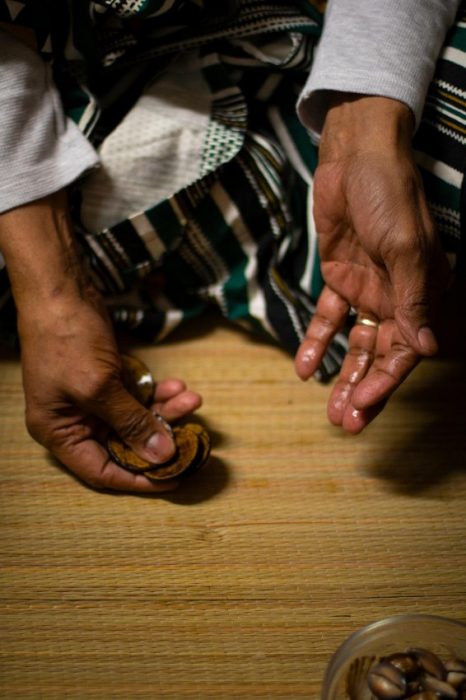
Later I learned the OBI and the Diloggun or Cowrie Shells. The Diloggun is the mouthpiece of the Orisha. It comes from Ifa. When our ancestors were brought across the Atlantic, all they could bring with them was what was in their memory, in their minds, in their hearts. I have heard stories that when some people were captured, they swallowed certain mysteries so they could create the fundamental essence of the Orishas. Ifa priests were also brought over enslaved, as well.
Who are the major Orishas?
The major Orishas are Eleggua, Ogun, Ochosi, Obatala, Yemaya, Shango, Oshun and Oya. These are the 8 principal crowned Orishas. Obatala was one of the first Orishas. Shango of all the Orishas was the only one that was a King. There are many deities, who can come up in a reading, but they are not crownable. For example, Olokun. In Afrika, they crown Olokun direct. But in Cuba/New York, they crown Olokun through Yemaya, because there is a saying that no one can hold all that water in their head. Yemaya is the owner of the full moon. She is the daughter of Olokun. She is the owner of the mysteries. Yemaya is your mother and Olokun is your father. So we crown Olokun through her. We also have a ninth Orisha. Some spiritual houses in Cuba deal with Babaluaiye.
What is the Ori? How can someone learn which Orisha is born with their Ori?
In today’s vernacular, your Ori is your crown chakra. The Ori refers to our spiritual consciousness that stays in the House of Ololudumare. It is where your life begins. When you break through the placenta of your mother, providing you are coming head first, your Ori is blessed, and you have Orisha. We believed that if you are born feet first, then there will be a health problem or disability. If you are born feet first or by caesarian section, you are automatically a child of Obatala. It is said that there is no life without your Ori. Knowledge is your Ori. Your head is where your spirit connects with you. When you are initiated, the initiation is done on your Ori. It is the Ori that is being crowned. To discover who your crown Orisha is, you must visit a Babalawo. He is a priest of Ifa. A ceremony with other Ifa priests will determine your Orisha.
Who is more important? The Ancestors or the Orisha?
They are equally important. However, it is the Egun/Ancestors who carry you to the Orisha. This is why it is important, in all Afrikan traditions, for you to honour your ancestors first and foremost.
How do you connect to your ancestors?
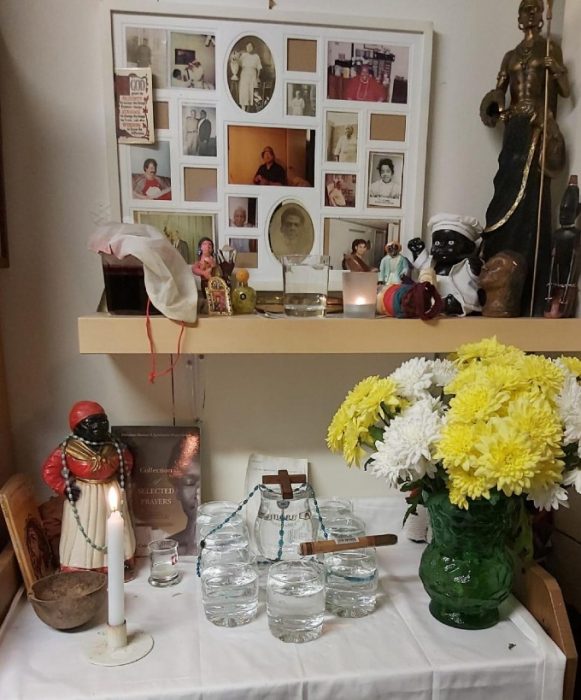
The best way to connect with the ancestors is to create an ancestral altar or a BOVEDA. It’s not difficult at all. You can ask a Santero, Spiritualist, or Palero to guide you in the setup. I teach a workshop on setting up your altar and empowering it, and I give you a guided meditation to help you start the connection. It is where you sit and meditate and communicate with my ancestor.
If you are following the path of Lucumi/Santeria, there is no temple. Your home becomes temple.
The boveda comes out of the enslavement of Afrikan people. The boveda originated in the late 1800s, when priests and priestesses in Cuba created it as a way to connect with ancestors. It’s a spiritual altar with about seven glasses filled with water. Water is very important. It’s the fluidity. People who are seers can use their boveda to see (fortune-telling). The water is about seeing the fluidity of the energy of life. If there are many bubbles in the glasses, it may indicate something is wrong. If it is normal bubbles, the spirits are happy. The water represents the ocean, and it is a way for our ancestors to communicate with us.
What is the difference between spirit guides and ancestors?
I love this question. It is the most asked question in my workshops. The word ancestor means those who have gone before us. Ancestors are mostly but not exclusively related to your bloodline. Spirit guides are those who have also passed on and who choose to guide you. Spirit guides choose you. You do not choose them. They connect with us through a particular situation in our lives, especially when choosing a spiritual path. Even if you are not following a spiritual path, they will still come to guide you.
The spirits that work with me (they chose me, I did not choose them), were enslaved. I even have a spirit guide that comes from Barbados. They will speak with you in your dreams until you learn how to channel them.
If you are of Afrikan descent, it is important to know where you are from. We have many brothers and sisters who do not know anything about their ancestry, but they need to connect with the spirit of their ancestors. I personally ask brothers and sisters to connect with their ancestors, even if it means doing a DNA test. Your ancestors have answers to all the questions you may ask. You have to connect and open yourself up to an energy that is greater than who you are.
Other questions I am often asked are, How do we know this is real? How do you know that this is not something that is a figment of our imagination? These are usually the questions I get asked over and over again. I explain that you have to feel it. One of the best indicators to know if this is real, is, “Do you get goosebumps?” Also, a person needs to have faith. Not faith in a religious sense but rather faith in who I am? When you are doing mediation and you are hearing voices or having a vision, you then ask yourself, “Does this apply to me? And, how does this apply to me?”
I remember the first time I channel as an adult. My godmother invited me to a Misa. It was one of my first Misas on my path. I was not initiated or anything yet. When you do a Misa, you are dressed in white, because that is what our ancestors did. I started breathing heavily and having hot and cold flashes, and that is all I remembered. I must have passed out, and when I got up, I was black. My clothes were black with dirt and dust. I asked what happened. My godmother told me a spirit guide came in. If you have a calling, you experience changing into a snake. And what does a snake do? It sheds its skin. I was crawling around in the apartment. I was shedding my skin to bring forth this gift deep inside me. This is when I started being a physical channel.
There are many gifted people within the community? Can anyone become a Santero or Palero just by thinking they could be one, or do they have to be called to the tradition?
A loaded question for sure. There are a few schools of thought on this question. Being gifted does not necessarily mean you can become a priest or Palero. You can have a strong desire to join, but first, the Orisha is consulted in reading by a qualified Santero/Santera or Palero/Palera. Since we don’t know who your Orisha is, we use the Diloggun of Ellegua, the Orisha of the Cross Roads. During the consultation, if it is determined that you have a path in Orisha, the Santero/Santera will offer the first phase of initiation. Everyone is considered a child of Obatala, for he is the father of all heads on earth, until the ceremony is conducted to determine which Orisha is connected to you. You have to be willing to follow this path. Willing to explore who your ancestors are, and everything else will fall into place.
You are also a teacher of channelling and meditation? What is channelling?
Channelling is the way of connecting with your spirit guide. It is the ability to connect with the spirit in general and listen to the messages. Everyone can channel if you put your mind to it. When I teach channelling, I tell my students that I will curse a lot. My biggest curse word is Patience. People are so impatient and want everything yesterday. I am a physical channel. Not everyone will be. Although physical channelling is sometimes called spirit possession, I don’t use that term because it can freak people out. When you are possessed, you don’t know what is possessing you. But what you are channelling makes you feel more in control. The technical meaning of channelling is a means of communicating with any consciousness that is not in human form by allowing that consciousness to express itself through the channel.
My students or clients are always telling me: I can’t channel or I am afraid or I can’t channel like you do. We are all Channels in one form or another. So why not open yourself to the channel you were meant be? Also, I have also been channeling for almost 50 years.
How can one begin their spiritual/healing journey?
We first need to make the distinction between healing and journey. Before we begin the journey, we must first heal ourselves. Think of it as taking a long holiday. Before you do so, you get a good health check, take care of any minor health issues, make arrangements with your friend/family to take care of your house and pets if you have any, and arrange with your bank to pay your bills while you’re away. This is the healing that will prepare you for the journey ahead.
What I help people to do is to clear the baggage, in this case, to clear up your past. Our spiritual path will take many turns, and your history can be one of those turns. We are creatures of the past, and our past has a cunning way of creeping up on us. If you do not work on that before your journey, it can stop you. We have one of two choices 1) the past bites you and you recognize it (you have already cleared it up), and you have the power to greet the issue and put it in its place and move on. 2) Your past creeps up, and bites you, and you fall and breakdown because you don’t have the tools to put it in its place.
What does Lucumi say about suffering?
“Those who attain blessings are those who live by their wisdom; only [the unwise] know not how to direct their lives. If we do not bare suffering that will fill a basket, we will not receive blessings that will fill a cup. Act not in the heat nor in haste for you may miss the good things in the evening of life.”
In general, we suffer for so many different reasons, and this has nothing to do with karma. We do suffer from karma, and that is our own fault. We do things we should not do, and then we suffer the consequences, but karma does not explain everything. We suffer every day. What is happening now in the USA and the world, with the brutal killings of Black men, was because our ancestors were dragged from Afrika and brought to the Americas, and the generations after them, their children, grandchildren, great-grandchildren grew up in this dynamic of believing that they are Americans or Europeans. They are brainwashed. You are doing homework to learn about your ancestry and where you are from. A lot of people don’t do that. Many of us live in ignorance. When we are ignorant of our ancestry, that is suffering itself. For us, a lot of our suffering is in our blood because we were taken away from where we were supposed to be. However, when we suffer, Orisha and our ancestors are there to support us in the suffering and help heal the wounds of suffering. Hence, it is good to know your ancestry because you can ask your ancestors for support to help you cope or to understand the right way to deal with a situation.
Can a reading reveal one’s life purpose?
Yes and No, let me explain. A reading can help you with your life purpose. It can explain some of the problems you have encountered in life, show you where you are now and where you might be able to go.
Once you’re crowned with your Orisha, you have what is called an ITA. I like to call it the guide book for the rest of your life. Sometimes you can figure out what your purpose can be. You will have the guide book told by the Orishas you are born with (born here means initiation).
Is there a simple spiritual bath or offering one could do to begin to clear their halo and start on their spiritual journey?
I always recommend a white flower bath; it is the simplest thing one can do. I like to call it a spiritual valium. The white flower bath can help you to relax and focus. Connecting to the ancestors after a spiritual bath can offer you a more reliable connection.
What is the best book to read on Santeria/Lucumi?
The best is difficult for me to say. There are so many books out there, and the internet is bursting with articles on Santeria. When I get someone serious about learning and understanding, the first book I recommend is “Altar of my Soul” by Marta Moreno Vega. She offers an excellent account and insight into Santeria. I also recommend “Santeria from Africa to the New World” by George Brandon.
If they are a godchild of mine and they have a calling for Palo, unfortunately, most useful books are in Spanish. However, there is one excellent book in English if you can find a copy, “PALO MAYOMBE: The Garden of Blood and Bones” by Nicholaj de Mattos Frisvold. It is not always easy reading, but it is still one of the best out there.
African spiritual traditions are seen as negative/primitive in comparison to other spiritual systems, especially Christianity. What would you say in response to this? Have you faced any personal struggles with regards to this?
Perhaps I have been lucky in this respect. I have always surrounded myself with people that have great respect and understanding of other people and their traditions.
That said, there have been times that I have had to explain myself and my belief. All we can do is embrace our traditions, wear them with pride, and teach by example. You can talk until you are blue in the face if the person is stuck in what they believe. Don’t get angry or upset. Leave them to their ignorance.
What advice do you have for aspiring shamans?
Be true to the path you wish to follow. Be true to the tradition you are learning. A shaman lives in a community. You don’t have to live in a village. But create a community. And be true to your community, whatever community that may be.
Learn and listen from your elders. The greatest gift we have is our grandparents, and if you are lucky enough to have them, ask them questions. They may not know everything, but they will find a way to answer your questions. Learn from your grandparents. Keep your mouth shut and listen before you speak. Always stay true to who you are and what you want to offer. Ego has NO PLACE in our tradition. Unfortunately, there is way too much of that around.
Know that your ancestors will be your teachers. Anyone who put their heart and soul in learning has a line to follow. Follow your bloodline. I have been fortunate to meet some great Shamans from around the world and the one thing we hold in common is the Ancestors. I always tell an aspiring person that they must know their ancestors even if they have to do a DNA test.
Also, some of us are Shamans and some of us work in a shamanic way. There is a difference. When you are a Shaman you have to respect all traditions.
What is your favorite proverb? What inspirational proverb(s) gets you through the challenges you have faced?
“There is no day so distant nor so far that it never comes.”
“Nobody knows what lies on the bottom of the sea. Only Olorun and Olokun – they are the ones who know.”
“All healing is essentially the release of fear.”
What kind of legacy do you want to leave? How do you want to be remembered?
I would like to be remembered for is that I had a kind heart, and I would always work with love in my heart. I think that would be my legacy. KINDNESS WILL SAVE ALL OF US.
Yes, Rivera conducts reading online, usually via Zoom. If you would like to contact Elliott Rivera, please visit his website. You can also email him at: elliottriveraathotmaildotcom
GLOSSARY
Aleyo: One who follows Lucumi/santeria but is not initiated as a priest or priestess; a noninitiate or an outsider.
Boveda: An altar set up to honour and propitiate Egun.
Diloggun: The system of cowrie divination by which a priest or priestess of Lucumi/Santeria learns the will of the Orishas.
Egun: The many ancestral spirits related to one through one’s blood relatives or one’s spiritual relatives.
Eleke/elekes: The beaded necklaces given to both aleyos and santeros.
Godmother/Godfather: In Lucumi, a godparent is one’s sponsor in the tradition. The priest or priestess who will give the initiations of the elekes, warriors and ocha.
Ire: Any type of blessing or good fortune that can befall one who sits for a session with the diloggun.
Misa: A spiritual gathering, sometimes called a seance, performed to honour the dead/ancestors. It involves prayers, offerings, and possession of mediums by spirits.
Ocha: A major initiation ceremony of Lucumi/Santeria. To make ocha means to engage in the ocha ceremony to become a priest or priestess.
Olodumare: A Yoruba word that translates to “owner of the womb.” Olodumare is the supreme deity of the Yoruba and Lucumi.
Osogbo: Negative influence; any evil that may be predicted for a client through the oracles of the diloggun.

1 comment
This is so beautiful. I loved the history and I really loved it all… Thank You.