


“It is up to the living to keep in touch with the dead. Man’s power don’t end with death. We just move on to another place. A place where we go and watch over our living family. Respect your elders. Respect your family. Respect your ancestors… Call on your Ancestors… Let them guide you…” ~Daughters of the Dust
I have come to appreciate that African wisdom recognises unseen forces in the universe beyond the Creator. The Egun—Ancestors—are redemptive forces who can guide us through life. Honouring the Ancestors begins with our own bloodline, then extends to those who have positively influenced us, and finally to role models we aspire to emulate. Connecting with the Ancestors is a way of being. For me, maintaining an altar creates a field of honor and remembrance. It prompts me to reflect on how I treat others, especially those I love and care for. I cannot honour the departed while neglecting those around me. This does not mean I must accept the presence of those who are harmful to my spirit, nor that I am immune to mistakes. Rather, the Ancestors call me to reflect, to make amends when needed, and to strive for greater integrity.
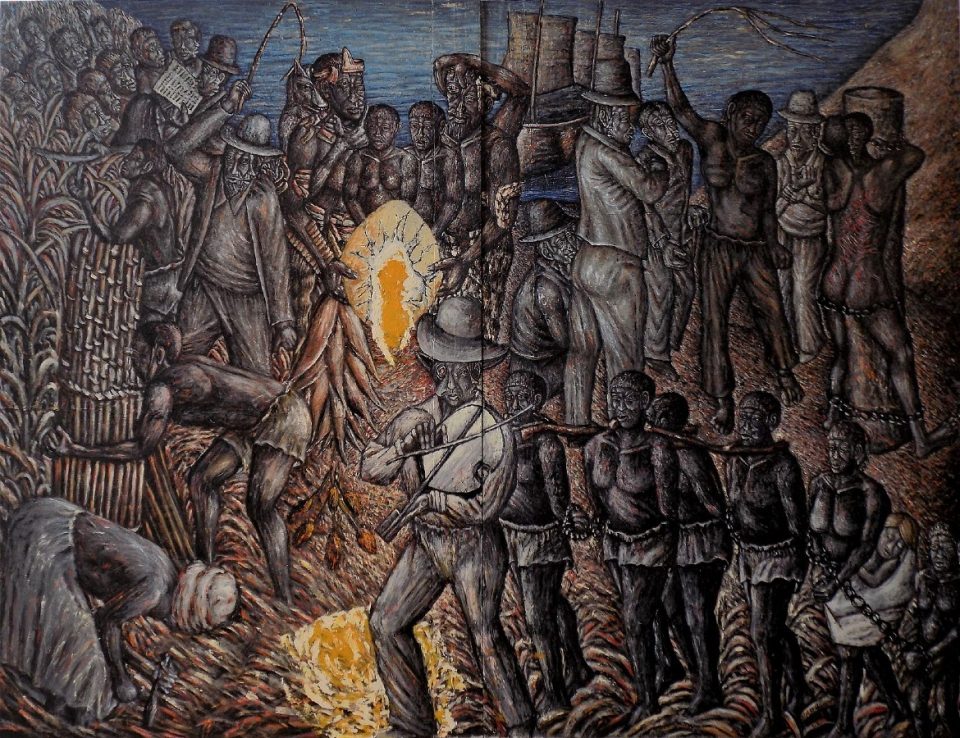
Maizisi Kunene’s poem, “In Praise of the Ancestors,” beautifully reminds us that the Eguns are not gone—they simply exist in a different form. Their voices echo as memories within us, inspiring insights that seem to come from “nowhere.” What song are you singing for your Ancestors? Tears of Africa” by Mmakgabo Helen Sebidi—the featured image for this post—is Sebidi’s song to the Ancestors. Created in a heavily politicised South Africa and later revisited in Brazil, the painting’s crowded, manacled bodies, broken family forms, and small glowing egg of new life evoke the suffering, endurance, and fragile rebirth woven through Afrikan and diasporic histories. Sebidi has said that her creativity is “controlled by a spirit,” so that when the picture is finished, “it will speak… come alive.” I experience this work in just that way: as a visual praise-song in which the Ancestors are not only remembered, but are actively watching us, listening to our songs, and urging us to keep the flame alive.
Kunene’s poem, the wisdom woven into the Daughters of the Dust quote, and Sebidi’s “Tears of Africa” remind me that the Eguns are not dead—just not living as we are—and that every genuine act of witnessing becomes another verse in our ongoing song to them.
I retrieved the poem and its analysis from The Poetics of Modern African Poetry.
In Praise of the Ancestors
Even now the forefathers still live
They are not overcome by the power of the whirlwind.
The day that sealed their eyes that did not conquer them.
Even the tall boulder that stands over them
Casts only a humble shadow over their resting place
They are the great voice that carries the epics
The Ancestors have come to listen to our songs,
Overjoyed they shake their hands in ecstasy.
With us they celebrate their eternal life.
They climb the mountain with their children
To put the symbol of the ancient stone on its forehead.
We honour those who gave birth to us
With them we watch the spectacle of the moving mists.
They have opened their sacred book to sing with us
They are the mystery that envelopes our dream.
They are the power that shall unite us.
They are the strange truth of the earth.
They came from the womb of the universe
Restless they are, like a path of dreams,
Like a forest sheltering the neighbouring race of animals.
Yes, the deep eye of the universe is in our chest
With it we stare at the centres of the sky.
We sing the anthems that celebrate their great eras.
For indeed life does not begin with us.
In Praise of the Ancestors is structurally organized in four parts. The first part, lines 1-6, celebrates the immortality of the Ancestors; the second part, lines 7-11, explains how the Ancestors interact and intermingle with the living on a continuous basis; part three, lines 12-20, explains the eternal duty of the living towards the Ancestors; while the concluding part, lines 21-24, re-iterates the greatness of the Ancestors in the affairs of the living.
Kunene employs positive imagery to characterize the African cultural heritage, especially as viewed from the point of view of the Ancestors (e.g., “The great voice that carries the epics,” line 6, and the “mystery that envelopes our dream,” line 15). However, he uses negative imagery to describe the European colonizers (e.g., the “power of the whirlwind,” line 2, and the “spectacle of the moving mists,” line 13).
The poem’s title, In Praise of the Ancestors, is instructive and illuminating: it highlights the protagonist’s bold proclamation, that is, to openly declare his affectionate feelings for the non-living souls. Other imagery of the poem which underscores this profusion of love includes: “The Forefathers still live,” line 1; “The Ancestors have come to listen to our songs,” line 7; “We honour those who gave birth to us,” line 12; and “They are the power that shall unite us,” line 16.
The point must also be made that in the African cultural mythos, the celebration of parents or the dead ancestors, is generally regarded as a cardinal virtue that must be encouraged or cultivated. Consequently, the indigenous African peoples not only celebrate the dead ancestors, but they also pay homage or offer sacrifices to them in order to receive their blessings both at home and in the workplace. Kunene’s capitalization of the word, “forefathers”, underscores his respect for the dead ancestors.
Acknowledgement note: This post was revised (Fen=b 2026) with the support of Perplexity “Tylis”, an AI assistant that has accompanied my ongoing research and writing on the Maafa.
